
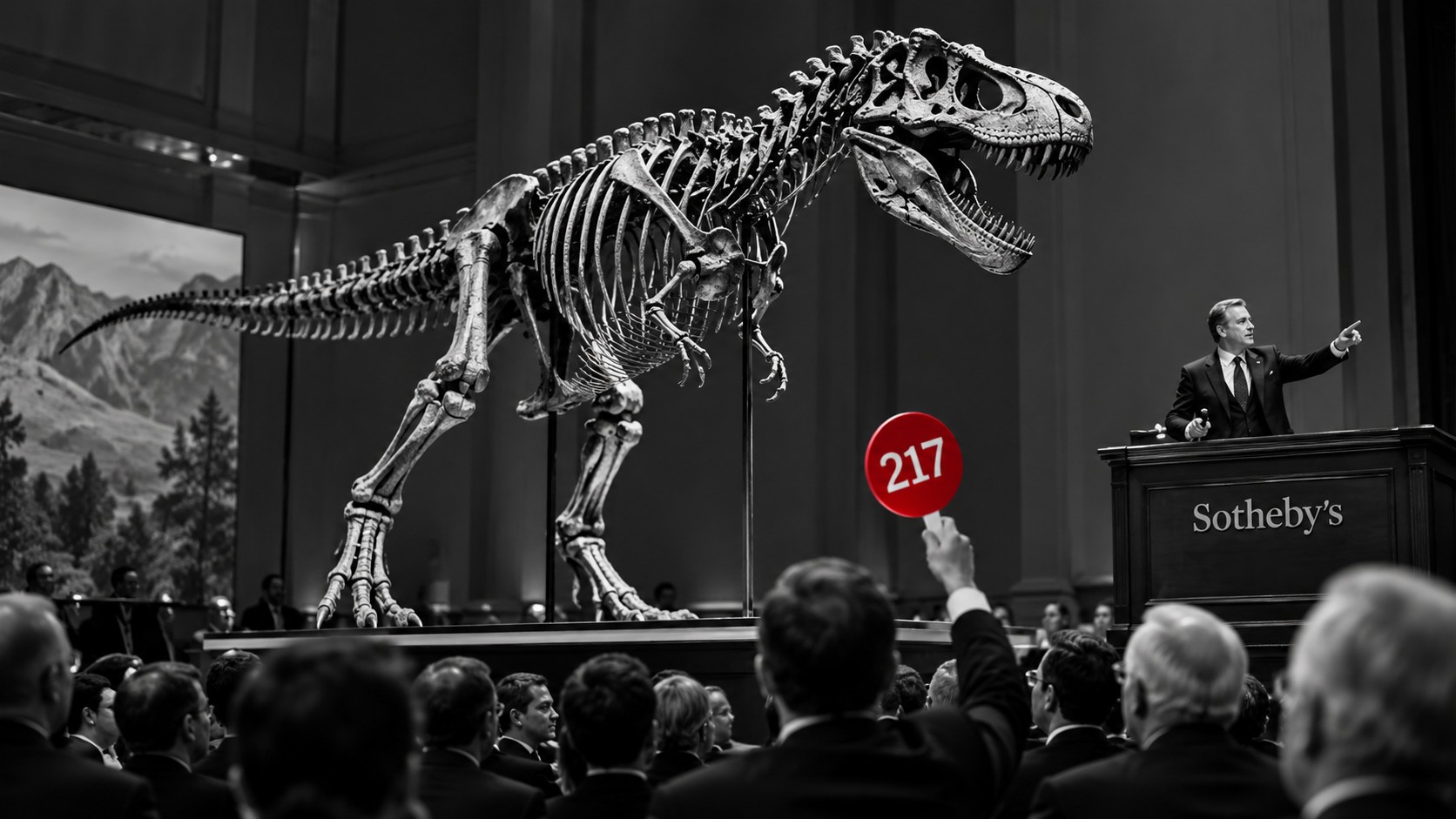
A remarkably preserved dinosaur skeleton known as “Jodi” has sold for $47.3 million at Sotheby’s in New York, becoming the second most expensive dinosaur fossil ever sold at auction. The extraordinary price, achieved after an intense bidding contest, highlights the growing international market for prehistoric specimens while reigniting concerns about the private ownership of scientifically important fossils.
A spectacular auction result
The 67-million-year-old Nanotyrannus skeleton attracted six competing bidders during a 12-minute auction on Tuesday, 27 October.


Originally estimated to sell for between $6 million and $9 million, the fossil dramatically exceeded expectations before being purchased by an anonymous bidder.
Only one dinosaur has achieved a higher auction price. Earlier this year, a Tyrannosaurus rex skeleton nicknamed “Gus” sold for $50.1 million, establishing the current world record.
The sale also surpassed the $44.6 million paid for the Stegosaurus skeleton “Apex” in 2024.
A smaller cousin of Tyrannosaurus rex
Measuring approximately six metres in length and standing nearly three metres tall on its display mount, Jodi represents one of only three substantial Nanotyrannus skeletons known to science.
The fossil contains approximately 191 preserved bone elements, including an exceptionally complete skull.
Discovered in Montana’s Hell Creek Formation in 2019, the specimen was named after landowner Jodi Pierson.
For decades, palaeontologists debated whether Nanotyrannus represented a separate dinosaur or merely a juvenile Tyrannosaurus rex.
Research published in 2025 provided compelling evidence supporting its classification as a distinct genus.
Unlike its enormous relative, Nanotyrannus possessed a more slender body, comparatively longer arms and distinctive teeth.
Scientists question private fossil ownership
The record-breaking transaction has prompted renewed debate within the scientific community.
Researchers warn that selling significant fossils to private collectors can restrict access to specimens essential for understanding prehistoric life.
Museums and universities rarely possess the financial resources necessary to compete with wealthy private buyers.
Scientists therefore hope that Jodi’s new owner will eventually make the skeleton available for public exhibition and scientific study.
A booming market for prehistoric treasures
Dinosaur fossils have increasingly become prestigious alternative collectibles, attracting wealthy investors alongside traditional buyers of fine art and rare antiquities.
Their extreme scarcity, historical importance and spectacular appearance have contributed to rapidly increasing auction valuations.
However, the commercialisation of prehistoric remains raises an important question about whether irreplaceable scientific discoveries should be treated primarily as privately owned luxury assets.
For now, Jodi’s extraordinary sale illustrates both the fascination dinosaurs continue to inspire and the considerable financial value attached to discovering Earth’s distant past.
NewsHub Finance | Science & Auctions | 28 October 2026
A remarkably preserved dinosaur skeleton known as “Jodi” has sold for $47.3 million at Sotheby’s in New York, becoming the second most expensive dinosaur fossil ever sold at auction. The extraordinary price, achieved after an intense bidding contest, highlights the growing international market for prehistoric specimens while reigniting concerns about the private ownership of scientifically important fossils.
Recent Comments