
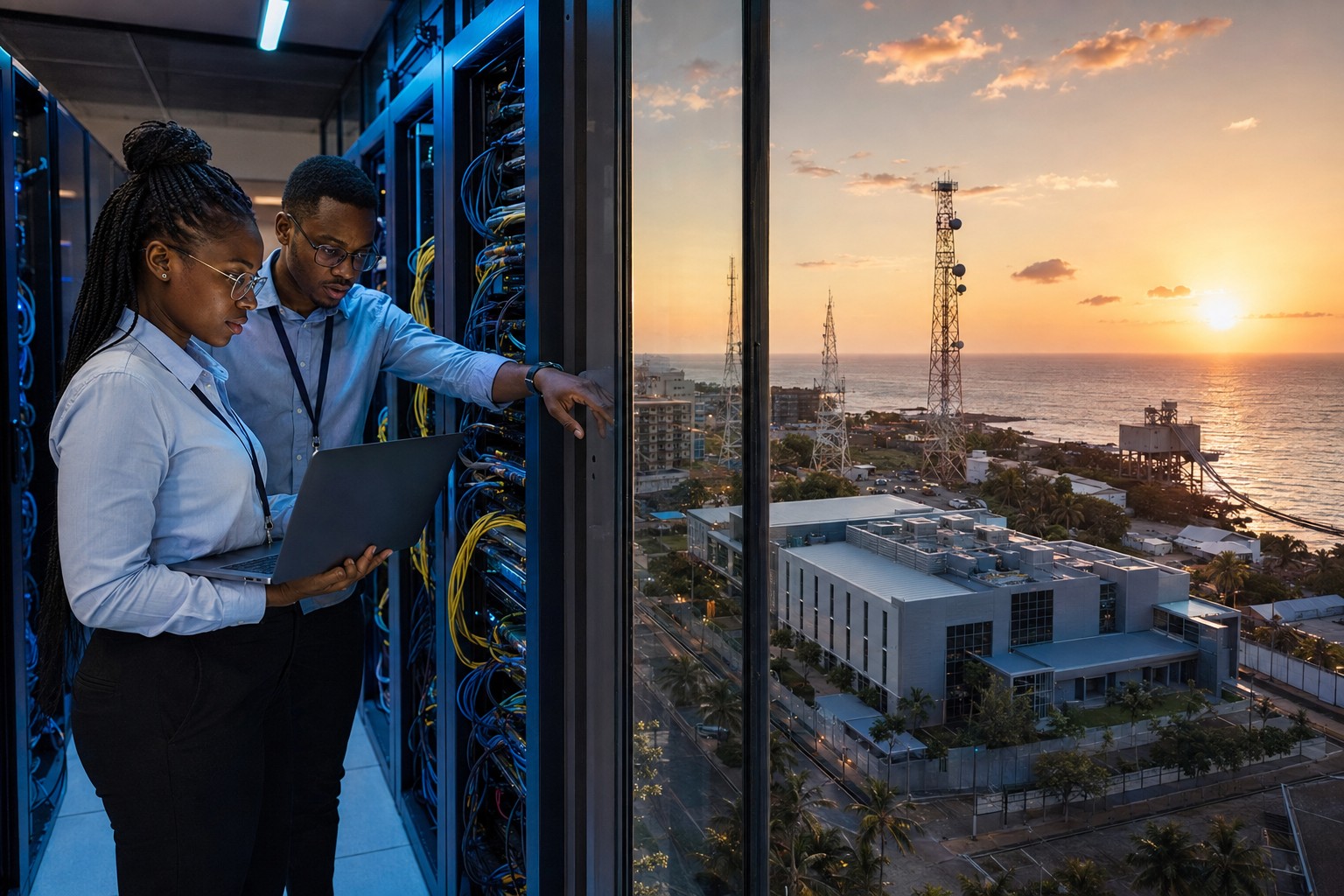
A new contest for Africa is under way, but this time the strategic assets are not gold, diamonds or oil. They are undersea cables, data centres, satellite networks, cloud platforms and the enormous volumes of information generated by a young and rapidly digitising population. The investment could transform African economies, but it is also raising a fundamental question: who will own the continent’s digital future?
The infrastructure hidden beneath the sea
Most internet users rarely consider the physical machinery behind the digital economy. Messages, financial transactions, videos and artificial intelligence queries appear to move instantly and invisibly. In reality, almost all international data travels through fibre-optic cables laid across the ocean floor.
Africa has traditionally depended on a relatively limited number of connections to Europe, Asia and the Americas. This has made internet access more expensive, less reliable and vulnerable to disruption. When several cables serving West and Central Africa were damaged in 2024, banks, mobile operators, businesses and government agencies experienced serious interruptions.


That vulnerability is now attracting some of the world’s largest technology companies.
Google, Meta, Microsoft and Amazon are investing billions of dollars in the cables, cloud regions, satellites and data centres that will form the foundation of Africa’s next economic era. Their involvement is improving connectivity and creating capacity that many governments could not finance independently. It is also placing a growing share of the continent’s essential infrastructure in the hands of foreign corporations.
The result is a modern scramble for Africa, conducted not through territorial occupation but through ownership of the systems on which future commerce, communication and government will depend.
Google’s billion-dollar commitment
Google announced in 2021 that it would invest $1 billion in Africa’s digital transformation. The company says its investments have already helped 100 million Africans gain access to the internet for the first time.
The Equiano cable, running along Africa’s Atlantic coast, links Europe with South Africa and has landing points in countries including Portugal, Togo, Nigeria and Namibia. Google has estimated that the additional connectivity could increase real economic output by billions of dollars in Nigeria and South Africa.
Its next major system, Umoja, creates a new terrestrial and undersea route from Kenya through several African countries before crossing the Indian Ocean to Australia. The project is designed to give African internet traffic an alternative path that does not depend entirely on routes through Europe.
This redundancy matters. A country with only one or two significant international connections can suffer widespread disruption when a cable is damaged. Multiple routes make networks more resilient and give telecom operators greater bargaining power when purchasing capacity.
For Google, however, the cables also serve a commercial purpose. Faster and cheaper internet access means more users of search, YouTube, advertising, cloud computing and artificial intelligence services. Infrastructure investment expands the market for the company’s products while strengthening its position within the digital supply chain.
Meta completes a cable around the continent
Meta and its telecommunications partners have completed the core of the 2Africa system, one of the largest undersea cable projects ever constructed.
The network stretches more than 45,000 kilometres and reaches three continents. Its landing points extend across Africa, the Middle East, Europe and Asia. Meta says the completed system reaches 33 countries and could support connectivity for more than three billion people across the wider regions it serves.
The scale is extraordinary. The system was designed to provide almost three times the combined capacity of all the undersea cables serving Africa when the project was originally announced.
For African consumers, additional capacity can mean faster connections and lower wholesale prices. For local companies, it can improve access to international customers, cloud services and payment infrastructure. For governments, it can make digital public services more reliable.
Yet Meta’s interest is also strategic. The company’s advertising business becomes more valuable as more people communicate, shop and consume entertainment through its platforms. Building the infrastructure gives Meta greater influence over the environment in which Facebook, Instagram, WhatsApp and future AI products operate.
The cable may be open to telecommunications companies on commercial terms, but the broader system still demonstrates how closely Africa’s public connectivity goals have become aligned with the expansion strategies of global technology companies.
The cloud moves closer to African customers
Undersea cables bring data to the continent. Data centres determine where that information is stored, processed and converted into economic value.
Historically, a considerable share of African data has been processed in Europe, North America or Asia. This creates delays, increases costs and makes local organisations dependent on foreign infrastructure and foreign legal jurisdictions.
The situation is beginning to change. Amazon Web Services, Microsoft Azure, Google Cloud, Huawei, Oracle, Equinix, Digital Realty and several African operators are building or expanding data-centre capacity.
South Africa is the clear leader, hosting an estimated 70 per cent of the continent’s capacity. Johannesburg has become the principal cloud and data-centre hub, while Cape Town is attracting additional investment. Kenya, Nigeria, Egypt, Morocco and Ghana are developing secondary centres capable of serving their own markets and neighbouring countries.
Africa’s data-centre market is expected to exceed $5 billion by 2031. Demand is being driven by online banking, mobile payments, streaming services, government digitisation, e-commerce and the accelerating use of artificial intelligence.
The opportunity is significant because Africa currently accounts for less than 1 per cent of global data-centre capacity despite containing approximately 18 per cent of the world’s population.
Artificial intelligence changes the calculation
The arrival of generative AI has increased the strategic value of computing infrastructure.
Traditional internet services require storage and connectivity. Advanced AI systems require enormous amounts of computing power, specialised chips, dependable electricity and sophisticated cooling systems. Countries without access to this infrastructure risk becoming consumers of foreign AI rather than producers of their own technologies.
African businesses already use AI for credit assessment, fraud detection, agricultural forecasting, medical screening and customer service. Farmers can receive planting advice based on weather and soil data. Banks can identify suspicious transactions more quickly. Healthcare systems can use imaging tools where trained specialists are scarce.
These applications could deliver considerable social and economic benefits. They could also deepen dependence on a small group of international providers.
Most of the powerful chips required for advanced AI are designed outside Africa. The leading cloud platforms are foreign-owned, and many of the largest language models have been trained primarily on American, European and Asian data.
If African languages, cultures and economic conditions are poorly represented, AI systems may produce inaccurate or discriminatory results. If the underlying computing infrastructure is controlled abroad, African governments and companies may have limited influence over pricing, access and technical standards.
The central challenge is therefore not simply whether Africa adopts AI. It is whether African institutions gain the skills, computing capacity and legal authority required to shape it.
The Kenyan project reveals the power problem
Microsoft and Emirati technology group G42 announced a $1 billion digital investment initiative for Kenya, centred on a proposed data-centre campus powered by geothermal energy.
The project was presented as a future Microsoft Azure cloud region for East Africa. Kenya appeared well positioned because of its technology sector, regional financial importance and substantial geothermal resources.
However, the scale of the proposed facility exposed one of the largest obstacles to Africa’s digital ambitions: electricity.
Modern data centres consume enormous amounts of power. A large AI-focused facility may require as much electricity as a city, operating continuously and demanding exceptionally reliable supply. Expanding such projects in countries where households and businesses still face shortages can create political and economic tension.
Electricity used by a data centre cannot simultaneously power factories, hospitals or residential districts unless generation capacity expands. Governments must therefore consider whether projects create sufficient local value to justify preferential access to land, water and energy.
Renewable generation can reduce the environmental impact, but it does not eliminate the underlying competition for capacity.
South Africa’s data-centre gold rush
South Africa illustrates both the promise and the tension.
After years of damaging electricity shortages, state-owned utility Eskom has achieved a major operational improvement and now reports periods of surplus capacity. The company is seeking to attract data centres as stable, high-volume customers.
Global investors see South Africa as the continent’s most mature market, with established fibre networks, financial services, skilled workers and connections to multiple undersea cables.
Proposed projects are becoming much larger. Equinix has secured approval for two data centres in Cape Town expected to require approximately 170 megawatts of power. That figure is close to the total critical power capacity currently operated across the campuses of Teraco, Africa’s largest data-centre company.
The Equinix proposal has faced objections from campaigners concerned about electricity consumption, water use and environmental transparency. The dispute reflects a wider question that will confront cities across Africa: should scarce infrastructure be allocated to foreign-owned computing facilities, and what must communities receive in return?
Data centres create construction work, demand for engineering services and some highly paid technical jobs. Once operational, however, they may employ relatively few people compared with a manufacturing plant consuming a similar amount of electricity.
The strongest economic case therefore depends on what develops around them. A data centre becomes more valuable when it supports local software companies, financial platforms, universities, AI researchers and digital exporters. Without that surrounding ecosystem, it risks becoming an energy-intensive warehouse for foreign-owned computers.
The last mile remains the hardest
International cables and large data centres solve only part of Africa’s connectivity problem.
A cable can land on the coast without reaching rural villages or low-income urban neighbourhoods. A mobile network may cover an area while residents remain unable to afford smartphones or monthly data packages.
Africa had approximately 56 mobile broadband subscriptions for every 100 inhabitants in 2025, well below the global average. The continent’s adoption of 5G also remains limited, with only a small proportion of mobile broadband subscriptions using the technology.
Affordability is often more important than physical coverage. Low-income consumers may live within reach of a 4G signal but remain offline because the price of a device, electricity or data represents too large a share of household income.
Digital skills and locally relevant content are additional barriers. A fast network provides limited value to someone who cannot read the available language, does not trust digital payments or has no formal identification required to open an account.
Microsoft’s Airband initiative has worked with local operators and satellite companies to expand access across African markets. Satellite systems operated by Starlink and future Amazon networks may reach regions where conventional fibre and mobile towers are uneconomic.
However, satellite subscriptions and equipment remain expensive for many households. Community networks, schools, local businesses and shared access points may initially be more important than individual subscriptions.
The next phase of Africa’s digital transformation will therefore depend less on spectacular international cables and more on the difficult work of affordability, education and last-mile distribution.
The economic prize is enormous
The potential return extends far beyond the technology sector.
Reliable connectivity enables small businesses to reach customers, receive digital payments and manage supply chains. It allows workers to provide services internationally without leaving their home countries. It gives students access to education and enables patients to consult medical professionals remotely.
The World Bank estimates that Sub-Saharan Africa could generate demand for hundreds of millions of digitally enabled jobs by 2030. These will not all be software-development positions. Increasingly, jobs in finance, logistics, agriculture, healthcare, retail and public administration require digital skills.
Mobile money has already demonstrated how Africa can develop technology around local needs. Services pioneered in Kenya and expanded across the continent allowed millions of people without conventional bank accounts to transfer money, receive wages and pay bills using basic mobile phones.
The next generation could include digital identification, cross-border payment systems, African-language AI, remote healthcare and platforms connecting small producers directly with regional and global markets.
Better infrastructure can also support the African Continental Free Trade Area. Digital customs systems, electronic documentation and interoperable payments could reduce the friction that continues to limit trade between African countries.
Who owns the data?
Economic opportunity is inseparable from data sovereignty.
Every digital transaction produces information. Payment histories reveal consumer behaviour. Medical records contain sensitive personal details. Agricultural platforms collect information about land and production. AI services accumulate enormous volumes of language, images and human interaction.
The location and ownership of this data determine who can analyse it, monetise it and use it to train future systems.
African governments are strengthening data-protection rules and increasingly requiring certain information to be stored locally. Nigeria, South Africa, Kenya, Ghana and other countries have introduced legislation governing privacy, processing and cross-border transfers.
Nigeria’s regulators fined Meta $220 million in 2024 following findings that the company had violated consumer and data-protection rules. The case signalled that large technology platforms could no longer assume that African users would receive weaker protection than consumers elsewhere.
Data localisation may strengthen security and encourage domestic infrastructure investment. Excessively rigid rules, however, can increase costs and make it difficult for smaller companies to access global cloud services.
The objective should not be isolation. It should be genuine bargaining power: clear standards, enforceable rights and the ability to decide which data may leave the country and under what conditions.
From digital investment to digital colonialism
Critics use the term digital colonialism to describe a system in which African users provide data, labour and markets while the most valuable intellectual property and profits remain abroad.
The concern is not purely theoretical. African workers have performed low-paid data-labelling and content-moderation tasks that help train profitable AI systems. Their labour may be essential, yet their compensation and working conditions often bear little relationship to the value created.
Foreign technology companies can also dominate local markets through scale. A startup may depend on a global company for cloud hosting, advertising, mobile distribution and access to customers. That dependence can make it difficult to negotiate prices or compete with services introduced by the platform itself.
The answer is not to reject foreign investment. Africa requires enormous amounts of capital to close its infrastructure gap, and international companies possess technology and experience that cannot be replicated immediately.
The important question is the structure of the partnership.
Governments can require local training, transparent tax arrangements, renewable energy commitments and meaningful procurement from African suppliers. Universities can negotiate access to computing capacity. Regulators can protect competition and prevent the abuse of consumer data.
African pension funds, development banks and sovereign investors can also take equity positions rather than leaving ownership entirely to foreign capital.
Africa is not merely a market
The language surrounding digital investment often portrays Africa as the final great pool of unconnected consumers. That description ignores the continent’s growing role as a producer of technology.
African fintech companies have built payment products that global businesses now seek to copy or acquire. Startups are developing agricultural, logistics and healthcare platforms designed for environments with unreliable addresses, fragmented infrastructure and limited formal banking.
Young engineers in Lagos, Nairobi, Cape Town, Cairo, Kigali and Accra are building companies for local and international customers. Governments are developing digital identity and payment systems. Regional operators are investing in fibre, towers and data centres.
The continent’s digital future will not be determined solely by decisions made in Silicon Valley, Seattle, Beijing or Abu Dhabi.
Yet the balance of financial power remains unequal. Global technology companies can invest billions of dollars, absorb losses and secure access to infrastructure years before a market becomes profitable. African companies often face high borrowing costs, small domestic capital pools and fragmented regulation.
Closing that financing gap is as important as closing the connectivity gap.
The terms of the new scramble
The first scramble for Africa extracted physical resources and left borders and institutions designed largely for external interests. The digital version does not have to repeat that history.
Cables can improve competition rather than create dependence. Cloud services can support African businesses rather than merely export their data. AI can strengthen local languages and industries rather than reducing the continent to a source of raw information.
Achieving that outcome will require stronger institutions and deliberate policy.
African governments must negotiate regionally wherever possible. A fragmented market of 54 separate regulatory systems strengthens the position of multinational companies. Common standards for data protection, cybersecurity, digital identity and cross-border payments would give the continent greater influence.
Investment agreements must also be judged by more than their announced dollar value. The important measures are local ownership, employment, skills transfer, tax contribution, environmental impact and whether the infrastructure remains open to competing businesses.
Africa needs the technology companies, but the technology companies increasingly need Africa. The continent has the world’s youngest population, rapidly growing cities, expanding digital demand and enormous stores of linguistic, commercial and cultural data.
That mutual dependence creates negotiating power, provided African countries recognise and use it.
The contest for Africa’s digital future
The arrival of new cables, satellites and data centres represents one of the most important economic developments on the continent in decades.
The investment can reduce costs, connect isolated communities and allow African companies to participate more fully in the global economy. It can support education, healthcare, financial inclusion and hundreds of millions of digitally enabled jobs.
But infrastructure is never neutral. Whoever owns the cables, computers and platforms gains influence over prices, access, standards and the flow of information.
Africa’s digital transformation should therefore not be measured only by the number of people brought online or the megawatts installed in new data centres. It should be measured by how much value remains on the continent, how many African companies are created and whether citizens retain control over the data their lives produce.
The new scramble for Africa has already begun. The decisive question is whether the continent will again be treated primarily as a source of raw material – this time data – or whether it will become an owner, builder and rule-maker in the digital economy it is helping to create.
Newshub Editorial in Africa – 16 August 2026

Ask NF GPT
If you have an account with ChatGPT you get deeper explanations,
background and context related to what you are reading.
A new contest for Africa is under way, but this time the strategic assets are not gold, diamonds or oil. They are undersea cables, data centres, satellite networks, cloud platforms and the enormous volumes of information generated by a young and rapidly digitising population. The investment could transform African economies, but it is also raising a fundamental question: who will own the continent’s digital future?
Recent Comments