
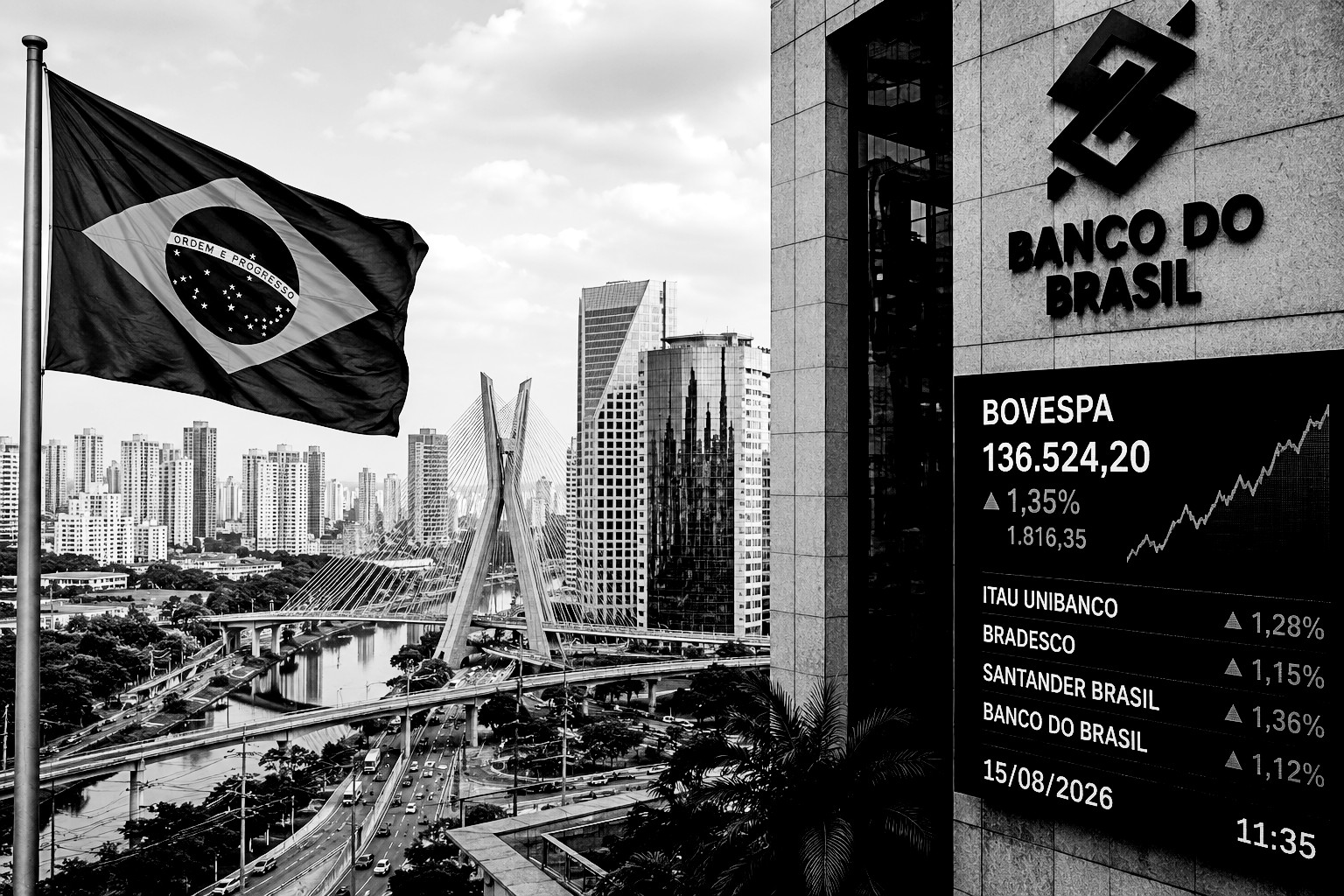
Brazil’s largest banks are becoming increasingly cautious about consumer credit as mounting household debt and signs of deteriorating loan quality raise concerns across Latin America’s biggest financial market. Major lenders are shifting towards secured lending and wealthier customers, illustrating how financial institutions are attempting to contain risk even as Brazil’s economy continues to perform more strongly than many analysts had expected.
Banks tighten their lending standards
Major institutions including Itaú Unibanco, Banco do Brasil, Bradesco and Santander Brasil are reducing their exposure to riskier forms of unsecured consumer lending, including personal loans and credit cards.
The change does not amount to a broad withdrawal from Brazil’s credit market. Instead, banks are becoming considerably more selective, favouring borrowers with stronger incomes and loans backed by collateral.

Santander Brasil, for example, has become particularly cautious towards lower-income borrowers. The strategy demonstrates how concerns about repayment capacity are beginning to influence lending decisions across the financial system.
Household debt becomes a warning signal
Household debt is approaching 50% of disposable income, according to Reuters, creating a potential vulnerability if employment conditions deteriorate or economic growth weakens.
Brazil has so far benefited from a relatively resilient labour market and stronger-than-expected economic activity. But banks must consider what happens if those conditions change while households remain highly leveraged.
Delinquencies are consequently becoming an increasingly important indicator for investors assessing Brazilian financial institutions. Digital lender Nubank, whose business includes substantial unsecured consumer lending, has reported increasing delinquency levels while maintaining a positive outlook.
Interest rates remain restrictive
The lending environment is complicated further by Brazil’s unusually high interest rates. The Central Bank of Brazil recently delivered its fourth consecutive 25-basis-point reduction, bringing the Selic benchmark rate to 14%.
Policymakers nevertheless continue to describe monetary conditions as restrictive. Inflation remains driven partly by domestic demand, while the central bank has emphasised that it intends to proceed cautiously as it works towards its 3% inflation target.
For borrowers, high interest rates increase monthly financing costs. For banks, they can improve lending margins but simultaneously increase the probability that financially stretched customers encounter repayment difficulties.
Fintech competition changes the market
Brazil’s financial system has also undergone a structural transformation. Digital banks and fintech lenders have introduced intense competition into a market historically dominated by a handful of large institutions.
Research published by the International Monetary Fund this year found that increased fintech competition has pushed traditional Brazilian banks towards lower lending rates to protect their loan portfolios.
That competition has improved access and reduced some costs for consumers, but it has also created a more aggressive credit environment.
Brazil faces a delicate financial balance
The behaviour of Brazil’s largest banks provides an important signal for the wider Latin American financial sector. Brazil has one of the region’s most sophisticated banking and fintech markets, meaning changes in credit conditions are closely watched by investors throughout emerging markets.
Banks are not predicting a financial crisis. Their increasingly defensive lending strategies instead suggest that institutions are preparing early for the possibility of weaker growth and greater consumer stress.
For Brazil, the challenge will be maintaining access to credit without allowing household indebtedness to develop into a broader financial problem.
The country’s banks are already making their choice clear: growth remains important, but protecting loan quality is becoming the priority.
Newshub Editorial in South America – 15 August 2026

Ask NF GPT
If you have an account with ChatGPT you get deeper explanations,
background and context related to what you are reading.
Open article chat
Recent Comments