
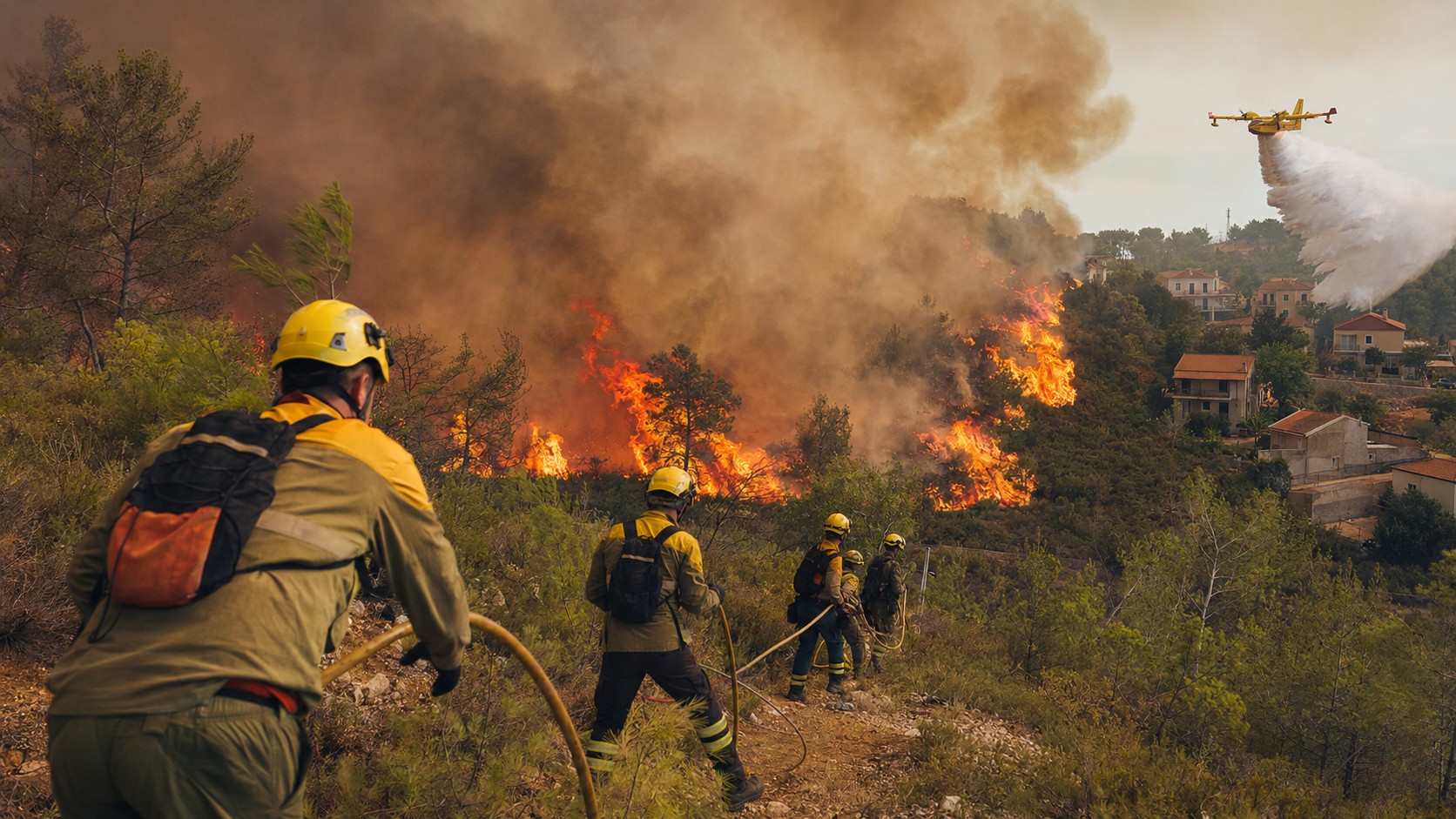
Firefighters are racing to contain wildfires across Europe as new figures show that the hot, dry and windy conditions driving the flames have reached record severity. Fire weather across the European Union has been 43% more severe this year than the average for the same period over the previous two decades.
A continent under pressure
Figures from the European Forest Fire Information System show that almost 435,000 hectares of land had burned across the EU by 29 July.
That is more than twice the 20-year average of approximately 172,000 hectares and already exceeds the area burned by the same point in 2025, previously the worst year on record.

More than 1,400 significant fires have been detected since January, compared with a long-term average of 632. The figures cover fires of approximately 30 hectares or larger and represent an estimated 95% of the total area burned annually in the EU.
France and Spain have suffered some of the greatest destruction. About 91,000 hectares have burned in France, while Spain has lost approximately 207,000 hectares – five times the usual area for this point in the year.
Firefighters face deadly conditions
In France, a wildfire west of Bordeaux devastated approximately 42,000 hectares of mainly pine forest and forced about 220,000 residents and holidaymakers to evacuate. Although parts of the fire have been stabilised, authorities remain alert for flare-ups as temperatures and wind speeds increase.
Spain has made progress against fires in the provinces of Ávila and Madrid, but new outbreaks have forced further evacuations in Zamora. A fire in Castellón remained out of control after burning more than 10,000 hectares, preventing thousands of residents from returning home.
In Greece, three firefighters died while battling blazes on Crete and in the Peloponnese. Strong winds pushed flames towards coastal settlements and tourist areas, forcing the evacuation of residents, hotel guests and visitors.
Climate change raises the danger
Fire weather measures the combination of heat, dryness and wind that determines how easily vegetation can ignite and how difficult a fire will be to control.
Scientists say greenhouse gas emissions have made these conditions considerably more likely. A World Weather Attribution analysis concluded that human-caused climate change had doubled the likelihood of the extreme fire weather experienced in south-western France and made comparable conditions in central Spain 20 times more likely.
A wet winter followed by a dry spring and summer has added to the danger. Rain encouraged abundant vegetation to grow before successive heatwaves dried it into highly flammable fuel.
Europe is the world’s fastest-warming continent, and experts warn that previous improvements achieved through better firefighting and forest management are being overwhelmed by rising temperatures and longer periods of drought.
Smoke creates a second emergency
The fires have also produced dangerous air pollution across large areas of France and Spain. Fine particulate matter reached more than 300 micrograms per cubic metre in Bordeaux and exceeded 400 micrograms in Limoges, more than 200 kilometres from the largest fires.
These particles can penetrate deep into the lungs and are associated with cardiovascular disease, respiratory illness and lung cancer.
European wildfires have emitted almost 18 million tonnes of carbon dioxide this year, compared with a long-term average of about 10 million tonnes. Half of this year’s fire-related emissions were produced during a single week.
The danger is moving north
Forecasts show very extreme fire conditions across parts of France, the Alpine region and northern Italy, with high danger also covering the Iberian Peninsula and the Balkans.
Fire services are increasingly being forced to prioritise evacuations when wind and heat make direct attacks on the flames ineffective. EU officials have warned that the wildfire season could continue into the autumn, stretching national resources and international assistance.
The crisis is demonstrating that firefighting alone cannot contain Europe’s growing risk. Scientists say governments must combine emergency response with improved land management, controlled removal of dry vegetation and faster reductions in the fossil-fuel emissions driving extreme heat.
Newshub Editorial in Europe – 31 July 2026

Ask NF GPT
If you have an account with ChatGPT you get deeper explanations,
background and context related to what you are reading.
Recent Comments