
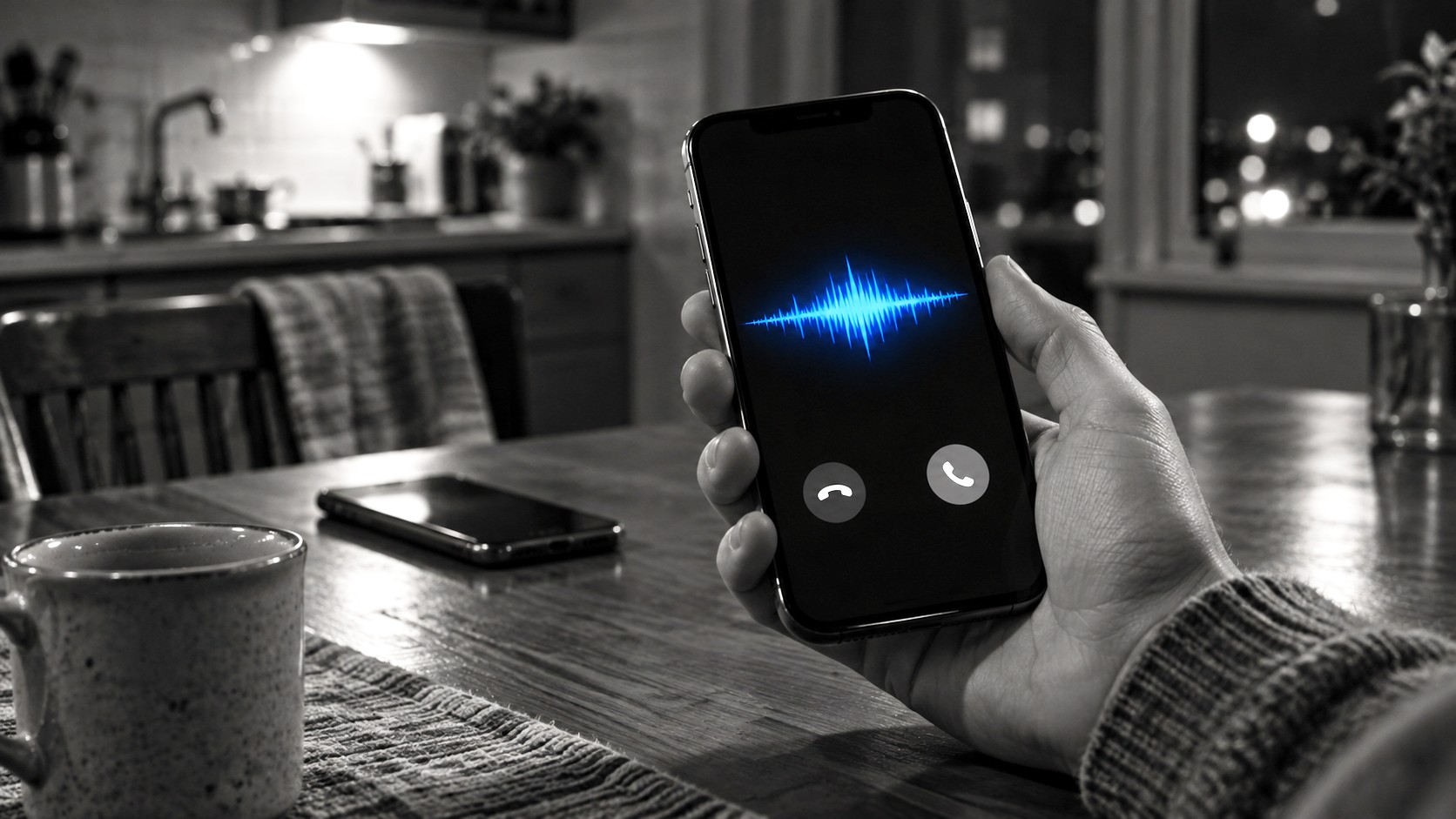
A call from a family member or a voice message from a colleague once offered a measure of reassurance: you recognised the voice. AI voice cloning is weakening that simple test. The same technology that can help people communicate can also make an urgent request for money sound as though it comes from someone they trust.
The useful tool
Synthetic voices can help people who have lost the ability to speak and make digital services more accessible. They can also translate or produce audio at speed. The technology itself has legitimate uses; the difficulty is knowing when a voice has been generated and whether the person it represents agreed to its use.
The threat
Fraudsters can use a short recording to imitate someone’s voice, then invent an emergency that pressures a listener to act immediately. In its report on 2025 cybercrime, the FBI recorded 22,364 complaints involving artificial intelligence, with reported losses approaching $893 million. That figure covers several kinds of AI-enabled fraud, including fake profiles, documents, videos and voice clones; it is not a voice-cloning total.


A different way to verify
The sound of a voice is no longer enough to authenticate a request. If a caller asks for money, account access or sensitive information, ending the call and contacting the person through a number already saved offers a separate check. The FBI has also warned that impersonators have used voice messages while posing as senior officials, showing that the problem extends from households to public institutions.
Trust needs a second step
Voice technology can remain a useful tool, but it changes what listeners must verify. A familiar voice may start a conversation. It should no longer be the sole proof of who is speaking.
Newshub Editorial in North America – 24 September 2026

Ask NF GPT
If you have an account with ChatGPT you get deeper explanations,
background and context related to what you are reading.
A call from a family member or a voice message from a colleague once offered a measure of reassurance: you recognised the voice. AI voice cloning is weakening that simple test. The same technology that can help people communicate can also make an urgent request for money sound as though it comes from someone they trust.
Recent Comments