
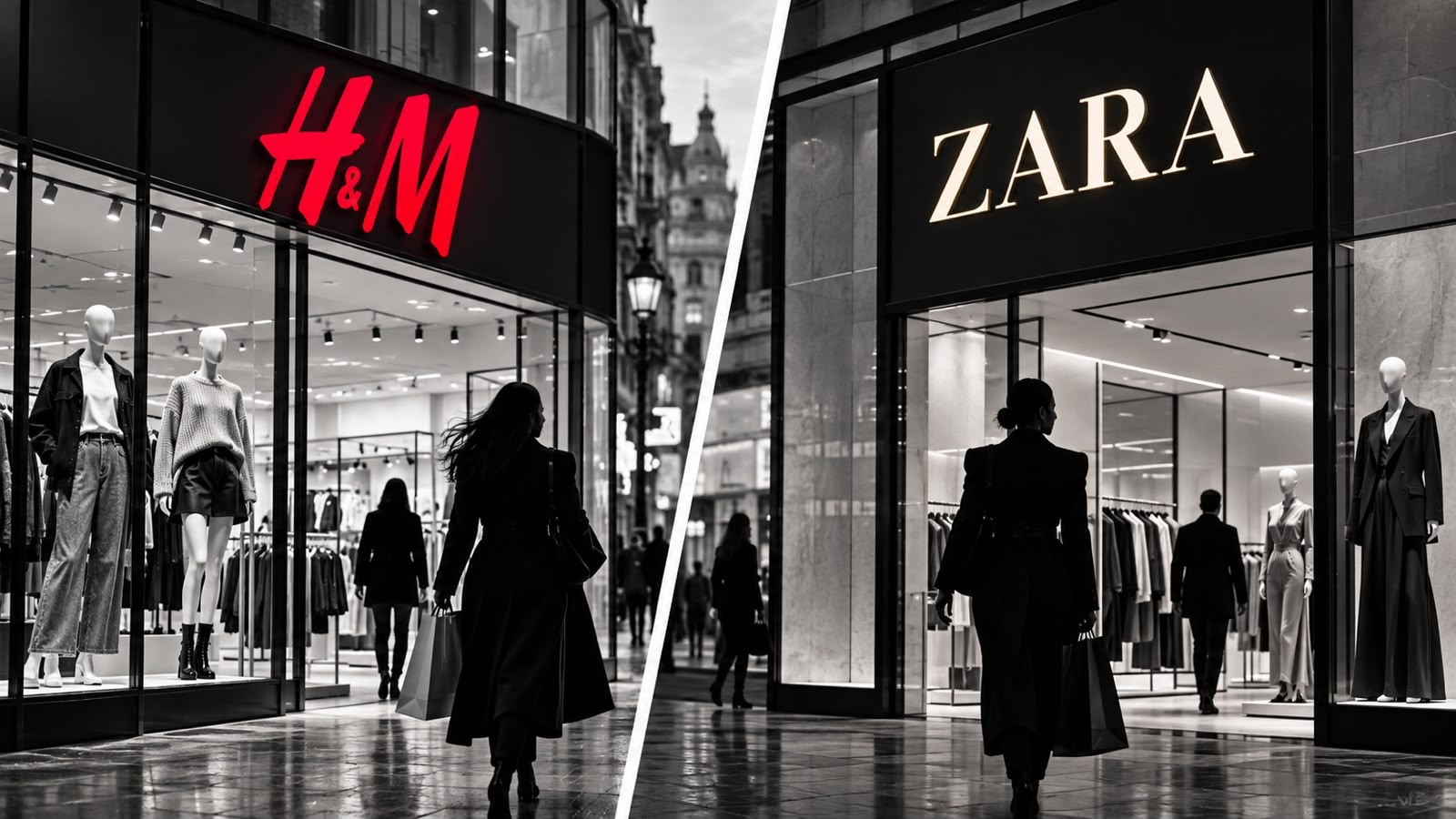
They sell to many of the same customers, compete on many of the same high streets and operate on a similar global stage. But financially, H&M and Zara are very different businesses.
At first glance, Sweden’s H&M and Spain’s Zara look like natural equals.
Both helped build the modern fast-fashion industry. Both operate enormous international store networks. Both compete for the same mainstream fashion customer.


But look underneath the shop windows and the difference becomes striking.
Zara’s parent company, Inditex, has built a business that generates considerably more profit from each euro of sales — and the stock market values that difference very highly.
Nearly twice the sales — but more than five times the profit
For the 2025 financial year, Inditex reported revenue of €39.9 billion and net profit of approximately €6.2 billion.
That represents a net margin of roughly 15.6%. (Inditex Annual Report)
H&M Group, by comparison, generated approximately SEK 228 billion, equivalent to roughly €21 billion, in annual sales, with net profit of around €1.1 billion.
In other words, Inditex generated less than twice H&M’s revenue — but more than five times its net profit.
That is where the real story begins.
The store count does not explain it
H&M and Inditex both operate huge physical networks.
H&M had just over 4,000 stores across its brands at the end of its 2025 financial year.
Inditex operated around 5,460 stores globally.
Yet the difference in profitability is far larger than the difference in store numbers.
On a rough group-wide basis, Inditex produces considerably more revenue per store and several times more net profit per store than H&M.
It is not a perfect calculation — both companies generate substantial online sales and operate several brands — but it illustrates the productivity gap.
Zara’s secret is speed — but not simply “fast fashion”
Zara is often described as the ultimate fast-fashion company.
That description is incomplete.
Its real advantage has historically been the speed and precision of the system behind the fashion.
Inditex has spent decades building a tightly controlled model connecting stores, customer demand, design, production, logistics and inventory.
Instead of making enormous bets on collections months in advance, Zara has traditionally been able to react faster to what customers are actually buying.
That can mean fewer markdowns, faster inventory turnover and less capital trapped in unwanted stock.
In fashion retail, those differences can determine whether a company makes five cents or fifteen cents of profit from every euro it sells.
H&M is fighting back
H&M is hardly standing still.
Its latest results, published on September 24, show a business becoming more profitable.
For the first nine months of its 2026 financial year, H&M reported sales of SEK 161.6 billion and operating profit of SEK 13.5 billion.
Its operating margin improved to 8.3%, compared with 7.1% during the corresponding period a year earlier.
In the third quarter alone, operating margin reached 10.6%, although approximately 1.6 percentage points came from positive one-off effects related to tariffs and imported goods. (H&M Group)
CEO Daniel Ervér says improvements in purchasing, cost control and operational efficiency are helping profitability.
H&M is also investing further in digital infrastructure designed to improve decisions across product development, purchasing, allocation, marketing and sales. (H&M Group)
So this is not a story about a weak company versus a strong one.
It is a story about two strong companies that currently operate at very different levels of economic efficiency.
The Spanish machine
Inditex remains exceptional by retail standards.
Its 2025 gross margin reached 58.3%, while net profit increased to €6.2 billion.
The company continues to invest heavily in larger and upgraded stores, e-commerce, logistics and technology rather than simply chasing a higher store count.
More than 400 store openings, extensions or major refurbishments were carried out during 2025 alone. (Inditex Annual Report)
That tells us something important about modern retail.
More stores are not necessarily better. Better stores are better.
The same applies to inventory, logistics and customer data.
Same clothes. Very different economics.
For consumers, the distinction can feel surprisingly small.
A customer can walk into H&M or Zara, buy a jacket, trousers or a dress and leave having spent roughly the same amount of money.
For shareholders, however, the difference behind that transaction is enormous.
One business has historically converted each euro of sales into substantially more profit.
And that explains why Inditex has grown into one of Europe’s most valuable consumer companies.
The comparison also offers a wider lesson.
Size alone does not create value.
Revenue alone does not create value.
Even global presence alone does not create value.
The companies that ultimately become the most valuable are often those that build the best machine behind the product.
And right now, in the global fashion industry, Zara’s machine remains extraordinarily difficult to beat.
NEWSHUB FINANCE
Beyond finance. Understanding the businesses shaping the global economy.

Ask NF GPT
If you have an account with ChatGPT you get deeper explanations,
background and context related to what you are reading.
They sell to many of the same customers, compete on many of the same high streets and operate on a similar global stage. But financially, H&M and Zara are very different businesses.
Recent Comments