
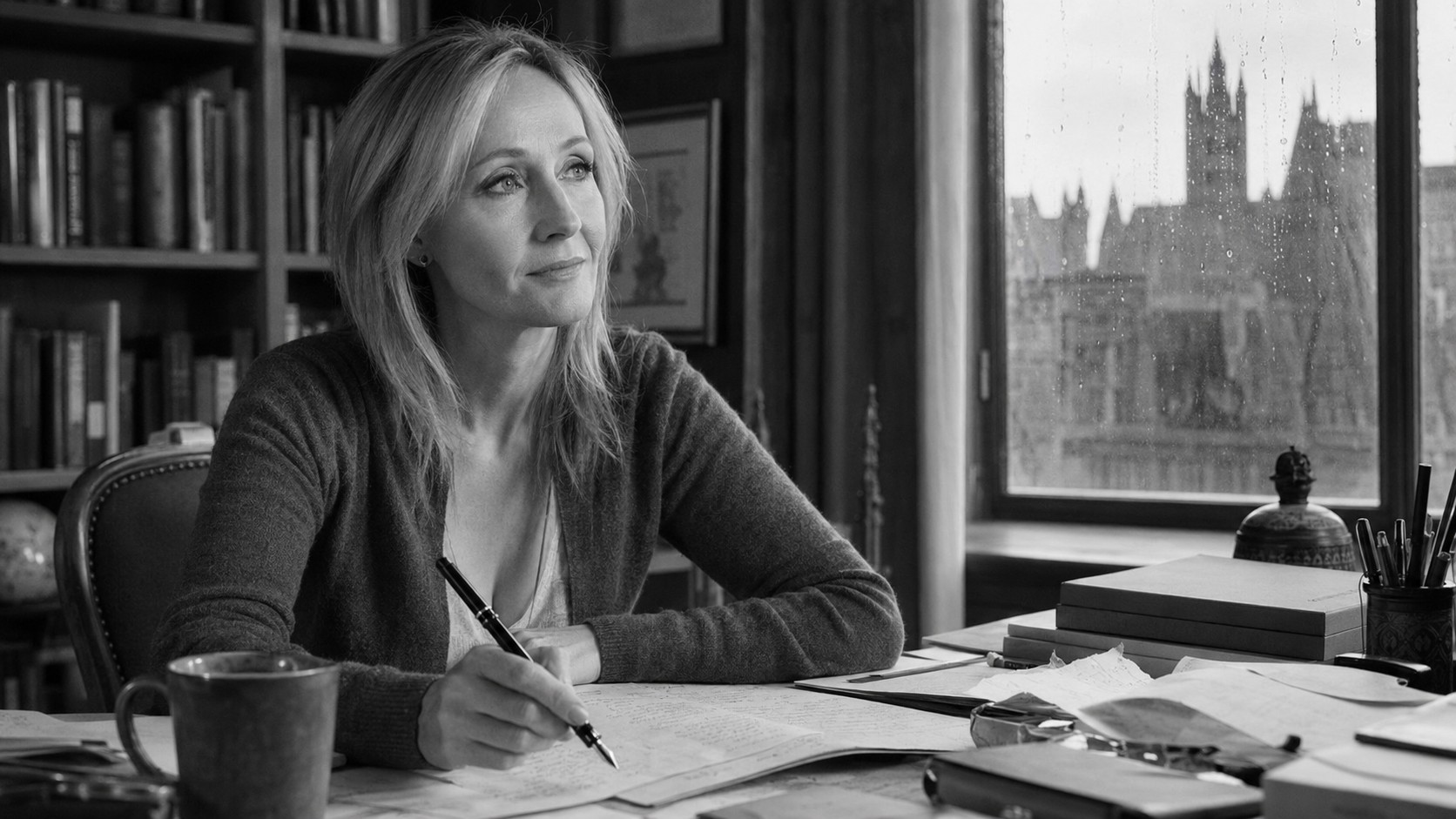
On this day in 1965, British author J.K. Rowling was born near Bristol, England. Four decades later, the former teacher and struggling single mother had become one of the world’s most successful writers, creating the Harry Potter series and a fictional universe that transformed children’s publishing, cinema and popular culture.
A childhood surrounded by stories
Joanne Rowling grew up in Gloucestershire and the Welsh border town of Chepstow. Books were central to her childhood, and she began writing at an early age. At six, she completed a story about a rabbit, while her first attempt at a novel came when she was eleven.
She later studied French and Classics at the University of Exeter. Her knowledge of mythology, language and Latin would eventually help shape the names, spells and traditions of the wizarding world.

After university, Rowling worked in several jobs, including as a researcher for Amnesty International. The defining idea of her career arrived in 1990, during a delayed train journey from Manchester to London. She imagined a young boy who did not know that he was a wizard.
Harry Potter takes shape
Over the following five years, Rowling planned the seven Harry Potter novels, often writing by hand and filling scraps of paper with characters, histories and magical rules.
After living in Portugal, she returned to Britain with her young daughter and settled in Edinburgh. Despite financial hardship and the demands of single parenthood, she continued writing whenever possible and completed the manuscript for Harry Potter and the Philosopher’s Stone.
The book was rejected by several publishers before Bloomsbury agreed to publish it in June 1997. It appeared under the name J.K. Rowling, with the “K” taken from her grandmother Kathleen. The initials were used after the publisher expressed concern that some boys might be reluctant to read a fantasy book written by a woman.
A worldwide phenomenon
Harry Potter and the Philosopher’s Stone quickly became a bestseller. Six further novels followed, chronicling Harry’s years at Hogwarts School of Witchcraft and Wizardry and his struggle against Lord Voldemort.
The seven books have sold more than 600 million copies worldwide and have been translated into 85 languages. Their film adaptations, released between 2001 and 2011, turned Harry, Hermione Granger and Ron Weasley into some of modern cinema’s most recognisable characters.
Rowling chose 31 July as Harry Potter’s birthday, giving her fictional hero the same birthday as his creator.
Beyond the wizarding world
Rowling later wrote the adult novel The Casual Vacancy and, under the pseudonym Robert Galbraith, created the Cormoran Strike crime series. She also expanded the Harry Potter universe through companion books, stage productions and the Fantastic Beasts films.
Her public statements on sex and gender have made her an increasingly divisive figure. They have attracted strong criticism from LGBTQ+ campaigners and some people connected with the Harry Potter films, while supporters describe her position as a defence of women’s sex-based rights.
Alongside her writing, Rowling has supported humanitarian causes through the Volant Charitable Trust and Lumos, the international children’s charity she founded. She has also funded neurological research in memory of her mother, who died from complications related to multiple sclerosis.
More than six decades after her birth, Rowling remains one of the most influential, commercially successful and debated British authors of her generation.
Newshub Editorial in Europe – 31 July 2026

Ask NF GPT
If you have an account with ChatGPT you get deeper explanations,
background and context related to what you are reading.
Recent Comments