
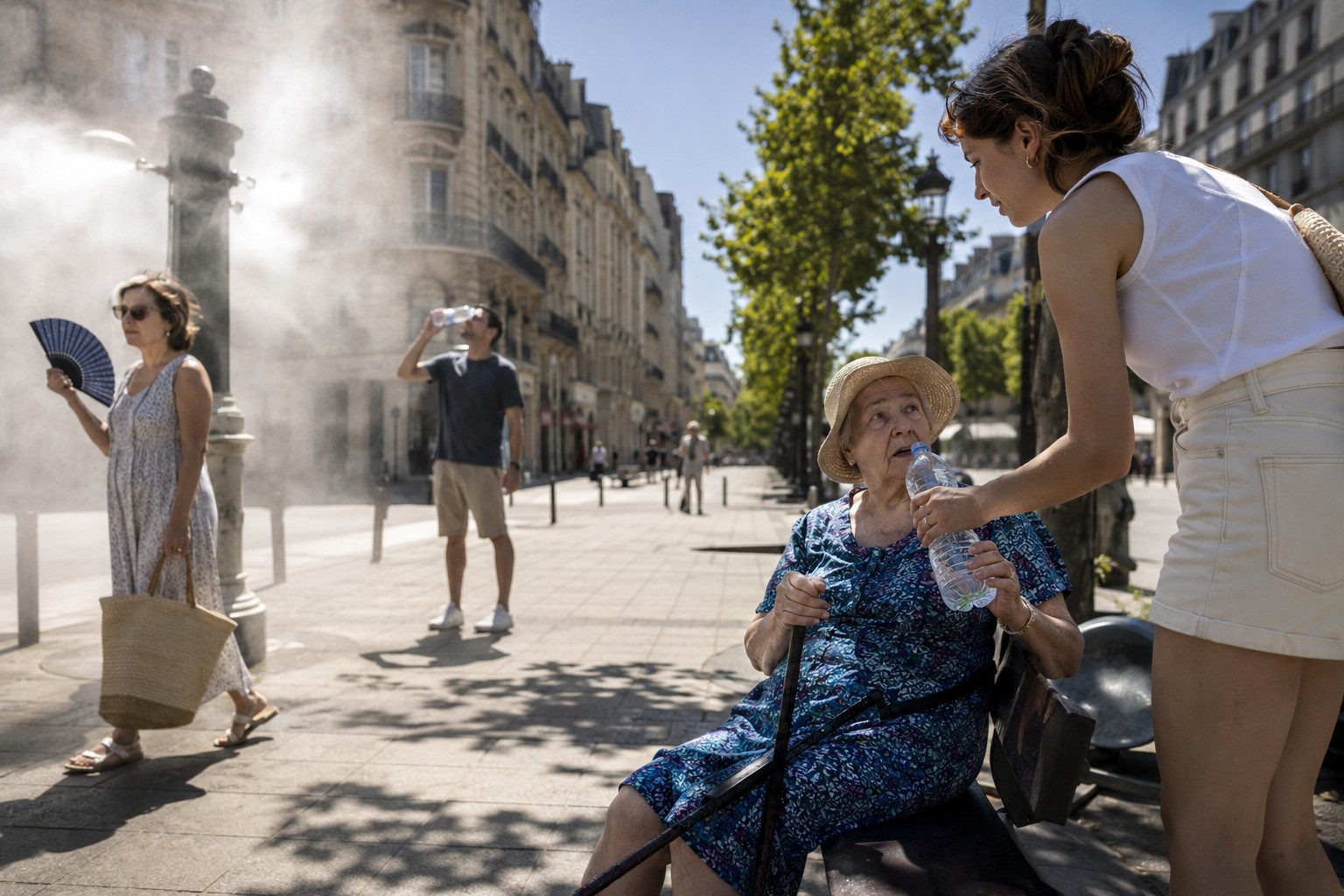
France counts 5,764 excess deaths after historic June heatwave
France recorded 5,764 more deaths than expected during an intense early-summer heatwave, according to provisional figures from the country’s national health agency, as southern Europe confronts another period of extreme temperatures and destructive wildfires.
Mortality rises by 36 per cent
The excess deaths were recorded between 17 June and 2 July, when unusually intense heat affected much of France. Public Health France said 21,674 people died during the period, compared with an expected figure of approximately 15,910.


This represented excess mortality of about 36 per cent. More than half of the additional deaths occurred between 25 and 27 June, close to the most intense point of the heatwave.
People aged 75 and over accounted for approximately two-thirds of the excess mortality, with 3,719 more deaths than normally expected in that age group. The Paris region was particularly badly affected, recording almost 2,000 excess deaths and an increase of more than 80 per cent above expected levels.
The figures cover deaths from all causes and do not mean that every additional death was directly caused by high temperatures. French health officials will need to examine medical and mortality data before determining how many deaths can formally be attributed to heat.
Record temperatures strain public services
France experienced exceptionally high temperatures during the second half of June. The national average approached 30C on the hottest days, while local temperatures exceeded 40C in several areas.
The timing of the heatwave increased its impact. Unlike many severe heat events that occur during the traditional August holiday period, the June heat arrived while schools, offices, transport systems and industrial workplaces were operating at full capacity.
Hospitals, care facilities and emergency services faced increased demand. Mortuaries in the Paris area also reported capacity problems as the number of deaths rose sharply.
The provisional toll is the highest recorded during a French heatwave since 2003, when approximately 15,000 excess deaths led to major reforms in the country’s heat-warning and elderly care systems.
Southern Europe faces renewed extreme heat
The publication of the French figures coincides with another period of dangerous temperatures across southern Europe. Parts of Spain, Italy, Greece and North Macedonia have experienced temperatures near or above 40C, increasing pressure on electricity networks, water supplies and emergency services.
Spain is also confronting one of its largest recorded wildfires. A major blaze in Guadalajara has burned more than 32,000 hectares and forced the evacuation or confinement of residents across numerous villages.
Other fires have affected parts of France, including the southern Var region, where hundreds of people were displaced. Firefighters throughout the Mediterranean are working in conditions made more dangerous by dry vegetation, strong winds and persistent heat.
Heat becomes a growing public health threat
Europe is warming faster than the global average, increasing the frequency and intensity of extreme temperatures. Older people, those with chronic illnesses, outdoor workers and residents of poorly ventilated housing face the greatest risks.
The French mortality figures underline that heatwaves are not only environmental events but also major public health emergencies. Adaptation measures, including cooler urban spaces, improved housing, workplace protections and stronger support for isolated elderly people, are becoming increasingly important as extreme heat becomes a regular feature of European summers.
Newshub Editorial in Europe – 23 July 2026

Ask NF GPT
If you have an account with ChatGPT you get deeper explanations,
background and context related to what you are reading.
Arbetade i 24s
Recent Comments