
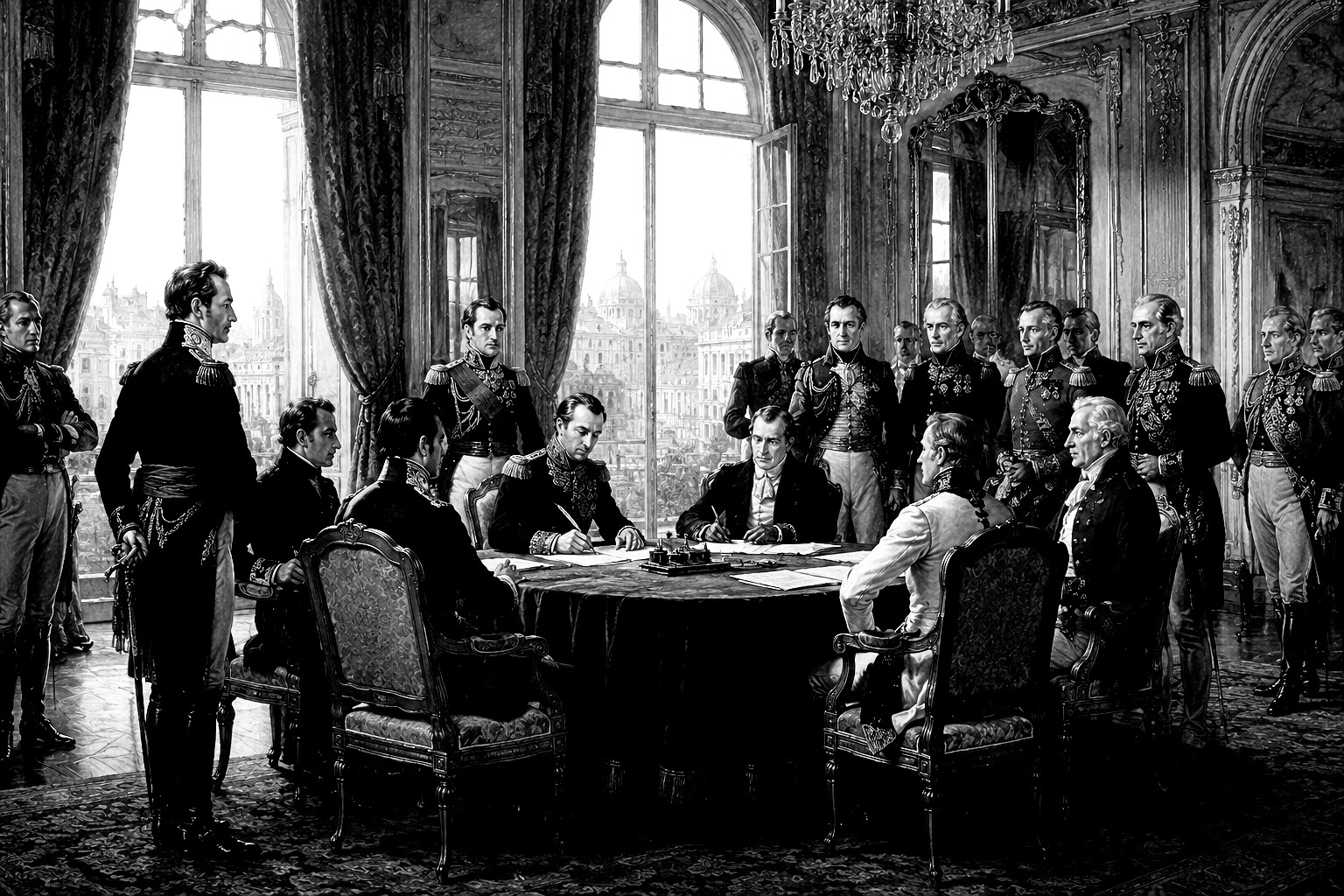
On 30 May 1814, European powers signed the First Treaty of Paris, formally ending more than two decades of conflict associated with the French Revolutionary and Napoleonic Wars. The agreement marked the fall of Napoleon Bonaparte’s empire and ushered in a new era of diplomacy aimed at restoring stability across the continent.
The end of an era
The First Treaty of Paris was signed in the French capital by representatives of France and the major Allied powers, including Britain, Austria, Prussia, Russia, Portugal and Sweden. The treaty followed Napoleon’s abdication in April 1814 and the restoration of the Bourbon monarchy under King Louis XVIII.
For much of Europe, the agreement represented a welcome end to years of warfare that had redrawn borders, disrupted trade and cost millions of lives. The conflict had transformed the political landscape of Europe and left many nations eager to prevent future continental wars.

A surprisingly moderate settlement
Unlike many peace agreements that impose severe penalties on the defeated side, the First Treaty of Paris was notably moderate towards France. The country was largely allowed to retain its 1792 borders and avoided the crippling reparations or territorial dismemberment often imposed on defeated powers.
The Allied leaders believed that a stable and cooperative France would be essential for long-term peace. This approach reflected a growing understanding that excessive punishment could fuel future instability and resentment.
The settlement also enabled France to re-enter the European diplomatic community rather than remain isolated. This decision would become a cornerstone of the post-war balance-of-power system.
The road to the Congress of Vienna
Although the treaty formally ended the war, many questions regarding Europe’s future remained unresolved. These issues would soon be addressed at the historic Congress of Vienna, where diplomats from across the continent gathered to redraw borders and establish a new political order.
The Congress sought to restore legitimacy to Europe’s monarchies while preventing any single power from dominating the continent as Napoleon had done. The negotiations laid the foundations for what became known as the Concert of Europe, a diplomatic framework that helped maintain relative peace among the great powers for decades.
Napoleon’s dramatic return
The peace established by the First Treaty of Paris proved short-lived. In March 1815, Napoleon escaped from exile on the island of Elba and returned to France, beginning the period known as the Hundred Days.
His comeback ended with the decisive Allied victory at the Battle of Waterloo in June 1815. A second and far stricter Treaty of Paris was signed later that year, imposing harsher conditions on France and confirming the new European order.
A lasting diplomatic legacy
Despite being overshadowed by Waterloo and the Congress of Vienna, the First Treaty of Paris remains one of the most significant diplomatic agreements in European history. It demonstrated the value of negotiated settlements and balance-of-power diplomacy at a time when Europe desperately needed stability.
More than two centuries later, historians continue to view the treaty as a pivotal moment that helped shape modern Europe, ending one of the continent’s most turbulent periods and opening the door to a new age of international cooperation.
Newshub Editorial in Europe – 30 May 2026

If you have an account with ChatGPT you get deeper explanations,
background and context related to what you are reading.
Open an account:
Open an account
Recent Comments