
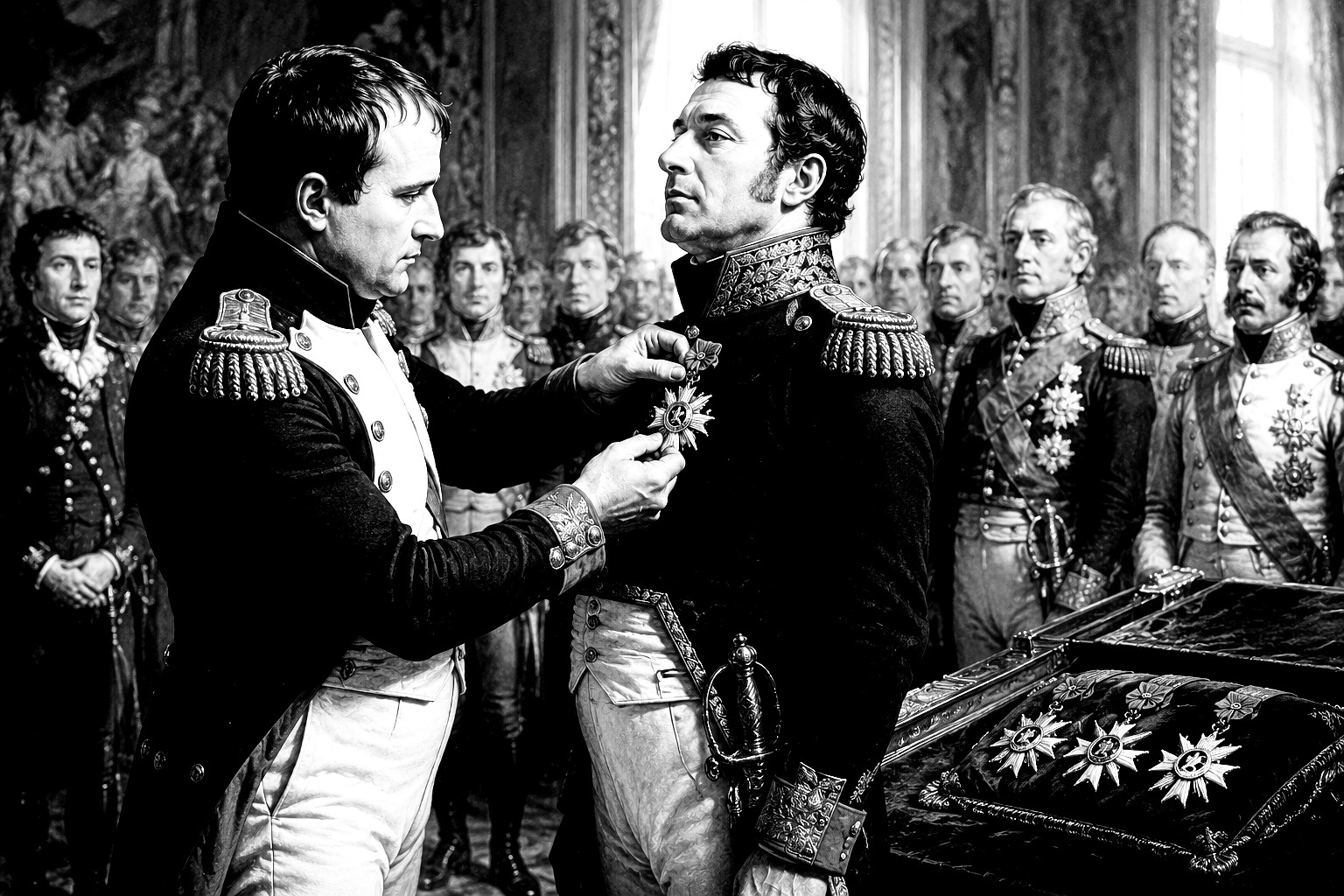
On 19 May 1802, Napoleon Bonaparte created the Legion of Honour, establishing what would become the premier order of merit of the French republic. Born from the turbulence of revolution and war, the institution was designed to reward service, loyalty and excellence rather than inherited privilege.
A republican order with imperial roots
The Legion of Honour was created while Napoleon was First Consul, before he crowned himself emperor. France had abolished many aristocratic distinctions during the Revolution, but Napoleon understood that a modern state still needed symbols of recognition. His answer was an order that could reward soldiers, officials, scientists, artists and civilians who served the nation with distinction.
Merit instead of birth
The new order was controversial. Critics feared it looked too much like the old monarchy’s honours system. Napoleon defended it as a practical tool of government. In his view, men and women were not driven by money alone, but also by honour, status and public recognition. The Legion of Honour therefore became a republican compromise: hierarchy remained, but it was based on service rather than noble blood.

A tool of nation-building
The timing was important. France had emerged from years of revolution, internal conflict and war. Napoleon needed a loyal administrative and military elite that could bind the state together. The Legion of Honour helped create that elite. It gave officers, civil servants and professionals a shared identity and a visible connection to the French state.
A symbol that survived Napoleon
Although Napoleon’s empire eventually collapsed, the Legion of Honour survived. Monarchies, republics and empires came and went in France, but the order remained. That endurance shows its institutional strength. What began as a Napoleonic innovation became part of the permanent architecture of French public life.
France’s highest distinction
Today, the Legion of Honour remains France’s highest order of merit. It is awarded for exceptional military or civilian service and continues to carry strong symbolic value. Its creation on 19 May 1802 marked more than the birth of a decoration. It marked the creation of a modern system of national recognition, blending republican ideals with the political realism that defined Napoleon’s rule.
Newshub Editorial in Europe – 19 May 2026

If you have an account with ChatGPT you get deeper explanations,
background and context related to what you are reading.
Open an account:
Open an account
Recent Comments