
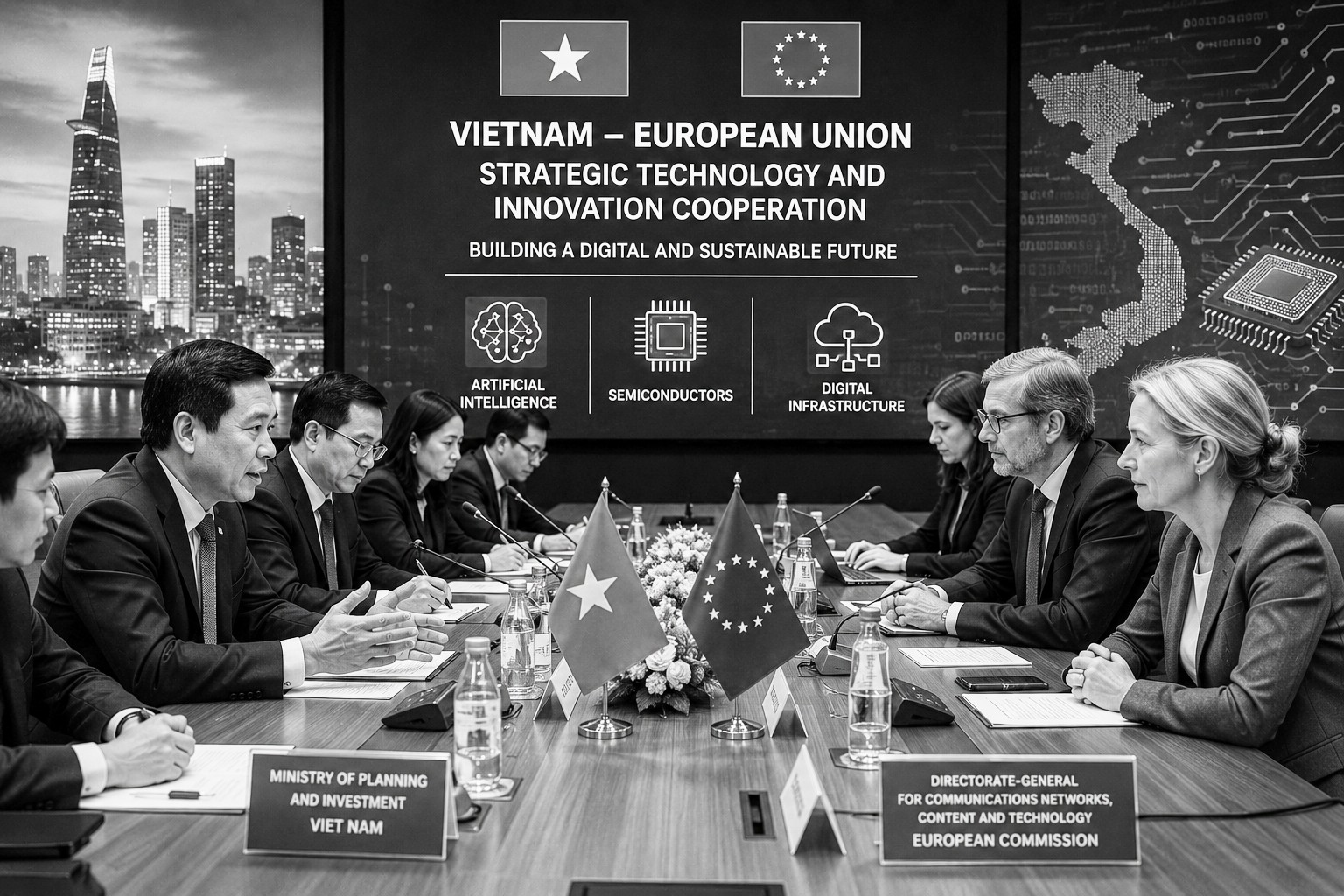
Vietnam and the European Union are expanding cooperation in technology, innovation and digital infrastructure, as both sides seek to strengthen economic ties and position themselves more strategically within the rapidly evolving global technology landscape.
AI and semiconductors become central priorities
Officials from Vietnam and the European Union have identified artificial intelligence, semiconductor production and digital infrastructure as key strategic sectors for future collaboration.
The discussions reflect a broader global race to secure technological competitiveness, diversify supply chains and reduce dependence on concentrated manufacturing hubs. For Vietnam, the partnership represents an opportunity to accelerate industrial upgrading and strengthen its role within advanced global technology supply chains.

European policymakers, meanwhile, increasingly view Southeast Asia as an important strategic partner for both economic resilience and geopolitical diversification.
Semiconductors have emerged as a particularly important area of interest as governments worldwide compete to secure access to advanced chip manufacturing and electronics supply networks.
Vietnam’s growing technology role
Vietnam has rapidly transformed into one of Asia’s most important manufacturing and technology hubs over the past decade. Global electronics firms have significantly expanded operations in the country, attracted by competitive labour costs, improving infrastructure and expanding trade access.
The country has also benefited from international efforts to diversify supply chains away from overdependence on single-market manufacturing exposure.
Technology exports, electronics assembly and digital services now represent increasingly important components of Vietnam’s economic growth strategy.
At the same time, Vietnamese authorities continue investing heavily in digital transformation, telecommunications infrastructure and technology education in an effort to move higher up the value chain.
Europe seeks stronger Indo-Pacific partnerships
For the European Union, expanding cooperation with Vietnam aligns with broader Indo-Pacific economic and strategic objectives. European leaders have increasingly emphasised the need for stronger partnerships in Asia focused on technology, trade security, clean energy and resilient infrastructure.
Digital regulation, cybersecurity cooperation and sustainable innovation standards are also expected to become increasingly important areas of collaboration between the two sides.
Analysts note that Europe is attempting to balance industrial competitiveness with regulatory oversight, particularly in sensitive sectors such as artificial intelligence and advanced computing infrastructure.
Vietnam’s expanding digital economy and growing manufacturing base make it an increasingly attractive long-term partner within that strategy.
Global competition drives cooperation
The strengthening relationship also reflects intensifying global competition surrounding emerging technologies. Governments across North America, Europe and Asia are investing heavily in AI systems, semiconductor capacity and digital infrastructure amid concerns over technological sovereignty and future economic influence.
Vietnam’s strategic geographic position, growing industrial ecosystem and relatively stable investment environment continue attracting multinational corporations seeking regional expansion opportunities.
As cooperation deepens, both Vietnam and the European Union appear increasingly focused on building long-term technological partnerships capable of supporting innovation, economic resilience and industrial competitiveness in a rapidly shifting global economy.
Newshub Editorial in Asia – May 15, 2026

If you have an account with ChatGPT you get deeper explanations,
background and context related to what you are reading.
Open an account:
Open an account
Recent Comments