
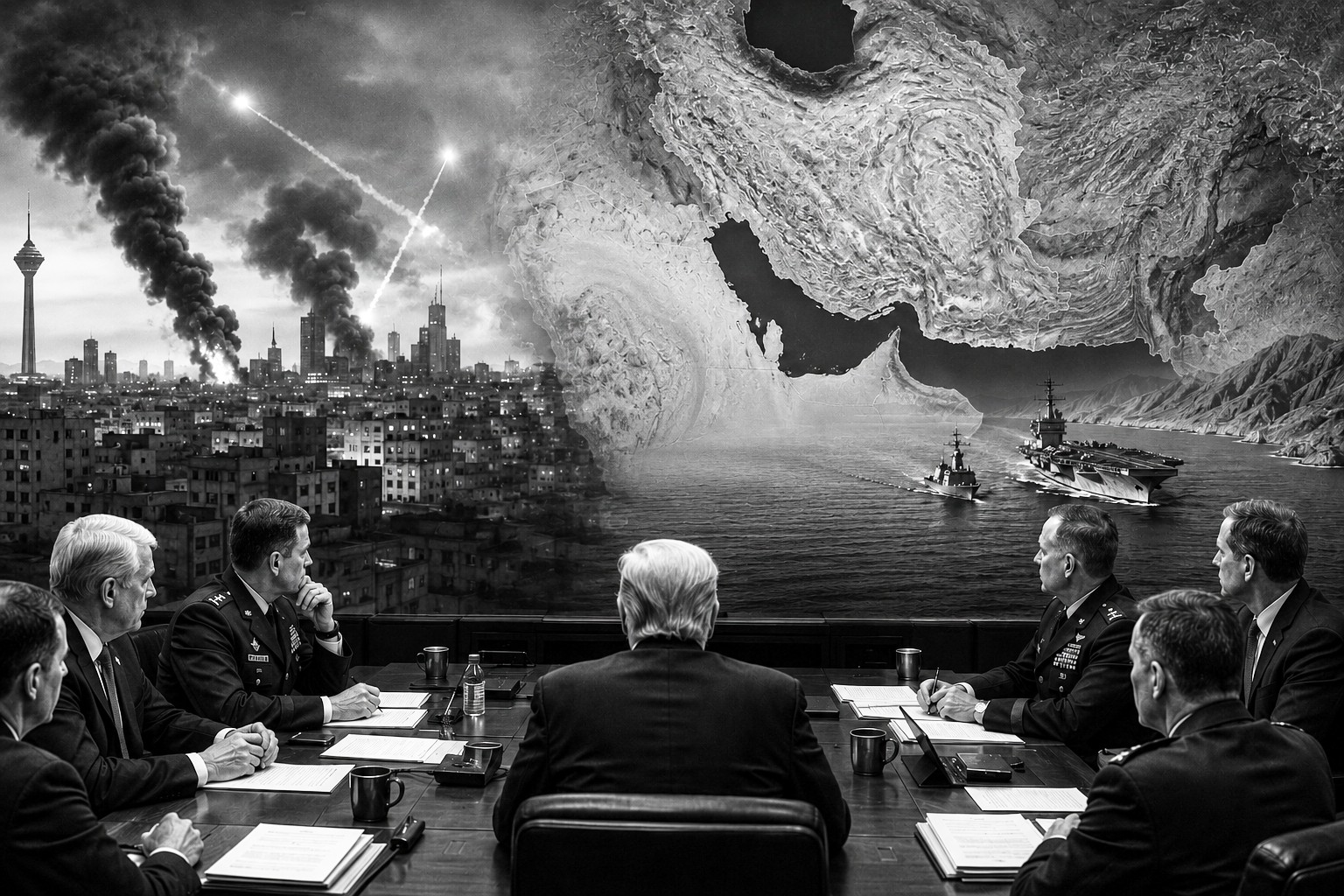
As the conflict involving Iran, the United States and Israel drags deeper into 2026, one question increasingly dominates political debate, financial markets and diplomatic discussions: when does this war actually end — and does Washington itself even agree on when it began?
A war without a clear beginning
The current conflict officially escalated on 28 February 2026, when US and Israeli strikes targeted Iranian military and government infrastructure.
Yet inside Washington, competing narratives have emerged regarding the origins of the war itself. Some US officials frame the conflict as a continuation of years of confrontation involving Iran’s nuclear programme, regional proxy networks and Gulf tensions. Others describe the current campaign as a direct response to immediate security threats in early 2026.

Critics argue this ambiguity matters enormously because wars without clearly defined starting points often struggle to establish achievable end goals. Legal experts and political analysts have increasingly questioned whether the United States has articulated a coherent long-term strategy beyond degrading Iran’s military capabilities and regional influence.
At the same time, the Trump administration’s stated objectives have repeatedly shifted — ranging from weakening Iran’s nuclear infrastructure to broader regime pressure and regional deterrence.
Military success but political uncertainty
Senior US military officials argue that Iranian military capabilities have been heavily degraded during the conflict. Recent testimony from US Central Command described Iran’s strike capacity as dramatically reduced following months of operations.
Yet military degradation does not automatically produce political resolution.
The conflict continues affecting energy markets, regional stability and global shipping routes, particularly around the strategically critical Strait of Hormuz. Iran has repeatedly linked any lasting ceasefire to broader negotiations surrounding sanctions, security guarantees and regional military activity.
Inside the United States, divisions are also growing regarding presidential war powers and the absence of a clearly defined exit strategy. Congressional efforts to limit military operations have repeatedly failed by narrow margins, reflecting deep political disagreement over both the legitimacy and long-term direction of the war.
Diplomacy struggles to catch up
Negotiations continue intermittently through regional intermediaries, including Pakistan and Gulf states. However, both Tehran and Washington remain publicly sceptical of each other’s intentions.
Iranian officials insist that ending hostilities must take priority before broader diplomatic concessions can occur. Meanwhile, Washington continues balancing military pressure with attempts to maintain regional alliances and avoid a wider Middle East escalation.
Analysts increasingly warn that the absence of clearly agreed political objectives risks transforming the conflict into a prolonged low-intensity regional confrontation rather than a decisive military campaign.
This uncertainty has also unsettled global investors. Oil markets, shipping insurers and defence sectors remain highly sensitive to developments in the Gulf region, while geopolitical risk premiums continue affecting energy and commodity prices worldwide.
A conflict that may redefine the region
The Iran war is no longer viewed simply as a short-term military confrontation. Increasingly, it is becoming part of a much broader geopolitical struggle involving energy security, nuclear deterrence, regional alliances and global power competition.
For now, the war’s end remains as unclear as its political beginning. Military operations continue, negotiations remain fragile and neither side appears willing to accept a definitive strategic defeat.
That uncertainty may ultimately become the defining feature of the conflict itself.
Newshub Editorial in Middle East – May 15, 2026

If you have an account with ChatGPT you get deeper explanations,
background and context related to what you are reading.
Open an account:
Open an account
Recent Comments