
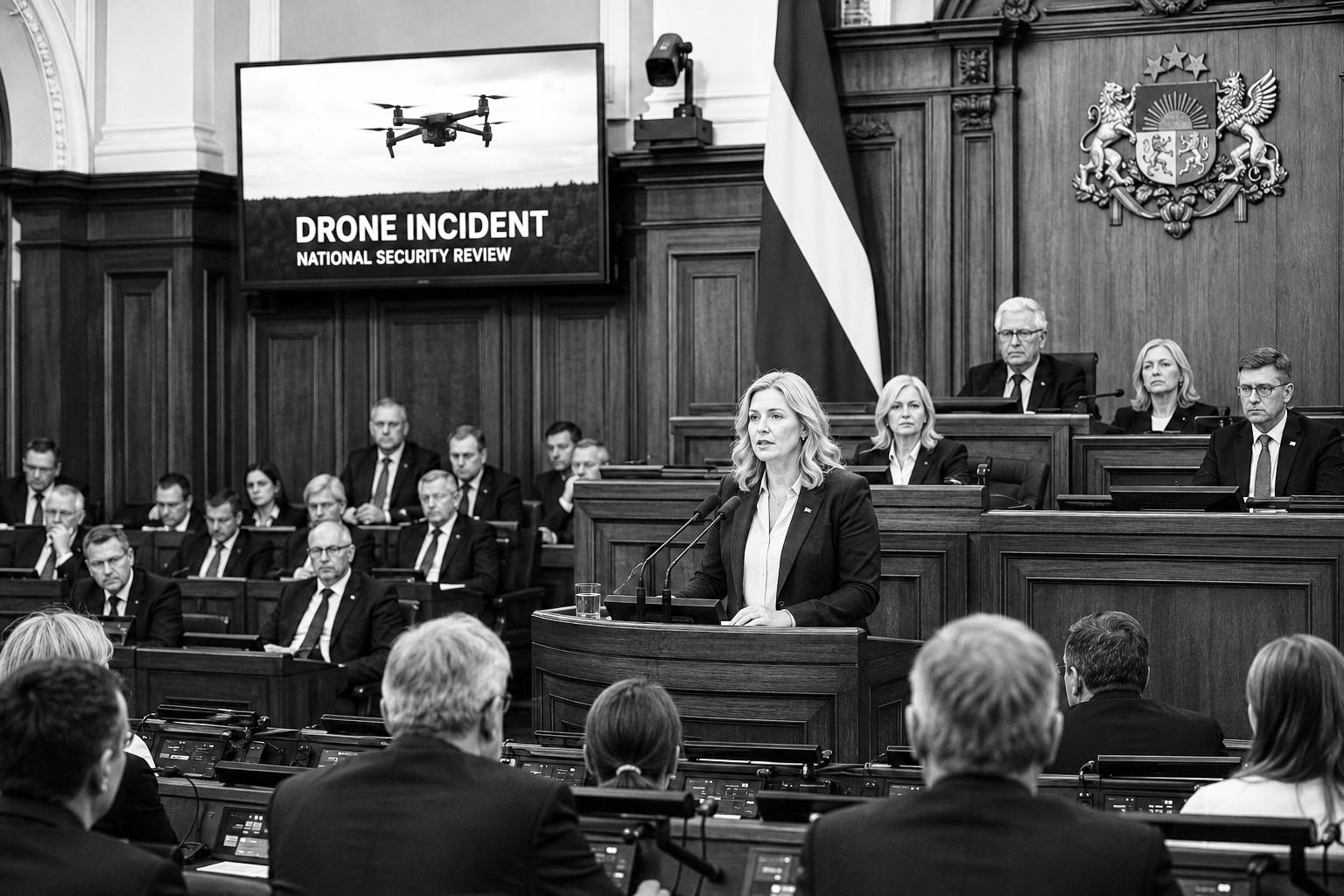
Evika Siliņa has announced her intention to resign as prime minister of Latvia after a political dispute within the governing coalition escalated into a parliamentary crisis centred around defence policy, national security and a controversial drone incident.
Coalition dispute triggers political crisis
The resignation announcement followed a breakdown between Siliņa and her coalition partners, the The Progressives, who refused to support her decision to dismiss Defence Minister Andris Sprūds.
The dispute reportedly stemmed from growing frustration inside the government regarding the handling of a recent drone-related security incident, which intensified debate over Latvia’s defence readiness and crisis response capabilities.


Siliņa sought to replace Sprūds with Raivis Melnis, but coalition partners declined to support the appointment. The Progressives subsequently indicated that they no longer effectively backed the prime minister, leaving her government without a functioning parliamentary majority.
The political breakdown rapidly evolved into a broader confidence crisis within Latvia’s ruling coalition.
Security concerns dominate debate
The crisis comes at a particularly sensitive moment for Latvia and the wider Baltic region, where security policy remains heavily influenced by heightened tensions between NATO and Russia following the continuing war in Ukraine.
Latvia, alongside neighbouring Baltic states, has significantly increased defence spending and military preparedness in recent years. Drone surveillance, border security and hybrid warfare threats have become especially important issues across the region.
Analysts noted that even relatively limited security incidents now carry heightened political sensitivity given the broader geopolitical climate in Eastern Europe.
The dispute surrounding the defence ministry therefore quickly became about more than a single personnel decision — instead reflecting deeper tensions regarding leadership, crisis management and coalition discipline.
Political uncertainty ahead
Siliņa’s resignation opens a new period of political uncertainty in Latvia, where coalition governments often rely on fragile parliamentary alliances.
Attention will now turn towards whether existing coalition parties can form a new governing arrangement or whether early elections may eventually become necessary.
Investors and European policymakers are likely to monitor developments closely, particularly given Latvia’s strategic position within NATO and the European Union.
Although Latvia remains politically stable compared to many regions globally, prolonged coalition instability could complicate decision-making on defence, fiscal policy and regional security coordination.
Baltic leadership under pressure
The developments also highlight the growing pressure facing Baltic political leaders as governments attempt to balance domestic politics with increasingly complex regional security realities.
Public expectations regarding military preparedness, crisis response and national resilience have risen sharply across Northern and Eastern Europe since 2022.
As a result, defence-related political disputes now carry far greater consequences than in previous years.
For Latvia, the coming weeks may prove decisive not only for the future of the government, but also for the broader direction of political leadership during one of the most security-sensitive periods in the country’s modern history.
Newshub Editorial in Europe – May 15, 2026

If you have an account with ChatGPT you get deeper explanations,
background and context related to what you are reading.
Open an account:
Open an accountEvika Siliņa has announced her intention to resign as prime minister of Latvia after a political dispute within the governing coalition escalated into a parliamentary crisis centred around defence policy, national security and a controversial drone incident.
Recent Comments