
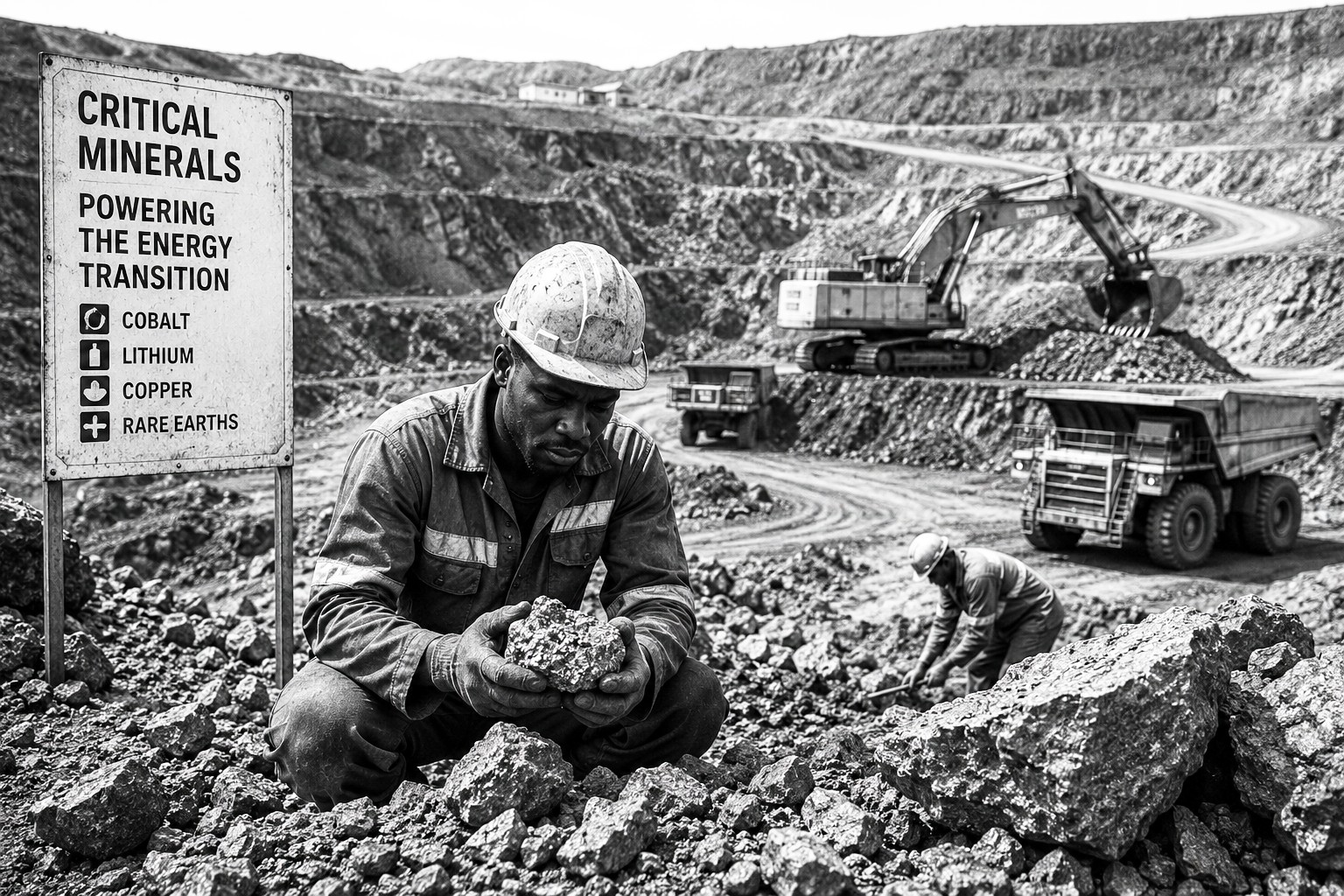
As governments and multinational corporations intensify efforts to secure access to critical minerals needed for the global energy transition, growing numbers of African policymakers, activists and analysts warn that the continent risks once again becoming the centre of a modern-day resource scramble driven by foreign powers.
Africa at the centre of the energy transition
The global push towards electric vehicles, battery storage, renewable energy infrastructure and advanced technology manufacturing has sharply increased demand for minerals such as lithium, cobalt, copper, graphite and rare earth elements.
Many of these strategically vital resources are heavily concentrated in Democratic Republic of the Congo, Zambia, Zimbabwe, Namibia and other African nations.

For supporters of the energy transition, these minerals are essential for reducing dependence on fossil fuels and building a lower-carbon global economy. Yet critics argue that the current investment rush increasingly resembles earlier eras when Africa’s raw materials were extracted primarily for the benefit of foreign economies.
Human rights advocates, including voices such as Deprose Muchena, have warned that many communities across Africa are experiencing a familiar pattern: foreign competition for strategic resources, weak local bargaining power and the risk that profits flow outward while environmental and social costs remain local.
Old patterns in a new global economy
Historically, Africa’s vast mineral wealth fuelled industrialisation in Europe and other regions during the colonial period, often leaving producing nations with limited infrastructure development or long-term economic diversification.
Today, critics argue that although the geopolitical landscape has changed, some economic structures remain strikingly similar. China, the United States, Europe, Gulf states and major multinational mining firms are all competing aggressively to secure long-term supply agreements and strategic mining partnerships across the continent.
At the same time, African governments are attempting to negotiate stronger local ownership rules, domestic processing requirements and industrial partnerships designed to avoid repeating past extraction models.
Several countries are now insisting that raw minerals should increasingly be processed locally rather than exported in unrefined form. Supporters say such policies could create jobs, strengthen industrial capacity and increase long-term national revenues.
Strategic competition intensifies
The growing competition for critical minerals is also becoming deeply geopolitical. Western governments increasingly view access to battery minerals as a matter of national security, particularly amid concerns about global supply-chain dependence and Chinese dominance in processing infrastructure.
This has accelerated investment activity across African mining regions, while simultaneously raising fears of corruption, political instability and intensified foreign influence over domestic policy.
Environmental concerns are also mounting. Mining projects linked to the green transition have sometimes generated criticism over land displacement, water usage, labour conditions and ecological damage — creating tension between climate goals and local realities.
A defining moment for Africa’s economic future
Many analysts argue that the current critical minerals boom could become either a transformative opportunity or a historic missed chance for African economies.
If managed effectively, Africa could leverage its resource position to build manufacturing industries, infrastructure networks and stronger fiscal systems tied to the global energy transition.
If not, critics warn the continent risks once again exporting strategic wealth while remaining dependent on external industrial powers.
As demand for critical minerals continues accelerating worldwide, Africa now finds itself at the centre of one of the defining economic and geopolitical contests of the twenty-first century.
Newshub Editorial in Africa – May 15, 2026

If you have an account with ChatGPT you get deeper explanations,
background and context related to what you are reading.
Open an account:
Open an account
Recent Comments