
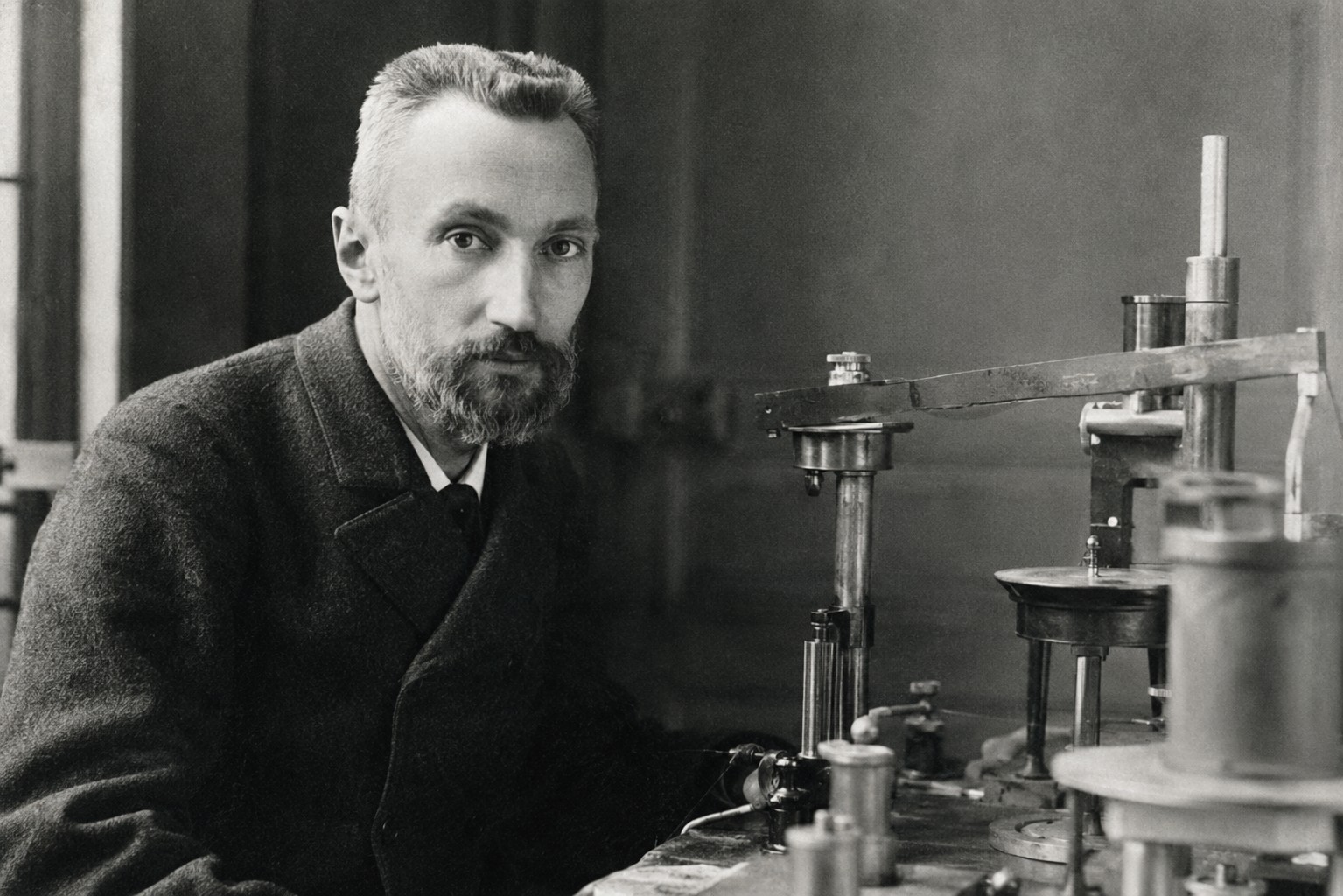
On this day, one of the most influential physicists in modern history was born. French scientist Pierre Curie, who shared the 1903 Nobel Prize in Physics with his wife Marie Curie and physicist Henri Becquerel, played a central role in the discovery and understanding of radioactivity — a field that would reshape science, medicine and industry throughout the 20th century.
A life devoted to science
Born in Paris on 15 May 1859, Pierre Curie showed scientific talent from an early age. Educated largely at home by his physician father, Curie entered higher education while still a teenager and quickly established himself as an exceptionally skilled experimental physicist.
Before his groundbreaking work on radioactivity, Curie had already made major contributions to crystallography and magnetism. Together with his brother Jacques, he discovered piezoelectricity — the ability of certain crystals to generate electrical charge under mechanical pressure — a principle still used today in microphones, ultrasound equipment and electronic devices.

Curie’s work was characterised not by flamboyance or self-promotion, but by precision, patience and relentless curiosity. Colleagues often described him as intensely focused, modest and deeply committed to scientific truth.
The partnership that changed physics
Pierre Curie’s marriage to Marie Curie became one of the most famous scientific partnerships in history. Working together in difficult laboratory conditions, the couple investigated mysterious radioactive emissions first identified by Henri Becquerel.
Their research led to the discovery of two new elements: polonium and radium. The work was physically exhausting and dangerous, conducted long before the health risks of radiation exposure were fully understood. Yet their findings opened an entirely new scientific frontier.
In 1903, Pierre and Marie Curie, alongside Becquerel, were awarded the Nobel Prize in Physics for their pioneering investigations into radiation phenomena. It marked one of the defining moments in modern science and established radioactivity as one of the key fields of twentieth-century research.
The discoveries later contributed to advances in cancer treatment, nuclear energy, industrial imaging and atomic physics — developments that would influence both medicine and geopolitics for generations.
A legacy beyond the laboratory
Despite global recognition, Pierre Curie remained uncomfortable with fame and resisted commercialising scientific discoveries. The Curies famously refused to patent their radium extraction methods, believing scientific knowledge should remain open to humanity.
Pierre Curie died tragically in 1906 after being struck by a horse-drawn carriage in Paris. He was only 46 years old. Marie Curie would continue their scientific work and later become the first person ever to win two Nobel Prizes in different scientific fields.
Today, Pierre Curie is remembered not only as a Nobel laureate, but as one of the foundational figures of modern physics. His work helped humanity better understand the invisible forces inside matter itself — knowledge that ultimately shaped the modern technological era.
More than a century after his birth, the Curie name remains synonymous with scientific excellence, sacrifice and discovery.
Newshub Editorial in Europe – May 15, 2026

If you have an account with ChatGPT you get deeper explanations,
background and context related to what you are reading.
Open an account:
Open an account
Recent Comments