
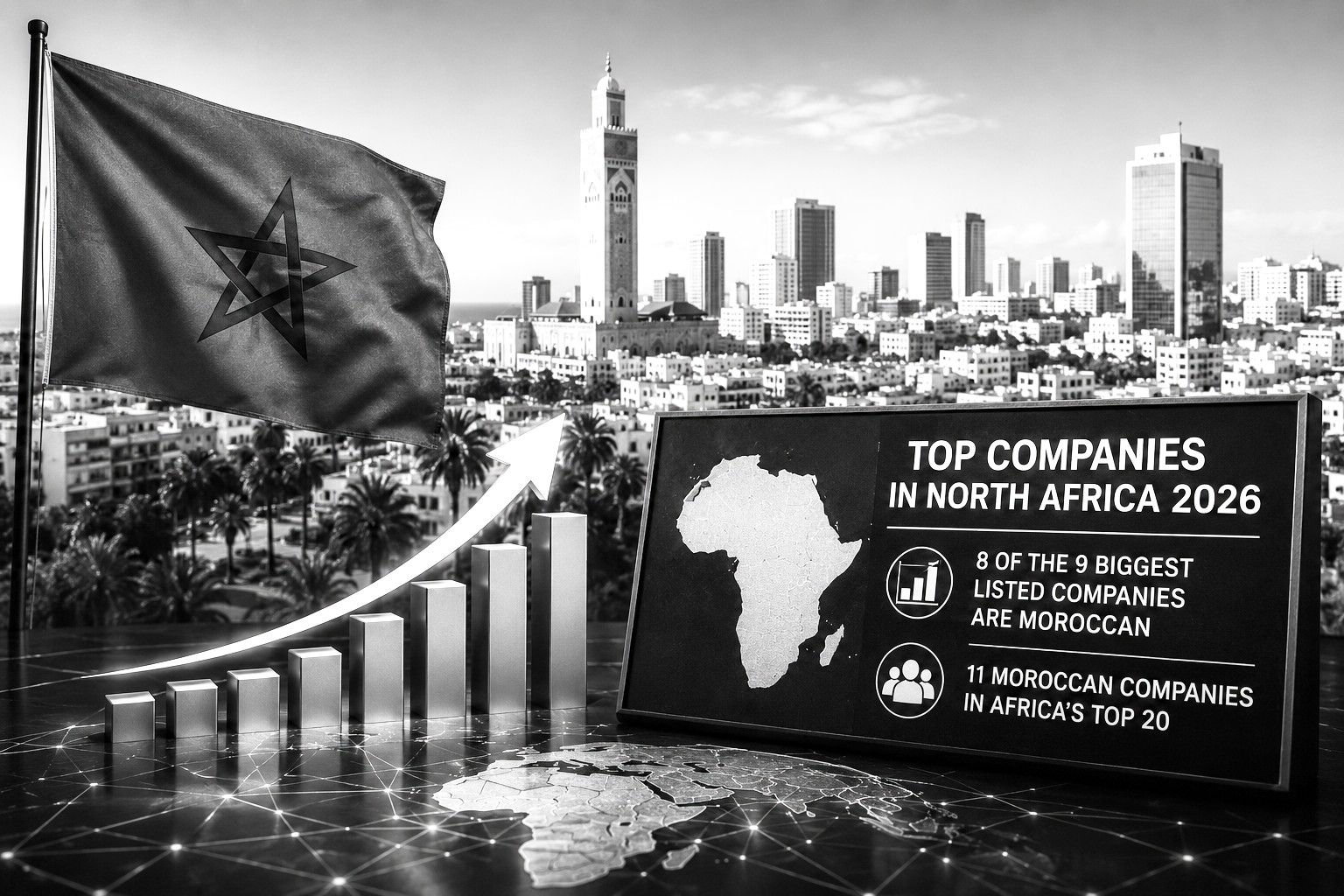
Morocco has firmly established itself as the economic and corporate powerhouse of North Africa in 2026, with Moroccan companies overwhelmingly dominating the region’s largest listed businesses. According to the latest regional rankings, eight of the nine biggest publicly traded companies in North Africa are now Moroccan, while 11 Moroccan firms have secured positions among Africa’s Top 20 listed corporations. The figures underline the country’s growing financial influence, industrial diversification and strategic role as a gateway between Africa, Europe and the Middle East.
The dominance reflects years of sustained investment in banking, telecommunications, infrastructure, renewable energy, manufacturing and logistics. Casablanca continues strengthening its position as one of Africa’s most important financial centres, attracting international investors seeking exposure to stable African growth markets.
Moroccan banking groups remain among the continent’s most influential financial institutions. Several have expanded aggressively across West and Central Africa over the past decade, building regional footprints that now stretch across dozens of countries. Their growth has helped position Morocco as a major exporter of financial services into emerging African economies.

Industrial expansion strengthens Morocco’s position
Morocco’s rise has not been limited to finance. The country has developed into a major industrial and manufacturing hub, particularly within automotive production, aerospace components and renewable energy infrastructure.
Automotive exports continue playing a critical role in the national economy, with Morocco increasingly integrated into European supply chains. Global manufacturers have expanded operations around Tangier and Kenitra, benefiting from relatively competitive labour costs, political stability and advanced logistics infrastructure connecting Africa with Europe.
The renewable-energy sector has also contributed significantly to investor confidence. Morocco remains one of Africa’s leaders in solar and wind energy development, reducing energy dependence while positioning itself as a future exporter of green industrial capacity.
North African contrast becomes clearer
The latest rankings also highlight widening economic divergence within North Africa. While Morocco’s listed companies continue expanding regionally and internationally, several neighbouring economies remain constrained by political uncertainty, energy dependence or slower structural reforms.
Egypt still maintains a significant corporate presence within the region, but inflationary pressure, currency weakness and debt concerns have complicated market conditions. Algeria, despite substantial hydrocarbon wealth, continues facing challenges in diversifying its economy and expanding private-sector capital markets.
Tunisia meanwhile remains under economic strain amid ongoing fiscal and political difficulties, limiting the ability of local corporations to compete at the same scale as their Moroccan counterparts.
A continental gateway strategy
Morocco’s broader strategic ambition extends beyond North Africa itself. The kingdom has spent years positioning itself as a commercial bridge between Europe and Africa, combining strong diplomatic ties, major port infrastructure and expanding financial networks.
Projects linked to logistics, transport corridors and digital infrastructure are helping Moroccan corporations strengthen their presence across French-speaking Africa. Investors increasingly view Morocco not only as a domestic market but also as a regional operational base for wider African expansion.
The latest corporate rankings therefore reflect more than stock-market performance alone. They signal a long-term structural shift in African business leadership, with Morocco increasingly emerging as one of the continent’s most influential economic centres.
Newshub Editorial in Africa – May 10, 2026

If you have an account with ChatGPT you get deeper explanations,
background and context related to what you are reading.
Open an account:
Open an account
Recent Comments