
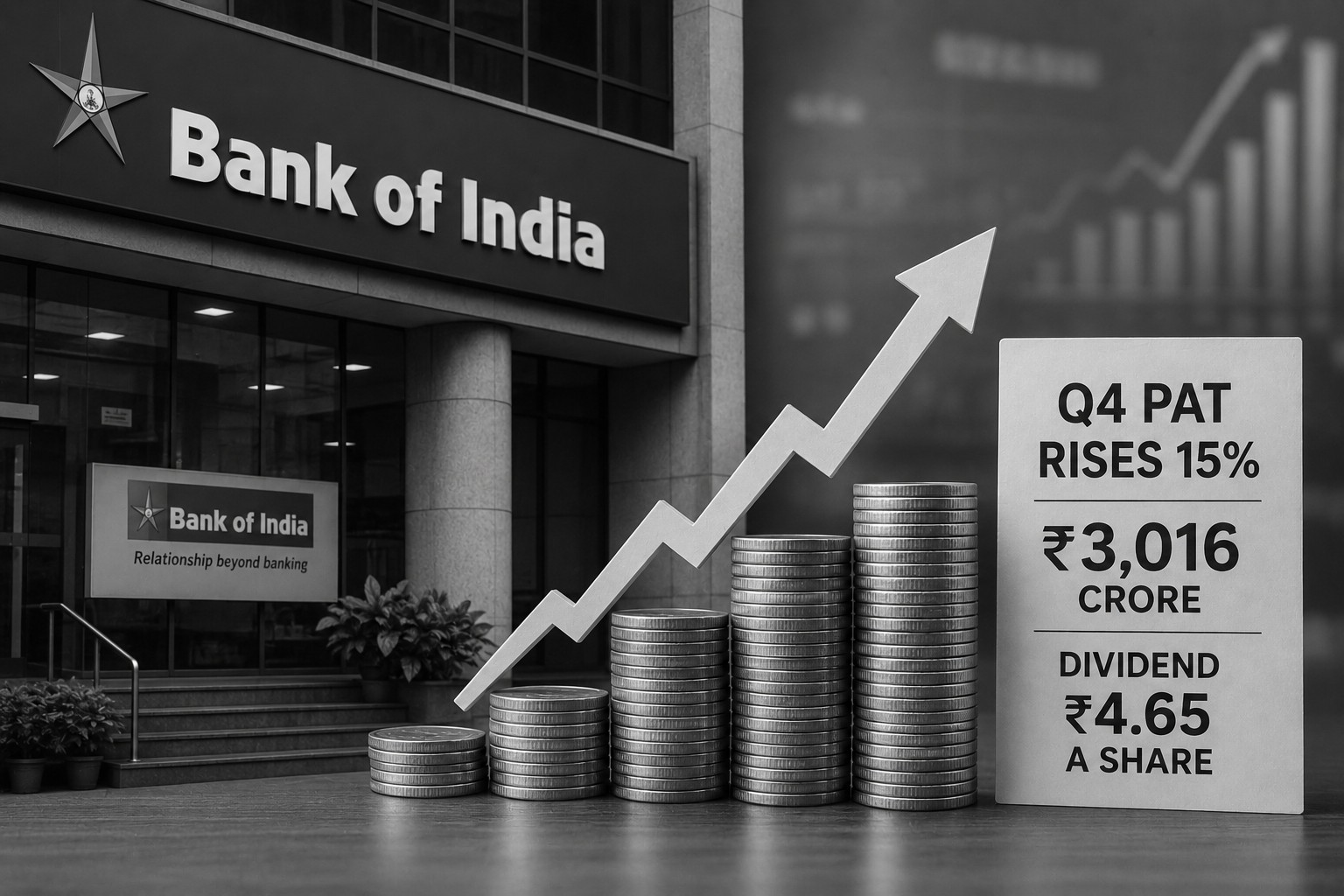
Bank of India reported a 15% year-on-year increase in fourth-quarter net profit, with profit after tax rising to ₹3,016 crore for the January–March 2026 period. The state-owned lender also announced a dividend of ₹4.65 per share, reflecting improved profitability, stronger asset quality and continued momentum in India’s banking sector.
The latest results underline the broader resilience of Indian banks as credit growth, retail lending and infrastructure financing continue supporting earnings across the financial system. Investors responded positively to the results, with analysts highlighting stable margins and improving balance-sheet conditions despite ongoing global economic uncertainty.
Bank of India’s quarterly performance was supported by stronger interest income and lower provisioning pressure compared with earlier periods. The lender also benefited from continued growth in corporate and retail lending, particularly within infrastructure, small business and consumer finance segments.

Asset quality continues improving
One of the key themes in the latest earnings report was continued improvement in asset quality. Gross non-performing assets declined further compared with the previous year, while the bank’s provision coverage ratio strengthened.
Indian public-sector banks have spent several years cleaning up legacy stressed assets following previous credit cycles tied to infrastructure and industrial lending. Stronger regulatory oversight and improved recovery mechanisms have helped many lenders stabilise their balance sheets.
Bank of India’s management indicated that credit demand remains healthy across several sectors of the economy, particularly manufacturing, renewable energy, transport infrastructure and digital services.
The bank also continued expanding its digital banking operations, reflecting wider structural changes within India’s financial sector as consumers increasingly shift toward mobile banking and online transactions.
India’s banking sector remains in focus
India’s banking industry has emerged as one of the country’s strongest-performing sectors in recent years, supported by economic growth, rising formalisation and increasing financial inclusion.
Public-sector lenders in particular have experienced improving profitability after years of restructuring and recapitalisation. Strong domestic demand and major government infrastructure projects have contributed to higher credit expansion across the economy.
At the same time, Indian banks remain relatively insulated from some of the pressures affecting Western financial institutions, including slower growth and higher exposure to international market volatility.
Investors are increasingly viewing Indian financial institutions as long-term beneficiaries of the country’s broader economic expansion and digital transformation.
Dividend signals confidence
The ₹4.65 per-share dividend announcement was interpreted by markets as a signal of management confidence regarding the bank’s capital position and future earnings outlook.
Dividend payments have become an increasingly important factor for investors evaluating India’s state-owned banks, many of which are now returning to stronger profitability after extended restructuring periods.
Looking ahead, analysts expect India’s banking sector to remain closely tied to domestic infrastructure spending, consumer demand and broader economic growth trends. While global market conditions remain uncertain, India’s internal growth dynamics continue providing support for lenders focused primarily on the domestic economy.
Newshub Editorial in Asia – May 10, 2026

If you have an account with ChatGPT you get deeper explanations,
background and context related to what you are reading.
Open an account:
Open an account
Recent Comments