
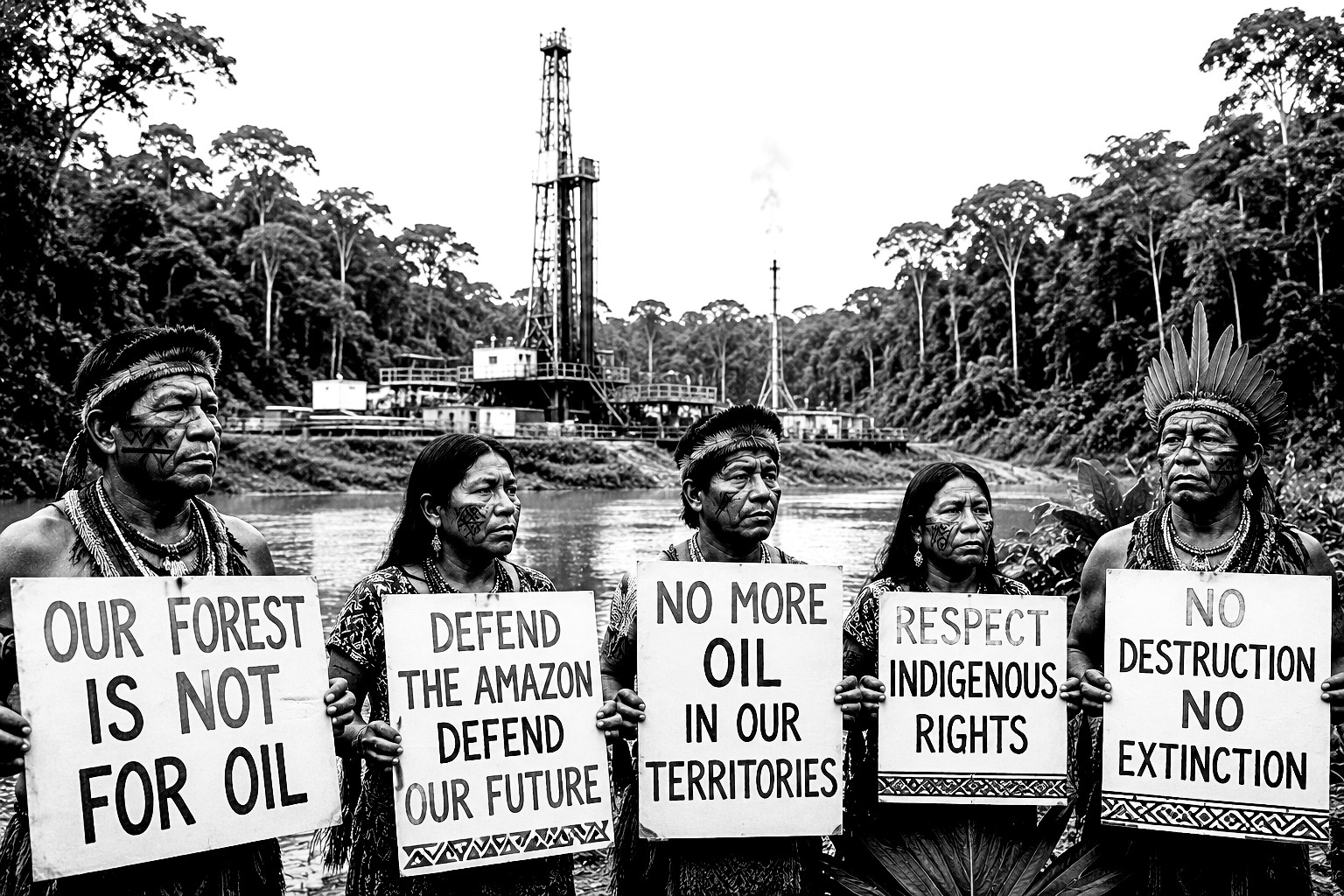
Indigenous organisations across South America are warning that expanding oil projects in the Amazon rainforest are placing growing pressure on international commitments to phase out fossil fuels. Leaders from Indigenous nations in Ecuador, Peru and Brazil argue that continued petroleum development in one of the world’s most biodiverse ecosystems risks undermining climate alliances that have pledged to reduce dependence on fossil fuels over the coming decades.
The warnings were voiced during discussions surrounding the Santa Marta conference on transitioning away from fossil fuels, where Indigenous representatives criticised governments for publicly supporting climate goals while simultaneously approving new oil exploration and infrastructure projects inside Amazonian territories.
Indigenous leaders from Ecuador’s Pastaza region stated that expanding extraction activities threaten not only fragile ecosystems but also the survival of communities that have lived in the rainforest for generations. Several groups argued that international climate commitments lose credibility if new oil production continues accelerating in environmentally sensitive regions.

Amazon remains central to global climate concerns
The Amazon rainforest plays a critical role in global climate stability, biodiversity preservation and freshwater regulation. Scientists have repeatedly warned that continued deforestation and industrial expansion could push parts of the rainforest towards irreversible ecological damage.
Despite these concerns, several South American governments continue viewing oil production as economically necessary. Export revenues from energy projects remain important sources of state income, foreign currency and public financing, particularly in economies facing fiscal pressure and rising social spending demands.
Ecuador has become one of the focal points of the debate. While the country has publicly supported global climate discussions and sustainability initiatives, it also remains heavily dependent on oil exports for national revenue.
Peru and Brazil are facing similar tensions between economic development and environmental protection. Infrastructure expansion, mining, agriculture and energy production continue increasing pressure across large parts of the Amazon basin.
Indigenous groups challenge energy transition narrative
Indigenous representatives argue that the current energy-transition debate often excludes the communities most directly affected by extraction projects. Several leaders attending the conference said governments and corporations continue treating the Amazon primarily as a resource zone rather than a protected ecological system.
Activists also criticised international investors and multinational energy companies for supporting projects that may conflict with climate commitments announced at global environmental summits.
The dispute highlights a growing contradiction facing many developing economies. Governments are under pressure to support economic growth, employment and fiscal stability while simultaneously responding to demands for lower carbon emissions and stronger environmental protection.
Pressure grows on fossil fuel alliances
The controversy is also testing the credibility of international coalitions advocating for fossil fuel reduction. Environmental groups argue that approving new oil fields while discussing climate transition policies risks weakening public confidence in long-term decarbonisation strategies.
Several climate-focused alliances involving Latin American countries have promoted gradual transition frameworks rather than immediate production shutdowns. However, critics warn that continued expansion of oil infrastructure could lock countries into long-term fossil fuel dependence for decades.
Meanwhile, Indigenous organisations are increasingly gaining international visibility and political influence within environmental debates. Their role in defending rainforest territories has become central to broader discussions surrounding biodiversity, carbon emissions and sustainable development.
As pressure grows ahead of future climate negotiations, the conflict between economic necessity and environmental protection inside the Amazon is likely to remain one of the defining geopolitical and ecological debates facing South America.
Newshub Editorial in South America – May 10, 2026

If you have an account with ChatGPT you get deeper explanations,
background and context related to what you are reading.
Open an account:
Open an account
Recent Comments