
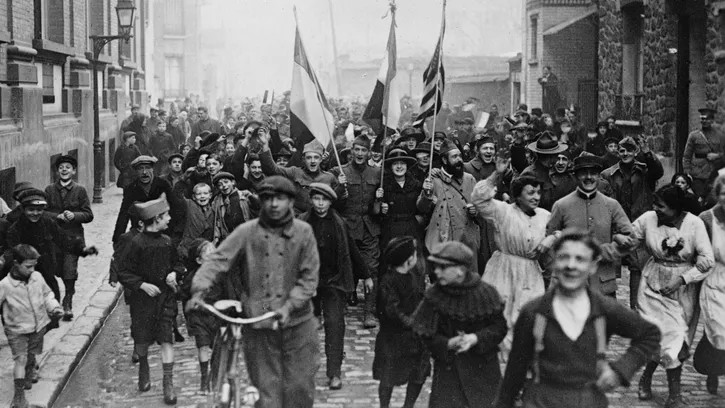
The First World War, one of the deadliest conflicts in human history, came to an end on 11 November 1918 when Germany signed an armistice agreement with the Allied powers, marking the cessation of hostilities on the Western Front and the close of a four-year global catastrophe.
A long and costly war
The conflict, which began in July 1914 following the assassination of Archduke Franz Ferdinand of Austria, rapidly expanded as alliances drew much of the world into war. Fought primarily across Europe but also extending to Africa, the Middle East, and Asia, it claimed an estimated 17 million lives — soldiers and civilians alike — and left much of the continent in ruins. Trench warfare, chemical weapons, and artillery bombardments defined the fighting, creating a brutal and static front that devastated entire generations.
The Armistice of Compiègne
Negotiations between Germany and the Allies culminated in the signing of the Armistice of Compiègne at 5:00 a.m. on 11 November 1918, inside a railway carriage in the French forest of Compiègne. The agreement called for the cessation of hostilities at 11:00 a.m. the same day — the origin of the phrase “the eleventh hour of the eleventh day of the eleventh month.” When the guns finally fell silent, soldiers along the front expressed both disbelief and exhaustion. Bells rang across Allied nations, signalling the long-awaited peace.

Political upheaval and new beginnings
Germany’s Kaiser Wilhelm II had abdicated just two days earlier, paving the way for the proclamation of the German Republic. Across Europe, empires disintegrated: Austria-Hungary collapsed, the Ottoman Empire faced partition, and Russia, already out of the war after the 1917 revolution, entered a period of civil conflict. The map of Europe was redrawn, and new nations emerged from the ruins of imperial rule.
Legacy of the Great War
The armistice did not mark a lasting peace. The Treaty of Versailles, signed the following year, imposed heavy reparations on Germany and sowed deep resentment that would later contribute to the rise of extremism and the outbreak of the Second World War. Still, the end of World War I symbolised the first collective attempt to end industrial-scale warfare, giving birth to international efforts such as the League of Nations and, eventually, the modern concept of global diplomacy.
Newshub Editorial in Europe – 11 November 2025
Recent Comments