
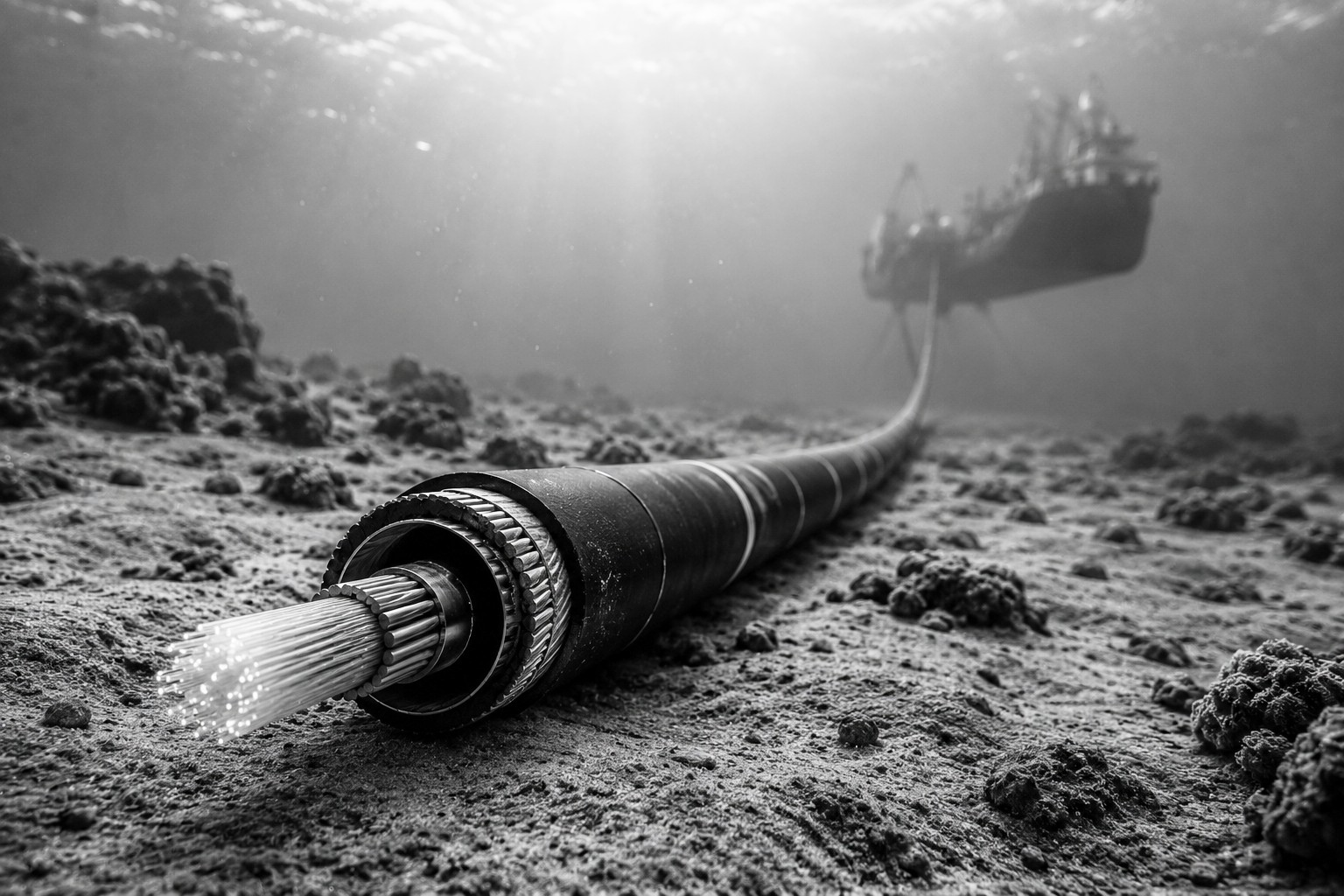
Every second, trillions of dollars in financial transactions, private communications, military signals and corporate data move silently through thousands of kilometres of fibre-optic cables lying on the ocean floor. While satellites often dominate public imagination, it is these largely invisible underwater systems that form the true backbone of the modern global economy.
Stretching across the Atlantic, Pacific, Indian Ocean and Arctic routes, submarine communication cables now carry more than 95% of the world’s international internet traffic. From stock market transactions in New York and London to video calls between Asia and Europe, global connectivity depends on a fragile network few people ever see.
The system has become one of the most strategically important pieces of infrastructure in the world — and increasingly one of the most vulnerable.

The hidden arteries of digital civilisation
The first undersea telegraph cables appeared in the 19th century, dramatically reducing communication times between continents. Today’s fibre-optic networks are vastly more advanced, capable of transmitting enormous volumes of information at near-instant speeds.
Modern submarine cables are typically no thicker than a garden hose, yet they carry the digital heartbeat of international banking systems, cloud computing, artificial intelligence networks and global commerce.
Technology giants including Google, Meta, Microsoft and Amazon have invested heavily in private cable infrastructure as demand for data capacity continues to surge.
The rise of AI and cloud computing has only intensified the importance of these systems. Massive datacentres across North America, Europe and Asia depend on uninterrupted high-capacity international connections.
Without submarine cables, the digital economy would effectively stop functioning.
A growing geopolitical battleground
As geopolitical tensions rise globally, submarine infrastructure has become an increasingly sensitive security concern.
Governments and military planners now view undersea cable systems as strategic assets critical to national security and economic stability. Damage to major cable routes can disrupt financial markets, communications systems and internet access across entire regions.
Recent incidents involving damaged Baltic Sea infrastructure and concerns over maritime sabotage have heightened fears around the vulnerability of global cable networks.
Many cables pass through narrow maritime chokepoints and politically sensitive waters, creating growing anxiety among Western and Asian governments alike.
At the same time, countries are competing for influence over the construction, ownership and routing of future cable systems. The infrastructure race is increasingly tied to broader technological and geopolitical competition between major powers.
Some analysts now describe submarine cables as the “new oil pipelines” of the digital age.
Invisible infrastructure powering financial markets
Financial systems are among the most dependent on low-latency cable networks. High-frequency trading firms spend billions of dollars to shave milliseconds off transaction speeds between global financial centres.
Entire market advantages can depend on how quickly information travels through undersea routes linking London, Frankfurt, Singapore, Tokyo and New York.
Cloud-based banking systems, payment processors and cryptocurrency exchanges also rely heavily on uninterrupted international connectivity.
As a result, cable disruptions can create immediate economic consequences far beyond simple internet outages.
Meanwhile, developing nations increasingly view submarine connectivity as essential national infrastructure capable of accelerating economic growth, digital services and foreign investment.
The network few people think about
Despite powering nearly every aspect of modern digital life, submarine cables remain largely invisible to the public.
Hidden beneath oceans and landing quietly on remote coastlines, they rarely attract attention unless something goes wrong.
Yet these silent fibres beneath the sea have become one of the defining infrastructures of the 21st century — supporting finance, communication, AI, commerce and geopolitics simultaneously.
As the world becomes more digital, interconnected and data-intensive, the importance of protecting and expanding this hidden network will only continue to grow.
The modern world may appear wireless on the surface. In reality, it still runs through cables at the bottom of the ocean.
Newshub Editorial in Europe – May 13, 2026

If you have an account with ChatGPT you get deeper explanations,
background and context related to what you are reading.
Open an account:
Open an account
Recent Comments