
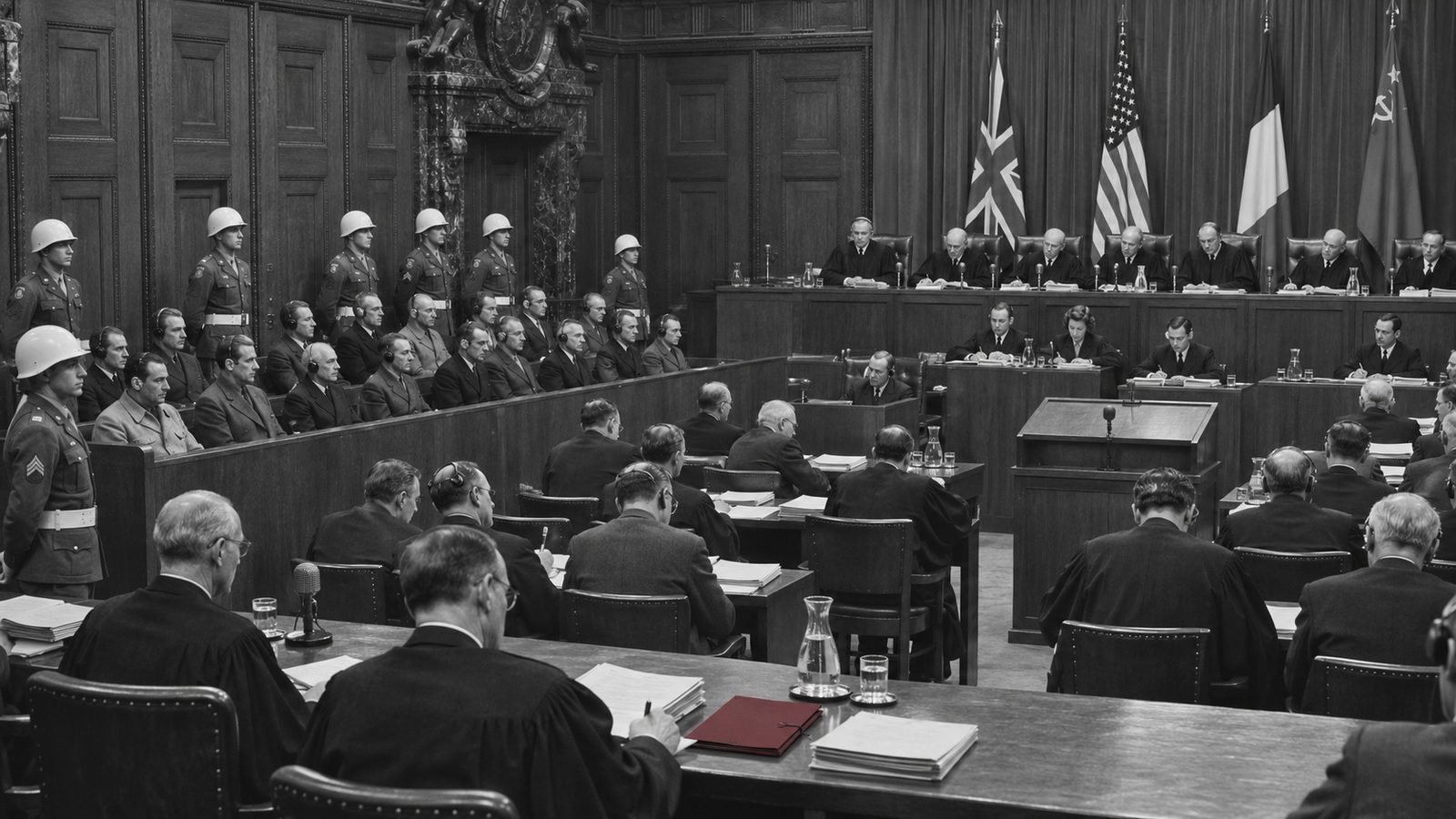
On 20 November 1945, the International Military Tribunal opened its trial of 22 leading figures of Nazi Germany at the Palace of Justice in Nuremberg. The proceedings brought together judges and prosecutors from four Allied powers and helped establish that individuals could be held criminally responsible under international law for acts committed on behalf of a state.
Four Allied powers establish the tribunal
Britain, France, the Soviet Union and the United States established the tribunal under the London Agreement in August 1945. Each country provided a judge and a prosecution team. The defendants included Hermann Göring, a senior figure in the Nazi regime, and Joachim von Ribbentrop, who had served as Germany’s foreign minister.
The indictment covered conspiracy, crimes against peace, war crimes and crimes against humanity. Prosecutors presented captured German records, witness testimony and film footage. The evidence traced how officials and institutions organised aggressive war, forced labour, deportations and mass murder. Defence lawyers could challenge the evidence, question witnesses and present their own cases.


Verdicts and subsequent trials
The trial concluded on 1 October 1946. The tribunal convicted 19 defendants and acquitted three. Twelve were sentenced to death, three received life sentences and four were given prison terms ranging from 10 to 20 years. Göring died by suicide before his scheduled execution.
Between 1946 and 1949, US military tribunals held 12 further trials in Nuremberg. Those proceedings examined the roles of doctors, judges, industrialists, military officers and other officials. The cases documented how persecution, forced labour and mass murder were carried out through institutions across Nazi Germany and occupied Europe.
A precedent for international justice
The tribunal’s charter made clear that holding public office did not shield a defendant from criminal responsibility. It also allowed judges to consider whether organisations such as the SS and the Gestapo were criminal. Many perpetrators of Nazi crimes were never prosecuted. The proceedings nonetheless created a public record of those crimes and set a precedent for later international criminal tribunals.
Newshub Editorial in Europe – 20 November 2026
On 20 November 1945, the International Military Tribunal opened its trial of 22 leading figures of Nazi Germany at the Palace of Justice in Nuremberg. The proceedings brought together judges and prosecutors from four Allied powers and helped establish that individuals could be held criminally responsible under international law for acts committed on behalf of a state.

Recent Comments