
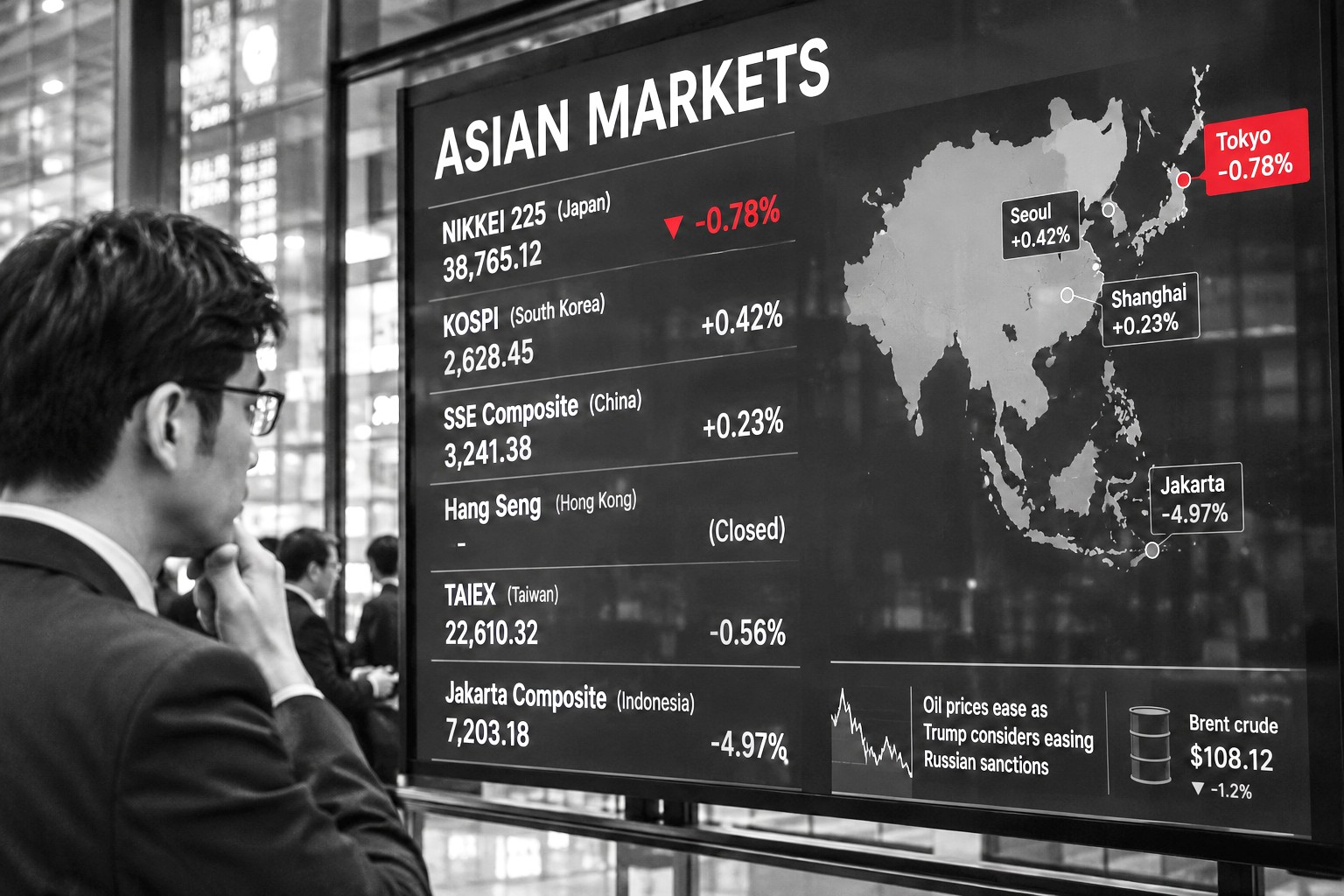
Asian stock markets began Monday, 19 October, under renewed pressure as investors weighed uncertainty surrounding artificial intelligence investments, elevated energy prices and geopolitical tensions. Japanese and Taiwanese equities declined, while South Korea recovered some recent losses and stronger-than-expected Chinese economic figures provided limited support to mainland markets.
Japan struggles as technology stocks retreat
Japan’s Nikkei 225 fell approximately 0.7–0.8% during early trading, with technology and semiconductor companies among the weakest performers.
Shares in Tokyo Electron and SoftBank came under selling pressure as concerns intensified over the enormous capital expenditure required to finance artificial intelligence infrastructure.


Investors are increasingly questioning whether future AI revenues will justify current valuations and borrowing levels.
China receives a growth boost
Chinese equities performed comparatively better after official figures showed the world’s second-largest economy expanding by 4.5% year-on-year during the third quarter, slightly exceeding expectations.
Retail sales increased by 1.1%, while industrial production grew by 5.5%.
The Shanghai Composite gained approximately 0.2%, while the CSI 300 edged 0.1% higher as the figures helped offset broader regional weakness.
Hong Kong’s stock market remained closed for a public holiday.
South Korea rebounds while Indonesia tumbles
South Korea’s Kospi recovered modestly following heavy losses in technology stocks during the previous week.
The rebound offered some relief to investors in major semiconductor producers, although concerns over AI valuations continued to dominate sentiment.
Indonesia experienced significantly greater pressure. Jakarta’s benchmark index fell around 5%, following warnings that MSCI could reconsider the country’s emerging-market classification.
Taiwanese equities also weakened amid continued volatility in the global semiconductor industry.
Oil prices provide temporary relief
Energy markets offered limited encouragement after Brent crude declined towards $108 a barrel.
The retreat followed President Donald Trump’s decision to consider easing sanctions affecting Russian energy exports, although uncertainty remains over the policy’s implementation.
Despite the decline, oil prices remain elevated because of the conflict involving Iran and continuing threats to shipping through the Strait of Hormuz.
Investors await corporate earnings
US stock futures strengthened during Asian trading, with Nasdaq 100 futures advancing approximately 1.3% and S&P 500 futures gaining 0.8%.
The coming wave of American technology earnings will provide an important test of whether artificial intelligence investments can deliver the profits investors expect.
Monday’s Asian session illustrated an increasingly divided regional market, with China’s economic resilience offering some support while expensive technology valuations, geopolitical uncertainty and high energy costs continue to limit confidence.
NewsHub Finance | Asian Markets | 19 October 2026
Asian stock markets began Monday, 19 October, under renewed pressure as investors weighed uncertainty surrounding artificial intelligence investments, elevated energy prices and geopolitical tensions. Japanese and Taiwanese equities declined, while South Korea recovered some recent losses and stronger-than-expected Chinese economic figures provided limited support to mainland markets.
Recent Comments