
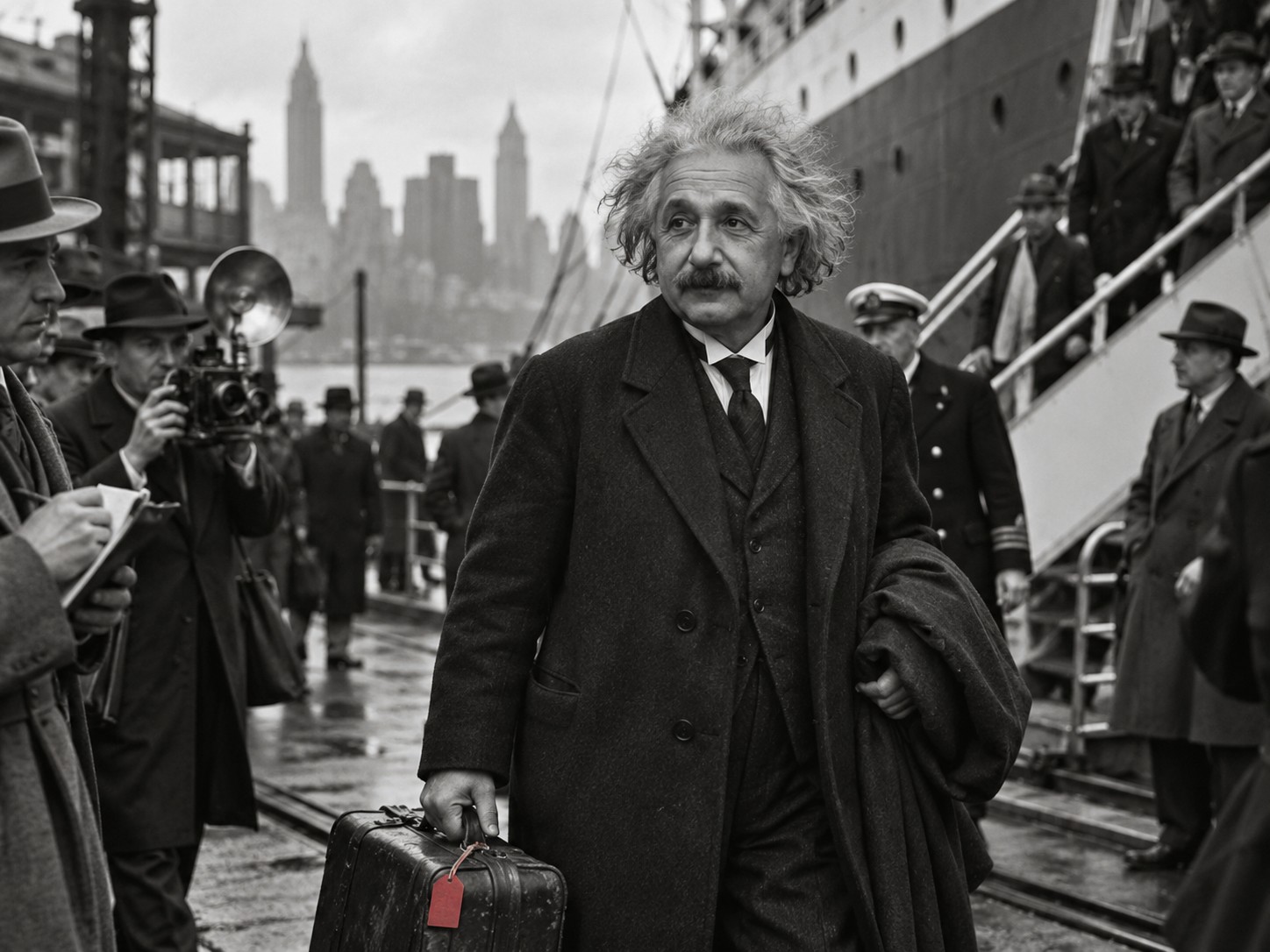
On 17 October 1933, Albert Einstein arrived in the United States as a refugee from Nazi Germany, marking a turning point in the history of modern science. The 54-year-old physicist, already internationally celebrated for his theory of relativity, would never return to live in Germany. His arrival symbolised both Europe’s intellectual exodus and America’s emergence as a global centre of scientific research.
Escaping Hitler’s Germany
When Adolf Hitler became German Chancellor in January 1933, Einstein was abroad. As a prominent Jewish scientist, outspoken pacifist and critic of nationalism, he had become a target of Nazi hostility.
His property in Germany was searched, his writings were publicly condemned, and threats against his life intensified. Einstein renounced his German citizenship and spent several months in Belgium and Britain before making his permanent move across the Atlantic.


His departure was part of a much larger migration of European intellectuals, scientists and academics fleeing political persecution.
An unexpected arrival in New York
Einstein arrived in New York Harbour aboard the ocean liner Westernland, accompanied by his wife Elsa and members of his professional staff.
Reporters and admirers were waiting to welcome the famous physicist, but the reception did not unfold as planned. Representatives of the Institute for Advanced Study arranged for Einstein to leave the ship discreetly by tugboat, avoiding the crowds and travelling directly towards Princeton, New Jersey.
There, he joined the recently established Institute for Advanced Study, an institution dedicated to fundamental research.
A new chapter in American science
Einstein’s appointment strengthened Princeton’s reputation and helped establish the United States as a destination for leading European researchers.
His scientific achievements had already transformed physics. His special theory of relativity, published in 1905, challenged conventional understandings of space and time, while his general theory of relativity, completed in 1915, fundamentally redefined gravity.
Einstein continued his theoretical research in Princeton and became an influential public voice on civil liberties, international cooperation and nuclear weapons.
In 1939, he signed a letter to President Franklin D. Roosevelt warning about the possibility of Nazi Germany developing atomic weapons, helping prompt American nuclear research.
A legacy beyond physics
Einstein became an American citizen in 1940 and remained in Princeton until his death on 18 April 1955.
His arrival on 17 October 1933 represented more than the relocation of one extraordinary scientist. It reflected the devastating consequences of political persecution for European intellectual life and the growing importance of the United States in global scientific development.
Ninety-three years later, Einstein’s journey remains a powerful historical example of how scientific progress, migration and freedom of thought are interconnected.
NewsHub Finance | History & Science | 17 October 2026
On 17 October 1933, Albert Einstein arrived in the United States as a refugee from Nazi Germany, marking a turning point in the history of modern science. The 54-year-old physicist, already internationally celebrated for his theory of relativity, would never return to live in Germany. His arrival symbolised both Europe's intellectual exodus and America's emergence as a global centre of scientific research.
Recent Comments