
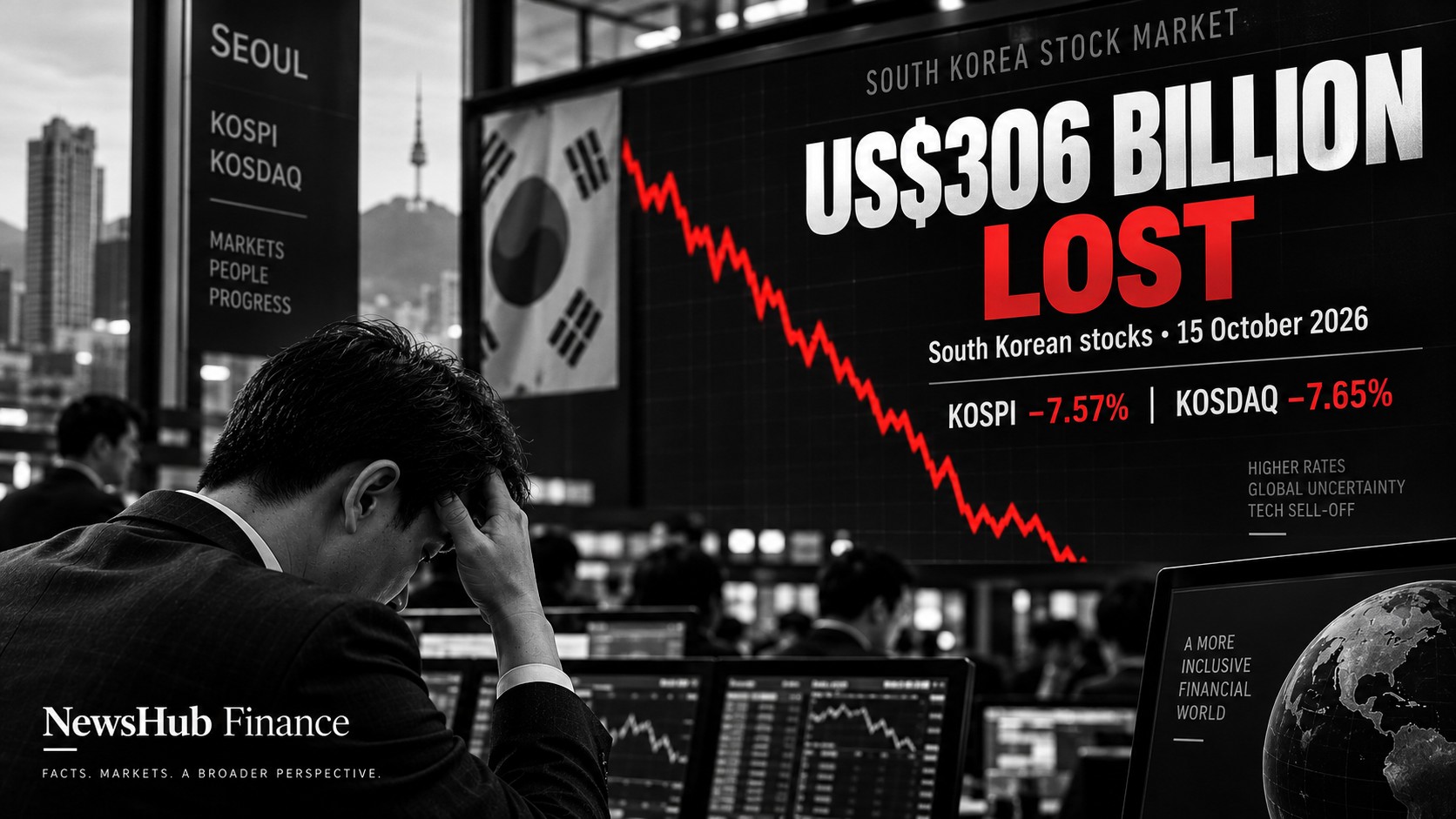
Asian stock markets suffered one of their most severe trading sessions of 2026 on Thursday, 15 October, as a technology-led collapse erased hundreds of billions of dollars in market value. South Korea alone lost approximately US$306 billion in equity capitalisation, while Japan, Taiwan and other regional markets recorded sharp declines amid renewed concerns about inflation, interest rates and the sustainability of artificial intelligence investment.
South Korea: US$306 billion disappears in one session
South Korea experienced the most dramatic losses, with the benchmark KOSPI plunging 7.57% to close at 5,554.22 points. The technology-focused KOSDAQ declined 7.65%.
Combined, the two exchanges lost approximately 410.9 trillion won in market capitalisation, equivalent to around US$306 billion at the prevailing exchange rate.


Trading became so volatile that circuit breakers temporarily halted activity.
Samsung Electronics declined approximately 9.5%, while semiconductor manufacturer SK Hynix lost 11.1%, reflecting mounting concerns about valuations across the artificial intelligence industry.
Japan and Taiwan: Semiconductor shares under pressure
Japan’s Nikkei 225 fell approximately 4.9%, closing at 64,425.95 points.
SoftBank Group, Tokyo Electron and other technology companies suffered substantial losses as investors reduced exposure to businesses closely associated with artificial intelligence infrastructure.
Taiwan’s benchmark TAIEX declined approximately 3.4%, extending the regional retreat despite continuing demand for advanced semiconductor technology.
The losses demonstrated how closely Asian equity markets have become connected through the global semiconductor supply chain.
Australia: A comparatively limited decline
Australia’s S&P/ASX 200 finished approximately 0.1% lower, near 8,719 points.
Although the broader market avoided the severe declines seen in Northeast Asia, mining and technology-related companies remained under pressure.
US inflation adds to investor uncertainty
The immediate catalyst was stronger-than-expected US inflation, which reached 3.7% annually in September.
The figures increased concerns that the Federal Reserve could maintain restrictive monetary policy or introduce further interest rate increases.
Higher borrowing costs are particularly significant for technology companies whose valuations depend heavily on expectations of future earnings.
The financial damage extends beyond South Korea
The confirmed South Korean market-capitalisation decline alone exceeded US$300 billion.
Losses across Japan, Taiwan, China and other regional exchanges added substantially to the financial damage, although a reliable combined dollar figure for the entire Asia-Pacific region has not yet been established.
Thursday’s sell-off underscored the vulnerability of global equity markets to changing expectations surrounding artificial intelligence, monetary policy and economic growth.
NewsHub Finance | Asian Markets & Global Economy | 15 October 2026
Asian stock markets suffered one of their most severe trading sessions of 2026 on Thursday, 15 October, as a technology-led collapse erased hundreds of billions of dollars in market value. South Korea alone lost approximately US$306 billion in equity capitalisation, while Japan, Taiwan and other regional markets recorded sharp declines amid renewed concerns about inflation, interest rates and the sustainability of artificial intelligence investment.
Recent Comments