
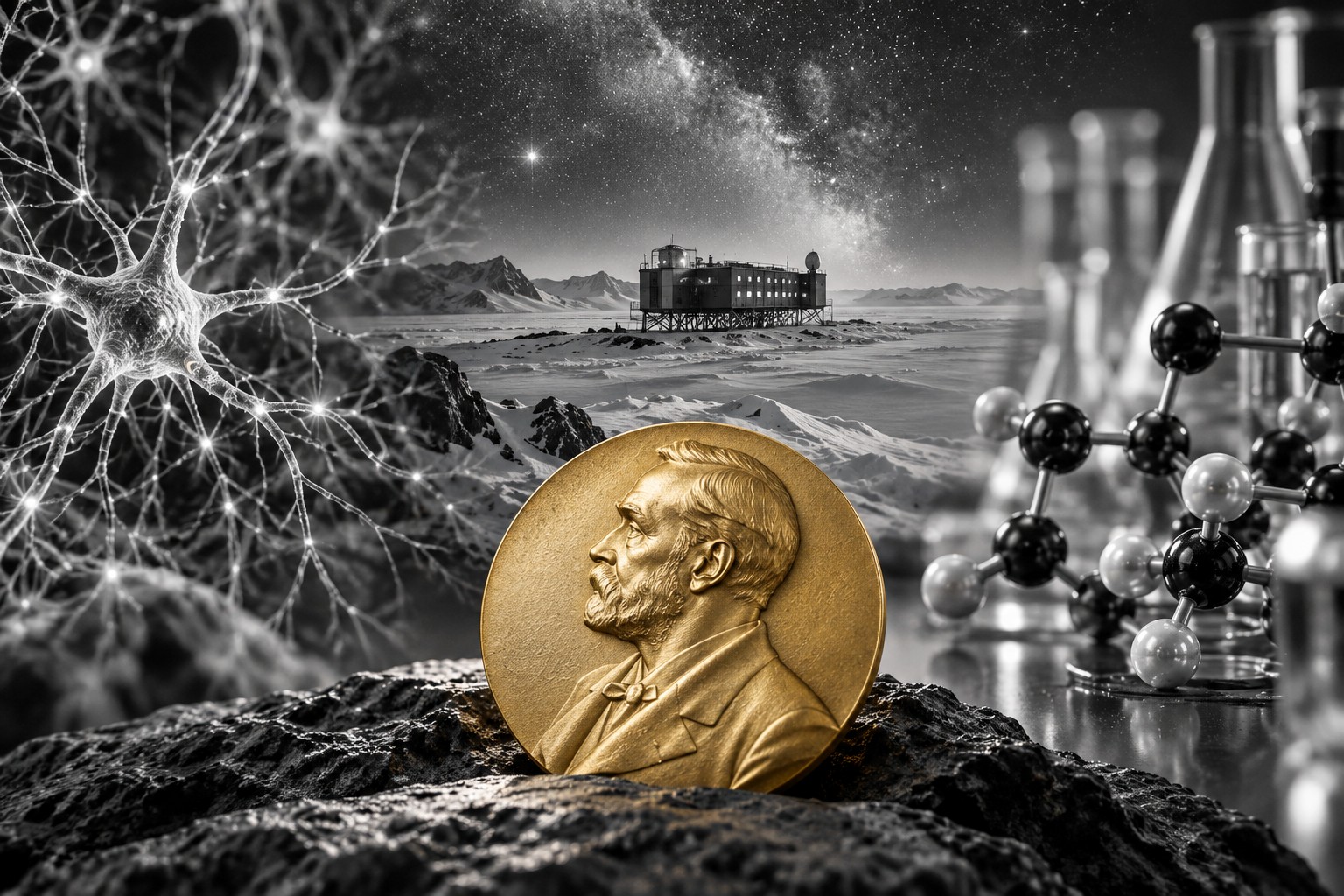
The first three Nobel Prizes of 2026 have recognised advances in neuroscience, astronomy and chemistry. By Wednesday lunchtime, 7 October, six scientists had been named across medicine, physics and chemistry, with literature, peace and economic sciences still to follow.
Medicine: controlling nerve cells with light
The Nobel Prize in Physiology or Medicine was awarded on Monday to Karl Deisseroth, Peter Hegemann and Georg Nagel for discoveries concerning light-gated ion channels and optogenetics.
Their work established a method for controlling nerve-cell activity using light, giving researchers a powerful tool for investigating how the brain functions.


Hegemann and Nagel’s research into light-sensitive proteins in algae provided the foundations. Deisseroth subsequently helped apply the approach to mammalian nerve cells, enabling scientists to examine the roles of particular cells and circuits.
The discoveries have transformed experimental neuroscience and opened new avenues for investigating neurological conditions.
Physics: observing the universe through Antarctic ice
Tuesday’s physics prize went to Francis Halzen, the Belgian physicist based at the University of Wisconsin–Madison, for his contributions to the IceCube Neutrino Observatory and the discovery of high-energy neutrinos originating beyond the Earth.
IceCube uses a cubic kilometre of Antarctic ice fitted with light sensors to detect the rare interactions of these elusive particles.
Because neutrinos can travel enormous distances through space, they provide information about powerful cosmic processes. Halzen’s scientific leadership helped establish a new way of observing the universe alongside conventional astronomy.
Chemistry: understanding molecular asymmetry
On Wednesday, Henri B. Kagan and Kenso Soai were awarded the chemistry prize for discoveries concerning non-linear effects and autocatalysis in asymmetric organic synthesis.
Their research concerns molecules that exist in mirror-image forms, a distinction that can strongly influence their biological behaviour.
The work has advanced understanding of how chemical reactions favour one form over another, with significance for pharmaceutical production and research into the molecular asymmetry associated with life.
Further announcements ahead
The literature prize is scheduled for Thursday, 8 October, followed by the Peace Prize on Friday, 9 October. The Sveriges Riksbank Prize in Economic Sciences in Memory of Alfred Nobel will conclude the announcements on Monday, 12 October.
The first three Nobel Prizes of 2026 have recognised advances in neuroscience, astronomy and chemistry. By Wednesday lunchtime, 7 October, six scientists had been named across medicine, physics and chemistry, with literature, peace and economic sciences still to follow.
Recent Comments