
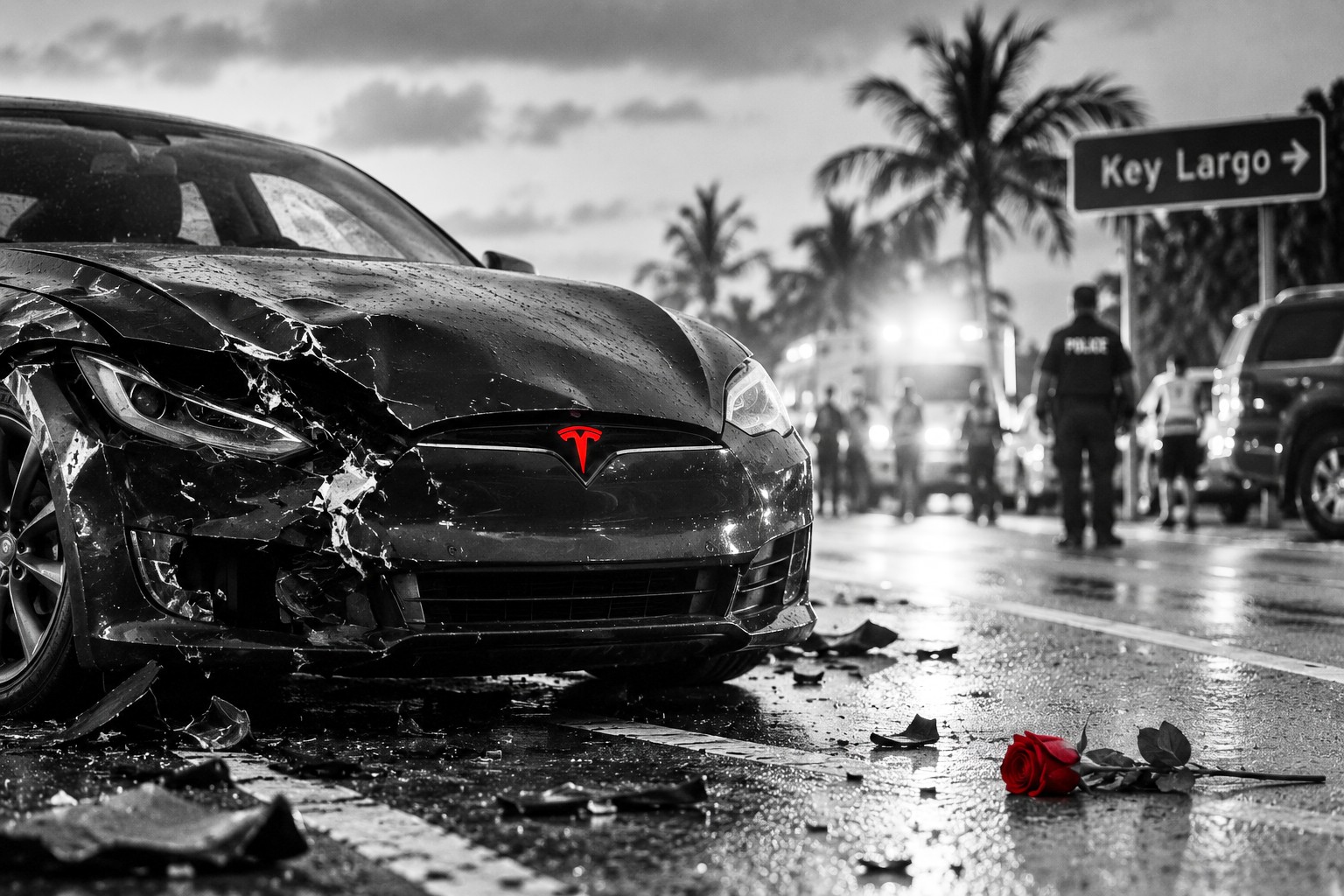
For years, the central legal question surrounding increasingly intelligent cars has been deceptively simple: when automated technology is driving and somebody dies, who is responsible — the human behind the wheel or the company that designed the system? A landmark US court case involving Tesla has produced one of the clearest answers yet. Sometimes, the responsibility can belong to both.
A fatal night in Florida
On 25 April 2019, George McGee was driving a Tesla Model S in Key Largo, Florida, using the company’s Enhanced Autopilot driver-assistance system.
McGee dropped his mobile phone and looked down to retrieve it. His Tesla continued through an intersection at approximately 62 mph — around 100 km/h — and struck a parked Chevrolet Tahoe.


Standing beside the vehicle were 22-year-old Naibel Benavides Leon and her boyfriend Dillon Angulo.
Benavides Leon was killed. Angulo survived with severe injuries.
The human was responsible — but not alone
Tesla argued that McGee was solely responsible. He had taken his eyes off the road, was speeding and had his foot on the accelerator.
The jury agreed that the driver carried most of the blame.
But not all of it.
In August 2025, a federal jury in Miami found McGee 67 per cent responsible and Tesla 33 per cent responsible for the crash. The jury concluded that a defect involving Autopilot had contributed to the accident.
That distinction could have consequences far beyond this individual collision.
Tesla has consistently maintained that Autopilot requires active driver supervision and does not make its vehicles autonomous.
The plaintiffs argued, however, that Tesla had allowed Autopilot to operate on roads for which it was not designed while promoting the technology in ways that could encourage drivers to place excessive confidence in its capabilities.
$243 million in damages
The financial consequences were substantial.
Jurors assessed total compensatory damages of approximately $129 million, with Tesla responsible for 33 per cent — about $42.6 million.
They then imposed an additional $200 million in punitive damages against Tesla.
That brought Tesla’s liability under the verdict to approximately $243 million.
The compensation covered the estate of Benavides Leon and the seriously injured Angulo. The driver had previously reached a separate settlement with the plaintiffs.
Tesla tried to overturn the verdict
Tesla challenged the decision and sought judgment in its favour or a new trial.
But on 19 February 2026, US District Judge Beth Bloom rejected that attempt.
The judge concluded that the evidence presented at trial more than supported the jury’s verdict and denied Tesla’s request to overturn it.
Tesla has maintained that the verdict is wrong and has indicated that it intends to appeal.
Other deaths have raised the same question
The Florida accident is not the only fatal collision associated with Tesla’s driver-assistance technology.
Other cases involving Autopilot have resulted in lawsuits, settlements or verdicts favouring Tesla. In one Florida case, Jeremy Banner died in 2019 when his Model 3, with Autopilot engaged, collided with a tractor-trailer. His family later reached a confidential settlement with Tesla after years of litigation.
The wider issue is therefore larger than one company or one accident.
Cars are increasingly making decisions traditionally made by humans: maintaining lanes, controlling speed, detecting obstacles and determining when to brake.
Yet systems such as Tesla Autopilot and Full Self-Driving (Supervised) still require human supervision.
That creates a new legal frontier.
When software becomes part of the driver
For decades, responsibility after a road accident was principally divided between drivers, vehicle owners, road authorities and manufacturers responsible for mechanical defects.
AI and automated driving complicate that equation.
If a driver becomes distracted because a system appears capable of controlling the vehicle, should the driver carry all responsibility?
If software fails to recognise a dangerous situation, is that a product defect?
And if a manufacturer knows that consumers may misunderstand the limits of its technology, how much responsibility does it have to prevent foreseeable misuse?
The Florida jury effectively answered that responsibility does not necessarily have to belong exclusively to either human or machine.
A driver can make a catastrophic mistake while the technology manufacturer can simultaneously bear part of the legal responsibility.
That may prove to be the most important consequence of the Tesla verdict.
As vehicles become more intelligent, courts will increasingly have to decide not merely who was driving the car — but who, or what, was making the decisions.
Newshub Editorial in North America – 15 September 2026

Ask NF GPT
If you have an account with ChatGPT you get deeper explanations,
background and context related to what you are reading.
For years, the central legal question surrounding increasingly intelligent cars has been deceptively simple: when automated technology is driving and somebody dies, who is responsible — the human behind the wheel or the company that designed the system? A landmark US court case involving Tesla has produced one of the clearest answers yet. Sometimes, the responsibility can belong to both.
Recent Comments