
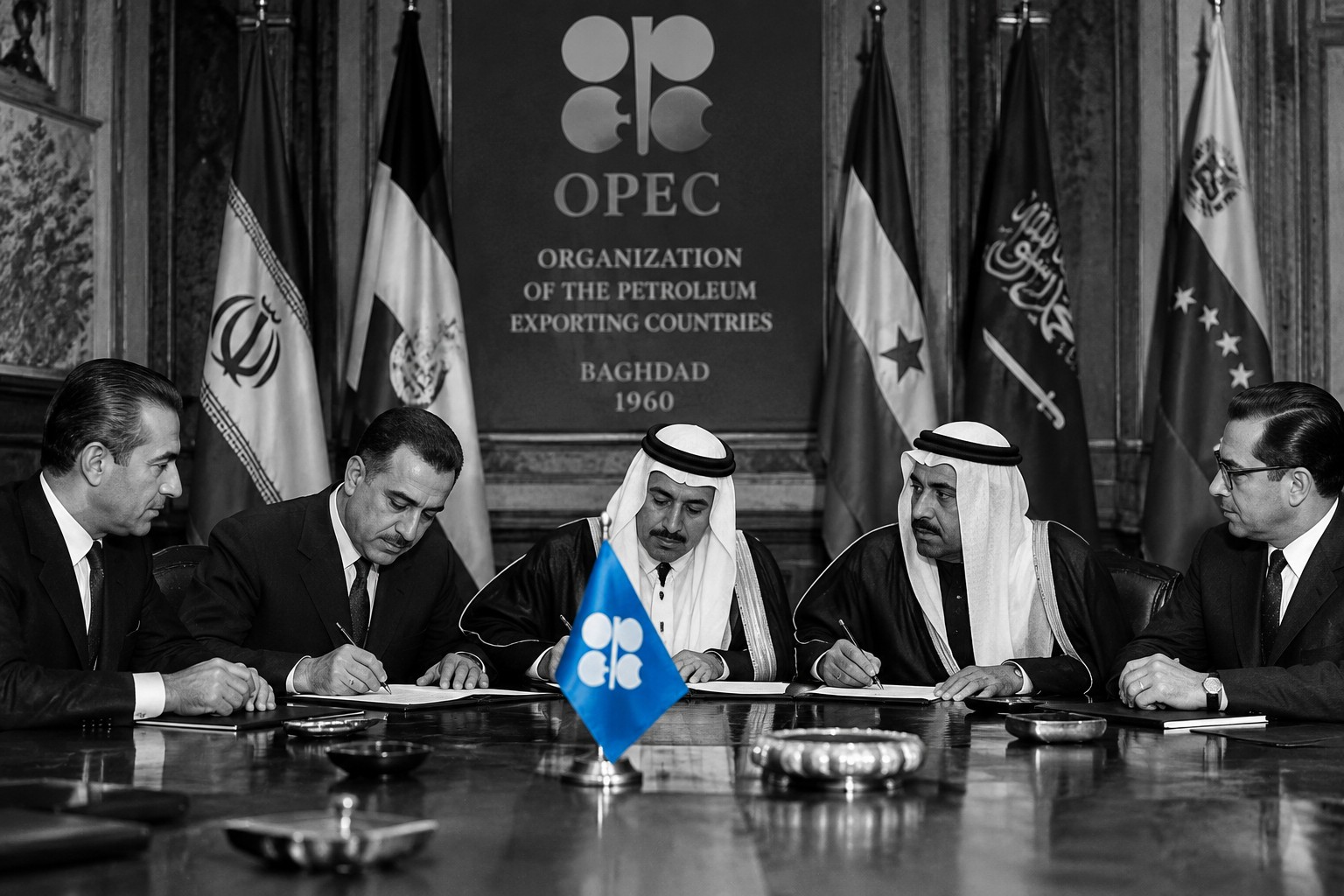
On this day in 1960, five oil-producing nations gathered in Baghdad and created an organisation that would fundamentally alter the balance of power in the global energy industry. Iran, Iraq, Kuwait, Saudi Arabia and Venezuela established the Organization of the Petroleum Exporting Countries — OPEC.
Representatives of the five countries met at Al-Shaab Hall in Baghdad between 10 and 14 September 1960. On 14 September, OPEC formally came into existence.
The organisation was born at a time when much of the international oil industry was dominated by large Western oil companies. Producing countries had relatively limited influence over pricing and over how their petroleum resources were developed and sold internationally.


A new balance of power
The five founding countries wanted greater sovereignty over their natural resources and a stronger collective position in negotiations with international oil companies.
Their representatives were Fuad Rouhani of Iran, Tala’at al-Shaibani of Iraq, Ahmed Sayed Omar of Kuwait, Abdullah Al-Tariki of Saudi Arabia and Juan Pablo Pérez Alfonzo of Venezuela. Despite differing national interests, they concluded that cooperation offered greater leverage than acting individually.
OPEC’s central objective was to coordinate and unify the petroleum policies of its members, while seeking stable prices, reliable supplies for consuming nations and reasonable returns for investors.
It was an ambitious idea.
The five founders were developing countries confronting some of the world’s most powerful corporations and industrial economies. Yet the organisation survived and gradually became one of the most influential institutions in the global energy market.
Oil becomes geopolitical power
The importance of OPEC became particularly visible during the 1970s, when oil moved to the centre of international economic and geopolitical affairs.
Control over production and supply demonstrated that petroleum-exporting nations possessed something far more powerful than simply another commodity.
They controlled a resource upon which much of the industrialised world depended.
The consequences reached far beyond petrol prices. Oil influenced inflation, currencies, government budgets, trade balances, foreign policy and ultimately the economic development of entire countries.
From Baghdad to the world
OPEC initially established its headquarters in Geneva before moving its Secretariat to Vienna in 1965. Other producing nations subsequently joined the organisation, transforming the original five-country alliance into a much broader force in international energy markets.
Its influence has risen and fallen as wars, recessions, new oil discoveries, technological developments and changing energy policies have transformed the global economy.
But the basic principle established in Baghdad has endured: oil-producing countries can exercise considerably greater influence when they coordinate their policies.
Sixty-six years after that meeting, the world is increasingly discussing renewable energy, electrification and the eventual transition away from fossil fuels.
Yet oil remains deeply embedded in the global economy.
And the organisation created by five developing nations in Baghdad on 14 September 1960 remains part of the architecture determining how that oil reaches the world.
Newshub Editorial in Middle East – 14 September 2026
On this day in 1960, five oil-producing nations gathered in Baghdad and created an organisation that would fundamentally alter the balance of power in the global energy industry. Iran, Iraq, Kuwait, Saudi Arabia and Venezuela established the Organization of the Petroleum Exporting Countries — OPEC.
Recent Comments