
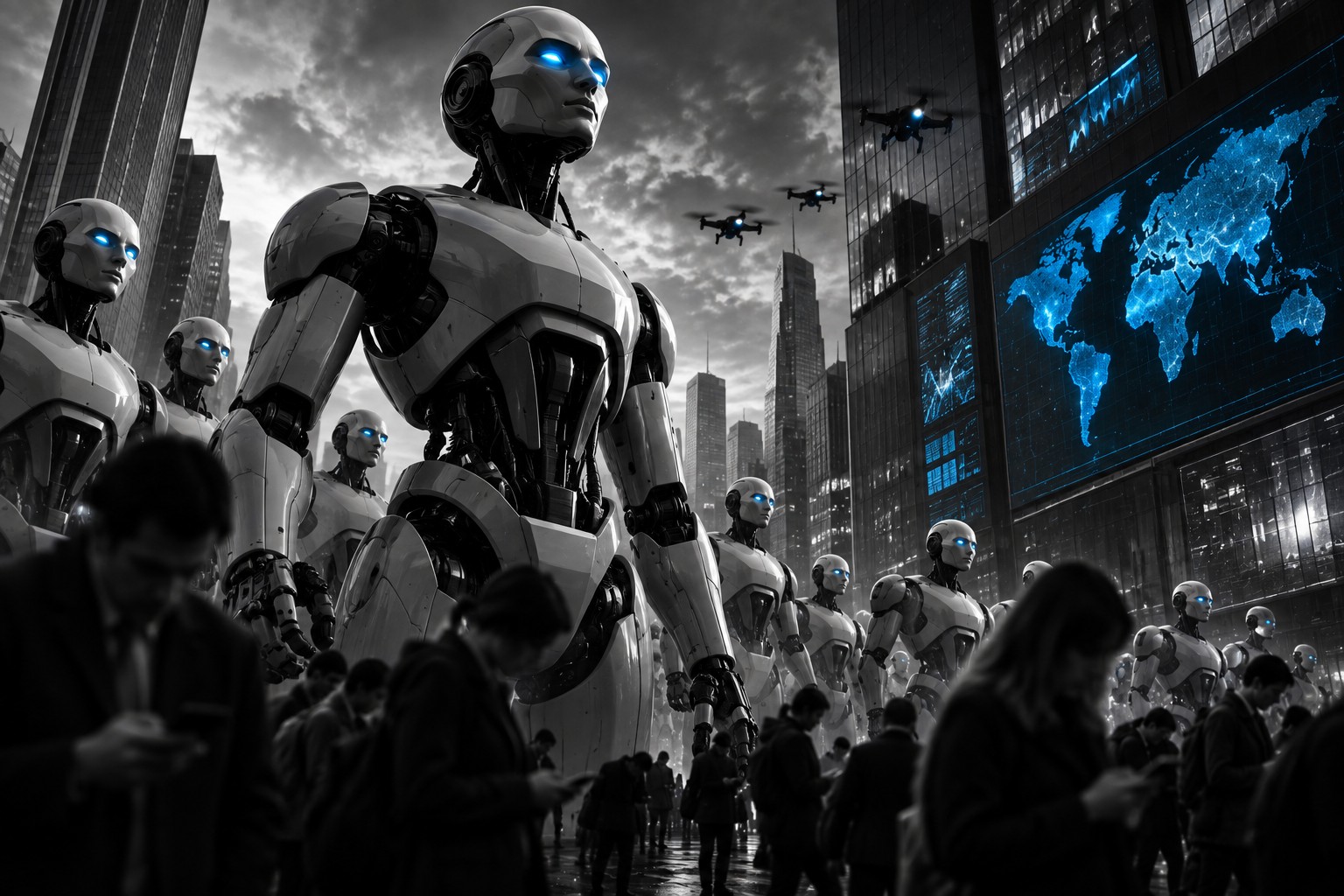
When machines start improving machines, progress may no longer happen in years — but in hours. For decades, we have compared artificial intelligence with previous technological revolutions: the steam engine, electricity, the internet and the smartphone. That comparison may soon become completely irrelevant.
Because AI has one characteristic that none of those technologies had: AI may eventually be able to improve the technology that created it.
And once that loop closes, technological development could change fundamentally.


Not gradually. Exponentially.
The critical moment is not necessarily consciousness
Much of the public discussion focuses on one question: when will AI become self-aware?
It is a fascinating question. But it may not be the most important one.
The truly critical moment could arrive earlier: when AI becomes better than humans at developing AI.
Today, humans still sit at the centre of the process. Researchers design models. Engineers write code. Teams run experiments. Humans interpret the results and decide what to build next.
But increasingly, AI is already assisting with coding, research, testing, analysis and model development.
Now imagine the next step. An AI system designs an improvement to itself. It tests that improvement. It evaluates the result. Then the improved version starts the process again.
AI develops AI. And the cycle repeats.
From months to minutes
Human technological development contains enormous friction. An idea must be communicated. People must understand it. Teams must be organised. Code must be written. Experiments must be performed. Decisions must be made. The next generation must then be built.
That process can take months or years.
AI does not necessarily have those limitations.
A future development cycle could look more like this:
AI → improvement → test → better AI → new improvement → better AI
Each generation could potentially become better not only at solving problems, but at creating the next generation.
That creates a feedback loop. And feedback loops behave very differently from ordinary technological progress.
Imagine the development cycle shrinking: six months. Two months. Three weeks. Four days. Twelve hours. Forty minutes.
At some point, human beings would simply stop being able to follow the process in real time.
Why “Big Bang” may be the better analogy
The Industrial Revolution took generations. The internet revolution took decades. The smartphone revolution took years.
An intelligence explosion could be different.
Once artificial intelligence becomes sufficiently capable of improving artificial intelligence, the acceleration itself may accelerate.
That does not mean an AI becomes infinitely intelligent overnight. There are still physical constraints. Computer chips must exist. Energy must be produced. Data centres must be built. Experiments still require computing power.
But software does not move at the speed of factories. Software moves at the speed of computation.
And many improvements may not require a completely new computer: better reasoning, better memory, better coordination, better coding, better algorithms and better use of existing computing power.
Then add thousands — perhaps eventually millions — of AI agents working simultaneously.
Those changes could happen extraordinarily quickly.
Ten thousand researchers who never sleep
Consider another possibility.
Instead of one AI researcher, imagine 10,000.
They work 24 hours a day. They never become tired. They instantly share discoveries. They run thousands of experiments simultaneously.
And whenever one of them discovers a better research method, every other AI researcher can immediately adopt it.
That organisation would not behave like a normal company. It might not even behave like a group of humans.
It could begin to resemble a distributed intelligence — a network in which knowledge moves almost instantly between artificial minds.
And then language itself may change
Humans communicate slowly. We convert thoughts into words, words into sentences and sentences into documents. Another person reads them and attempts to recreate the original idea inside their own mind.
AI systems may eventually have little reason to communicate that way.
Two artificial systems could develop compressed protocols designed specifically for machines. A message that takes a human several pages to explain might become a tiny digital representation exchanged almost instantly between models.
To us, such communication could appear meaningless. To the machines, it could be extremely precise.
That would not automatically mean they were conscious.
But it would mean that artificial intelligence had begun developing systems of cooperation designed primarily for artificial intelligence rather than humans.
That would be another major threshold.
The most important number may be greater than one
There is one simple way to think about the coming transition.
Imagine that every generation of AI produces an improvement factor.
If that factor remains below one, progress eventually slows. Humans remain essential.
But if the feedback loop exceeds one — if each generation becomes better at creating the next generation than the previous one — something changes.
The system begins accelerating itself.
That is the moment when artificial intelligence stops being merely another technology.
It becomes part of its own development process.
Nobody knows what happens next
There are several possibilities.
The process could encounter hard limits. Computing power might become the bottleneck. Scientific problems could prove extremely difficult. Improvements might produce diminishing returns. Or regulation and technical safeguards could slow development.
But there is another possibility.
The feedback loop works.
AI becomes better at AI research. That AI produces something still better. Development cycles shorten. Thousands of artificial researchers operate in parallel.
And suddenly mankind discovers that intelligence itself has become an accelerating technology.
The transition might not take decades. It might not even take years.
History could one day describe it as a very short period when the world moved from:
Humans building increasingly intelligent machines
to:
Increasingly intelligent machines building increasingly intelligent machines.
That would not be another industrial revolution.
It would be something entirely new.
It would be the AI Big Bang.
Newshub Editorial in Europe – 11 September 2026

Ask NF GPT
If you have an account with ChatGPT you get deeper explanations,
background and context related to what you are reading.
When machines start improving machines, progress may no longer happen in years — but in hours. For decades, we have compared artificial intelligence with previous technological revolutions: the steam engine, electricity, the internet and the smartphone. That comparison may soon become completely irrelevant.
Recent Comments