
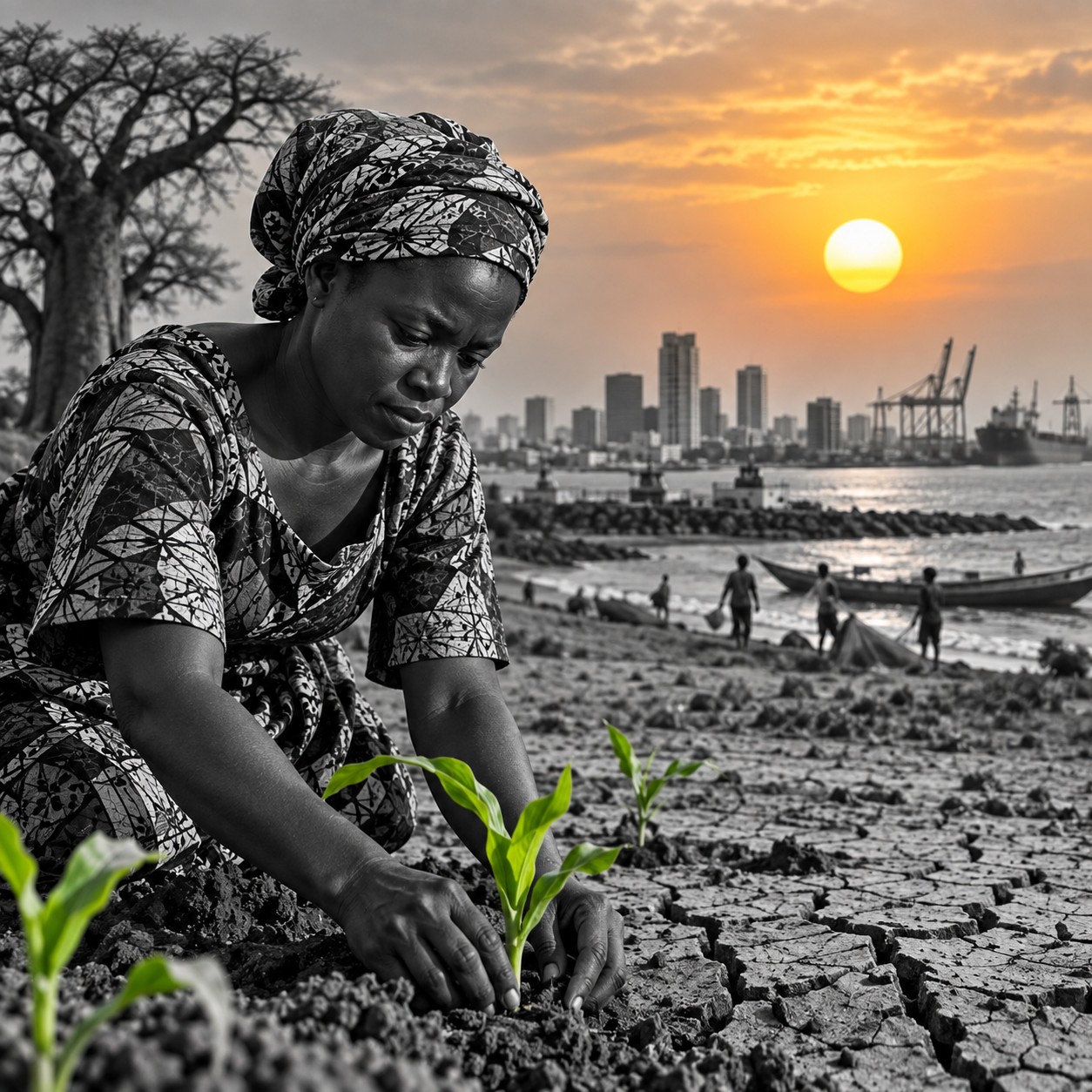
Climate change is no longer simply an environmental challenge for West Africa. Rising temperatures, unpredictable rainfall, flooding and coastal erosion are changing how farmers invest, where businesses operate and how governments allocate capital — gradually turning climate resilience into an economic necessity across the region.
Extreme heat changes agricultural economics
New research published in 2026 examining farming households in Ghana, Mali and Nigeria shows how extreme temperatures are already influencing economic decisions.
When exposure to temperatures above 32°C increases, farmers tend to reduce spending on productive inputs such as fertilisers while increasing their use of defensive products including pesticides, fungicides and herbicides.


That matters because agriculture remains a major source of employment and income across West Africa. Lower productivity can reduce household earnings, increase food prices and weaken rural economies.
Research in Senegal has similarly found that temperatures above 35°C during the growing season reduce both groundnut yields and farm profits.
The coastline carries enormous economic value
Climate pressure is equally visible along West Africa’s coast, where many of the region’s largest cities, ports and industries are concentrated.
Around one-third of West Africa’s population lives in coastal areas, which generate more than half of regional GDP.
The economic exposure is already substantial. A World Bank assessment estimated that flooding, erosion and pollution cost Benin, Côte d’Ivoire, Senegal and Togo approximately $3.8 billion in a single year.
Rising sea levels and more severe flooding threaten roads, ports, homes, tourism, fisheries and commercial property — transforming climate adaptation into an infrastructure and investment issue.
Adaptation creates a new economy
The response is also generating economic opportunities.
In 2026, the World Bank expanded its West Africa Coastal Areas programme, with new investments designed to protect more than 530,000 people while supporting approximately 13,000 jobs linked to the blue economy.
Investment is increasingly flowing towards coastal protection, resilient agriculture, irrigation, renewable energy, water management and climate-resistant infrastructure.
Growth increasingly depends on resilience
For West Africa, climate change creates an unusual economic equation.
Failure to adapt means declining agricultural productivity, damaged infrastructure and increasingly expensive disasters. Investment in adaptation, however, can generate employment, modernise infrastructure and attract international climate finance.
Climate resilience is therefore becoming part of the region’s economic development strategy rather than a separate environmental policy.
For emerging West African economies, the ability to adapt may increasingly determine not only how they manage climate change — but how quickly they can grow.
Newshub Editorial in Africa – 8 September 2026

Ask NF GPT
If you have an account with ChatGPT you get deeper explanations,
background and context related to what you are reading.
Climate change is no longer simply an environmental challenge for West Africa. Rising temperatures, unpredictable rainfall, flooding and coastal erosion are changing how farmers invest, where businesses operate and how governments allocate capital — gradually turning climate resilience into an economic necessity across the region.
Recent Comments