
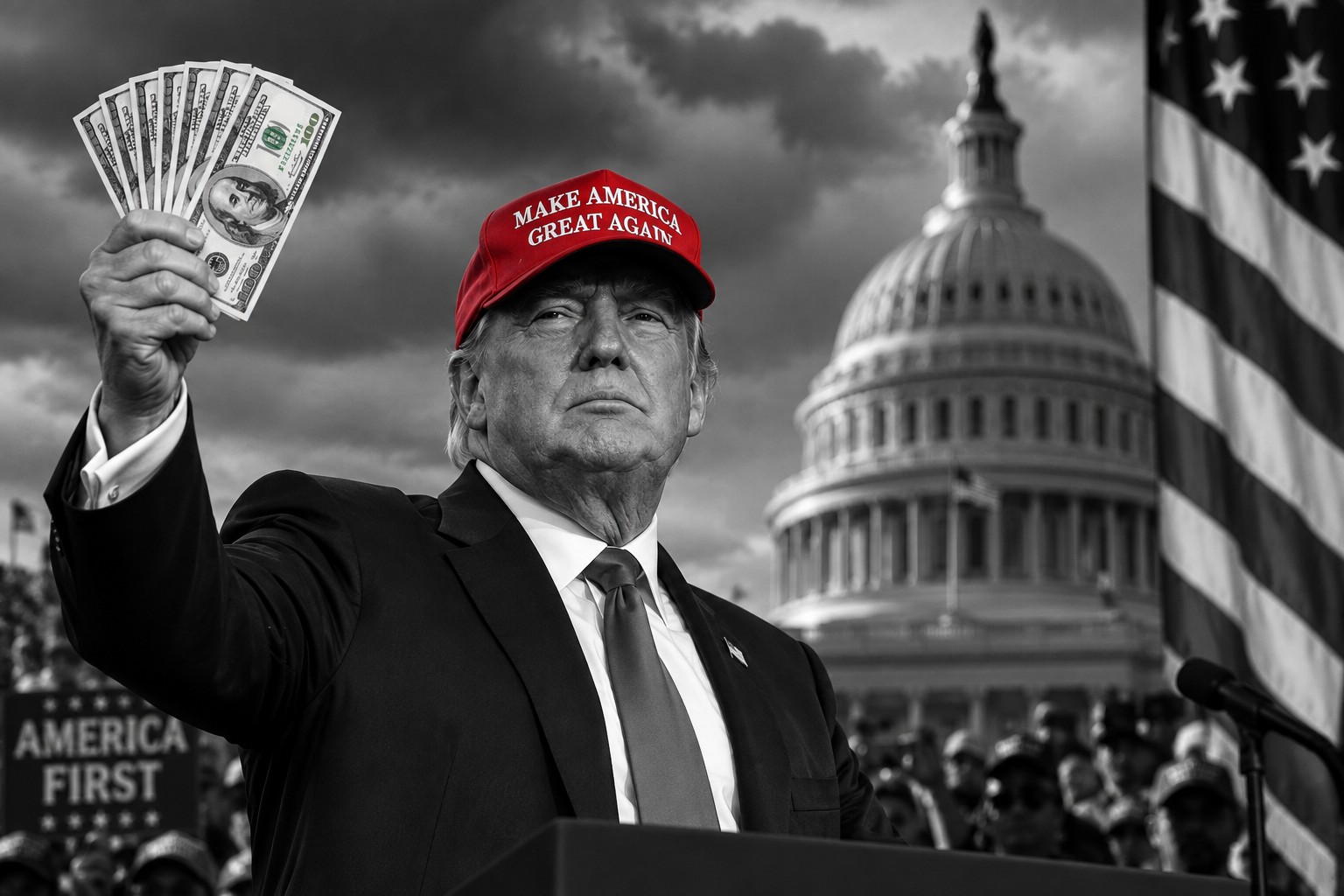
Donald Trump is not simply having a bad week. His administration is confronting a control crisis.
The symptoms are now visible across several systems at once.
The White House tried to exclude three major news organisations. A federal judge called the move likely unlawful viewpoint discrimination. A press secretary selected to improve the president’s message was gone within five days. Secret records exposed hundreds of millions of dollars in privately financed White House construction. An eight-month war with Iran drove Brent crude above $109 a barrel. Trump turned to Russia for diesel and then suspended sanctions he had signed into law only weeks earlier. A Russian spacecraft then made a deliberate close approach to a commercial satellite supporting Ukraine.


There is no public evidence that all these events were coordinated.
There is also no verified evidence that American news organisations have uncovered one hidden fact so explosive that it alone explains the president’s behaviour.
But the documented record supports a serious conclusion: several independent investigations and crises are converging on the same vulnerabilities — war costs, energy prices, private money, foreign influence and the possibility of congressional subpoenas.
The White House’s response has increasingly been to restrict access, hunt leaks, attack the legitimacy of critical reporting and replace messengers.
That is not proof of a secret conspiracy. It is evidence of an administration attempting to regain control before political pressure becomes legal exposure.
The sequence matters
The confrontation with the American press did not occur in a vacuum.
In mid-September, a Pentagon inspector general review provided the fullest official accounting yet of the Iran war’s costs and damage. The review described strategic shortages of advanced munitions and tens of billions of dollars in expenditure and losses.
Days later, a United Nations fact-finding mission said it had reasonable grounds to believe the United States was responsible for two February strikes on an Iranian school and sports facility and that the attacks constituted war crimes.
The same UN mission found that Iranian authorities had committed crimes against humanity during their suppression of anti-government protests.
The Trump administration rejected the conclusions concerning American forces. A UN fact-finding mission is not a criminal court, and its conclusions do not constitute a criminal conviction. Nevertheless, these were official findings from a UN-mandated investigation, not unsupported allegations circulating on social media.
On September 18, Trump announced that CNN, MS NOW and Politico would be barred from the White House. He accused the organisations of publishing fiction and lies.
Justice Department lawyers subsequently attempted to defend the ban on national-security grounds.
U.S. District Judge Timothy Kelly — appointed by Trump during his first presidency — found that Trump’s own public statements showed that the news organisations were targeted because the president considered their reporting biased and inaccurate, rather than because of an identified security threat.
“Simply put, that is unlawful viewpoint discrimination,” Kelly wrote when extending the journalists’ access while the case proceeds.
The distinction is important.
The court did not rule that every complaint Trump made about the reporting was necessarily meritless. It found that the government probably could not punish selected news organisations for their editorial viewpoint after granting comparable access to other outlets.
The ban may therefore prove more revealing than effective.
It identified the reporting the administration feared, handed the affected organisations a constitutional case and gave rival newsrooms a reason to examine the administration’s national-security justification.
The result resembles a classic information-control failure: an attempt to suppress scrutiny instead concentrates it.
That does not mean the news organisations began investigating Trump out of revenge. There is no evidence supporting such a claim. Investigative reporting is their normal function, and the resulting stories must stand or fall on documents, witnesses and corroboration.
It is nevertheless reasonable to conclude that excluding major outlets raised the stakes and strengthened their institutional commitment to continue investigating the administration.
Iran is the engine of the pressure
The immediate economic crisis begins in the Middle East.
Iran says it can reopen the Strait of Hormuz within seven days if Washington accepts a series of conditions. These reportedly include lifting the American blockade of Iranian ports, removing sanctions on Iranian oil exports and ending hostilities across regional fronts.
The United States, in turn, insists that Iran’s nuclear programme must be addressed from the beginning of any negotiations.
Before the war, the Strait of Hormuz carried approximately one-fifth of the world’s oil and liquefied-natural-gas trade.
This is not an ordinary supply disruption. It is coercive bargaining over the world’s most important energy chokepoint.
Brent crude closed Friday at $109.86 a barrel, its highest settlement since May. Diesel prices have increased dramatically since the conflict began.
Those costs move rapidly through freight, food, agriculture, manufacturing and consumer inflation. They are arriving immediately before the November 3 midterm elections.
The military dimension is equally damaging.
The Pentagon inspector general’s accounting described depleted advanced munitions, damaged bases and diplomatic facilities, lost or damaged aircraft and a widening financial bill. The UN investigation created another area of potential exposure: accountability for the conduct of the war.
The administration therefore faces three Iran problems simultaneously:
An unresolved military conflict.
An energy shock visible to every American consumer.
And an expanding documentary record that could become the subject of future congressional investigations.
The Russian diesel decision is a symptom, not a solution
Trump’s turn to Russian diesel is best understood as evidence of increasingly constrained choices.
The president says additional Russian supply will help reduce fuel prices. But the amount discussed for the initial period is small in global terms. Analysts cited by Reuters estimated that it represented approximately 12 hours of worldwide diesel consumption.
The transaction may offer marginal relief. It is not large enough by itself to reverse the broader energy shock.
The political price may be considerably greater.
Congress passed the Lindsey O. Graham Sanctioning Russia and Iran Act with substantial bipartisan support. Trump signed it in September.
On October 16, shortly before important provisions were due to take effect, Trump waived many of its sanctions and tariffs and opened a 60-day review. The decision immediately generated objections from members of both parties.
This does not prove that Moscow controls Trump. Such a conclusion would require evidence that is not publicly available.
What it demonstrates is that the Iran war and high fuel prices have created Russian leverage.
An administration that intended to increase economic pressure on Moscow now needs Russian energy supplies to support its domestic political position. Russia receives revenue, weaker sanctions and an important strategic message: pressure on international energy markets can alter American policy.
Russia does not need to control the White House to benefit from its vulnerability.
The satellite encounter
The Russian satellite incident should be considered in that context, but it must be described with discipline.
Space-tracking company LeoLabs reported that Russia’s Cosmos 2612 appeared to make a deliberate approach towards ICEYE-X36, a U.S.-registered commercial imaging satellite belonging to a network that has supported Ukraine.
Axios reported that the two satellites were approximately three miles — roughly five kilometres — apart on Friday. One day earlier, they had reportedly been separated by more than 200 miles.
The manoeuvre was unusual and potentially threatening.
It was not, based on the publicly available evidence, an attack.
Close approaches in space can be used for inspection, intelligence collection, intimidation, surveillance or technical testing. Without additional evidence, it is impossible to establish which purpose motivated the manoeuvre.
The responsible conclusion is that Russia demonstrated proximity and capability while Washington was weakening sanctions and turning towards Russian fuel.
Any more specific claim concerning Russia’s intentions remains unproven.
Follow the money — carefully
The most consequential recent disclosure may not involve Russia at all.
Internal records obtained by The Washington Post listed $333 million in private commitments towards Trump’s White House ballroom project.
At least $77 million reportedly came from donors who requested anonymity.
The newspaper found that approximately half the money came from companies — or executives of companies — holding federal contracts during Trump’s second presidency. Most of the total came from corporations and wealthy individuals with interests before the federal government.
The list included commitments of $25 million each from Apple and Nvidia. Cryptocurrency companies and investors collectively promised more than $18 million.
The records also showed a $2.5 million commitment from the daughter of an international banker whom Trump later pardoned after the banker’s charges had previously been reduced through a plea agreement.
The White House said the privately funded construction saves taxpayers money and described allegations of conflicts of interest as false. Donors who responded to questions denied that their contributions were connected to government decisions.
Most importantly, The Washington Post explicitly stated that its reporting did not establish a causal connection between donations and favourable government actions.
NewsHub makes no such allegation.
But the absence of a proven quid pro quo does not remove the public-interest problem.
The arrangement placed enormous private contributions into a White House-controlled construction project while protecting the identities of some donors. Several of those donors were regulated by, negotiating with or receiving contracts from the same federal government.
That is not automatically corruption. It is an architecture of potential influence.
It deserves full disclosure and independent examination, even before anyone proves that a corrupt exchange occurred.
The White House’s response was also revealing. It promised to pursue the source of the leaked documents while continuing to protect the donors.
The immediate institutional instinct was not greater transparency. It was source identification.
Why the midterm elections change everything
The November election is the clock behind the crisis.
A Fox News poll conducted between October 9 and 12 placed Trump’s approval rating at 36 percent.
Government corruption was the issue voters most frequently described as an extreme concern, ahead of inflation and petrol prices.
A separate Washington Post–ABC News–Ipsos poll placed Trump’s approval at 33 percent. It also found an increase in the proportion of Republican and Republican-leaning respondents who believed the president was using public office to enrich himself.
Polls are snapshots rather than election results. But the institutional consequences of a change in control of the House of Representatives are concrete.
Committee chairmanships.
Larger investigative staffs.
Compulsory requests for documents.
Hearings under oath.
And subpoena power.
Democratic lawmakers have already identified Trump-linked cryptocurrency ventures, Donald Trump Jr.’s investment business and other Trump family financial arrangements as potential subjects for investigation.
The ballroom financing, the conduct and cost of the Iran war, the Russian energy decisions and the government’s stated rationale for restricting media access would be obvious additional lines of inquiry, even where no final investigative agenda has been announced.
This is the point at which a political scandal can become an evidentiary process.
Journalists can ask questions, cultivate sources and publish documents. Congress can compel testimony and records.
The administration’s opportunity to shape the public narrative before that possibility becomes reality is rapidly closing.
The five-day press secretary
Katie Zacharia’s record-short tenure is not, by itself, a national crisis. It is an organisational signal.
Trump selected Zacharia after concluding that he needed a more effective messenger to promote his administration’s achievements.
She began work on Monday, held her first White House briefing on Tuesday and was dismissed by Friday following criticism of her performance and questions concerning statements about her legal career.
Reuters reported that it could find no record showing that Zacharia had been admitted to practise law in any U.S. state or in the District of Columbia. Zacharia subsequently acknowledged that she had not passed the bar examination.
An administration confident in its strategy does not normally select, expose and remove its principal public spokesperson within five days during the final weeks of a national election campaign.
The episode suggests haste, inadequate vetting and an internal search for someone capable of solving a political problem that is not fundamentally a communications problem.
No press secretary can talk away $109 oil, a contested war, documented munitions shortages, secret donors or a court finding of likely viewpoint discrimination.
Changing the messenger does not change the evidence.
Has the press found what Trump fears?
Possibly — but not necessarily in the form of one hidden master secret.
The public evidence does not justify claiming that a newsroom possesses proof of Russian blackmail, a criminal bargain or a single suppressed document explaining every presidential decision.
Publishing such a claim now would convert a strong investigation into speculation.
The more defensible answer is also more disturbing: reporters may have uncovered multiple documentary trails that become substantially more dangerous when viewed together.
One trail follows private money into a White House construction project.
Another follows the Iran war into military depletion, civilian deaths and energy inflation.
A third follows the administration’s attempts to restrict press access and identify confidential sources.
A fourth follows the reversal of American policy towards Russia at the precise moment the United States needs Russian fuel.
A fifth leads towards an election that could give congressional investigators subpoena power.
None of these trails independently proves a hidden conspiracy.
Together, however, they explain behaviour that appears increasingly panicked: attacks on institutions, rapid personnel changes, contradictory policies and repeated attempts to narrow the information reaching the public.
The NHX assessment
The central story is not that Donald Trump has lost control of every institution.
It is that the instruments he uses to maintain control are now colliding with one another.
The Iran war was intended to demonstrate strength. Instead, it produced energy vulnerability, military depletion and a growing record of civilian harm.
The Russia sanctions were intended to demonstrate resolve. The diesel shortage made those sanctions politically expendable.
Excluding critical reporters was intended to suppress damaging coverage. Instead, it produced a constitutional lawsuit, a judicial rebuke and intensified scrutiny.
Private financing was intended to build a presidential monument without burdening taxpayers. Secrecy surrounding the donors transformed it into an ethics investigation.
Replacing the White House press secretary was intended to repair the message. Her five-day collapse became further evidence of internal disorder.
Russia does not need to have designed this crisis to benefit from it.
American news organisations do not need to participate in a conspiracy to investigate the same administration.
Donors do not need an explicit written agreement for secret access to create serious conflicts of interest.
And Trump does not need to admit panic for his decisions to reveal extraordinary pressure.
The facts already establish the essential point: the White House is fighting on too many fronts, with too little credibility and too much at stake in the approaching election.
The unanswered question is no longer whether the pressure is real.
It is what the next documents will reveal when reporters — or a congressional subpoena — reach the next layer.
Donald Trump is not simply having a bad week. His administration is confronting a control crisis.