
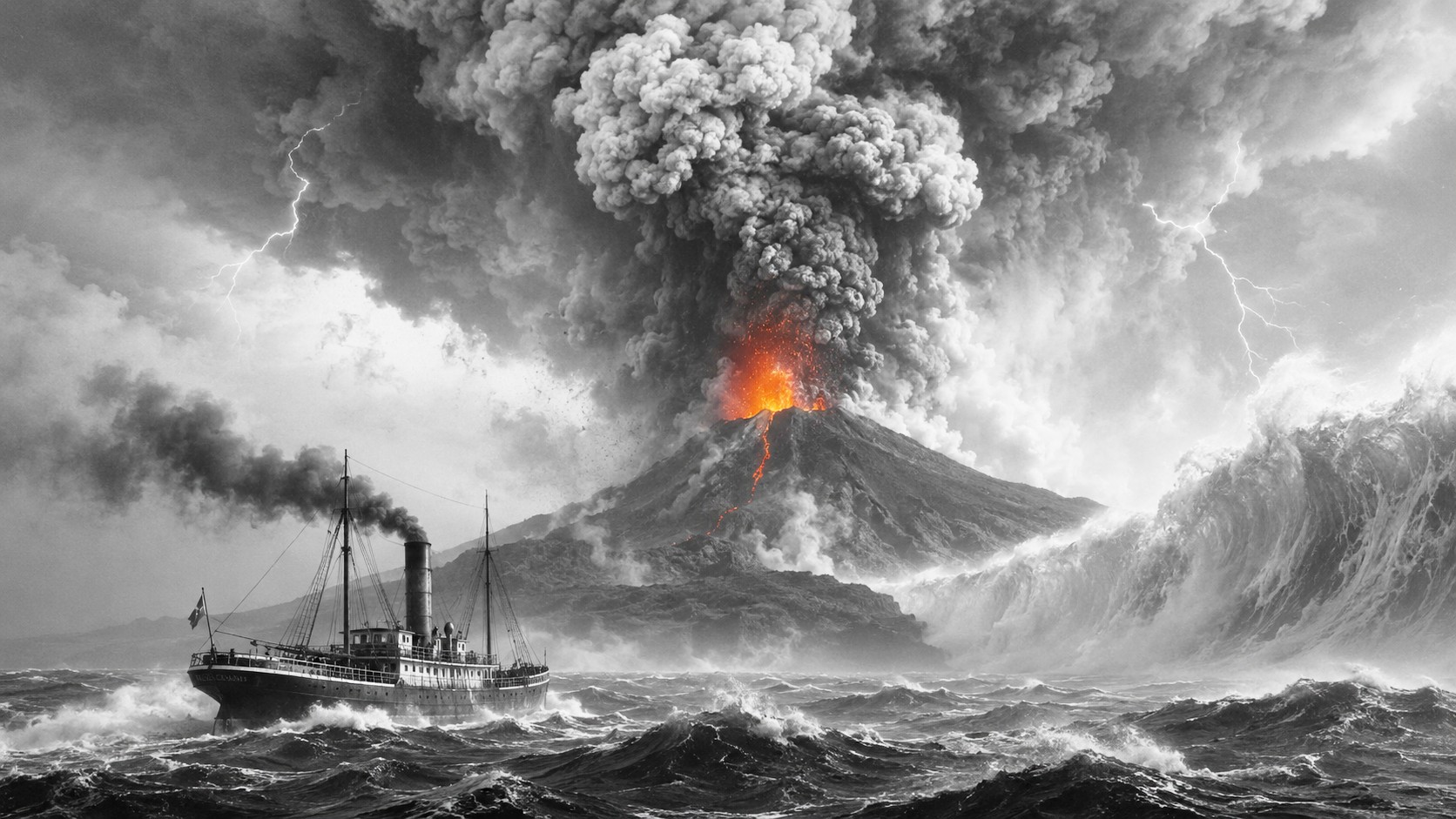
On 26 August 1883, the volcanic island of Krakatau entered the climactic phase of an eruption that would become one of the deadliest and most powerful natural disasters in recorded history. Within hours, the Sunda Strait between Java and Sumatra was transformed into a landscape of darkness, ash and advancing waves.
Warnings had been building for months
Krakatau, then part of the Dutch East Indies and commonly known in the West as Krakatoa, had shown signs of renewed activity since May 1883. Ships passing through the Sunda Strait reported explosions, smoke and columns of ash rising above the island.
The spectacle initially attracted curiosity. Commercial vessels and sightseeing parties approached the volcano, while scientific expeditions attempted to document its activity. Few observers understood that the eruptions were leading towards a catastrophic collapse.

At approximately 13:00 on 26 August, the volcano entered a far more violent phase. Explosions became almost continuous, and a dense ash cloud rose high into the atmosphere. By the evening, the sounds could be heard across Java and waves were already striking nearby coastlines.
The catastrophe reaches its climax
The most destructive explosions followed on the morning of 27 August. Four immense blasts occurred in rapid succession, with the largest generating what is generally regarded as the loudest sound recorded in modern history.
The detonation was heard thousands of kilometres away in Australia and on the island of Rodrigues in the Indian Ocean. Atmospheric pressure waves travelled around the world several times and were detected by scientific instruments in Europe and North America.
Much of Krakatau collapsed into the emptied magma chamber beneath the island, creating a large underwater caldera. More than 20 cubic kilometres of rock, pumice and volcanic material were expelled during the eruption.
Tsunamis caused most of the deaths
The collapse displaced enormous volumes of seawater and generated a succession of tsunamis. Waves reaching an estimated 41 metres struck the coasts of Java and Sumatra, destroying towns, ports and hundreds of villages.
Approximately 36,000 people were killed, with more than 34,000 of the deaths attributed to the tsunamis. Some coastal communities were completely erased, while ships were carried inland by the force of the water.
Pyroclastic flows containing superheated gas, ash and rock also travelled across the sea, reaching parts of Sumatra approximately 40 kilometres from the volcano.
A disaster felt around the world
Ash was projected as high as 80 kilometres into the atmosphere and spread across an estimated 800,000 square kilometres. The surrounding region remained in darkness for more than two days.
Fine volcanic material gradually circulated around the planet, producing unusually vivid red and orange sunsets. Global temperatures fell by as much as 0.5 degrees Celsius during the following year and did not fully return to previous levels until several years later.
The eruption became one of the first natural catastrophes whose physical effects were measured across the world. Barometers recorded its pressure waves, tide gauges detected disturbed sea levels and international telegraph networks helped reports travel far beyond Southeast Asia.
Krakatau remains active
Most of the original island disappeared, but the volcanic system survived. In 1927, a new cone began emerging from the sea inside the caldera. It became known as Anak Krakatau — the Child of Krakatau — and remains active today.
The events that began on 26 August 1883 changed scientific understanding of volcanoes, atmospheric circulation and tsunami hazards. They also demonstrated that a disaster on one small island could produce consequences measurable across the entire planet.
Newshub Editorial in Asia – 26 August 2026

Ask NF GPT
If you have an account with ChatGPT you get deeper explanations,
background and context related to what you are reading.
Recent Comments