
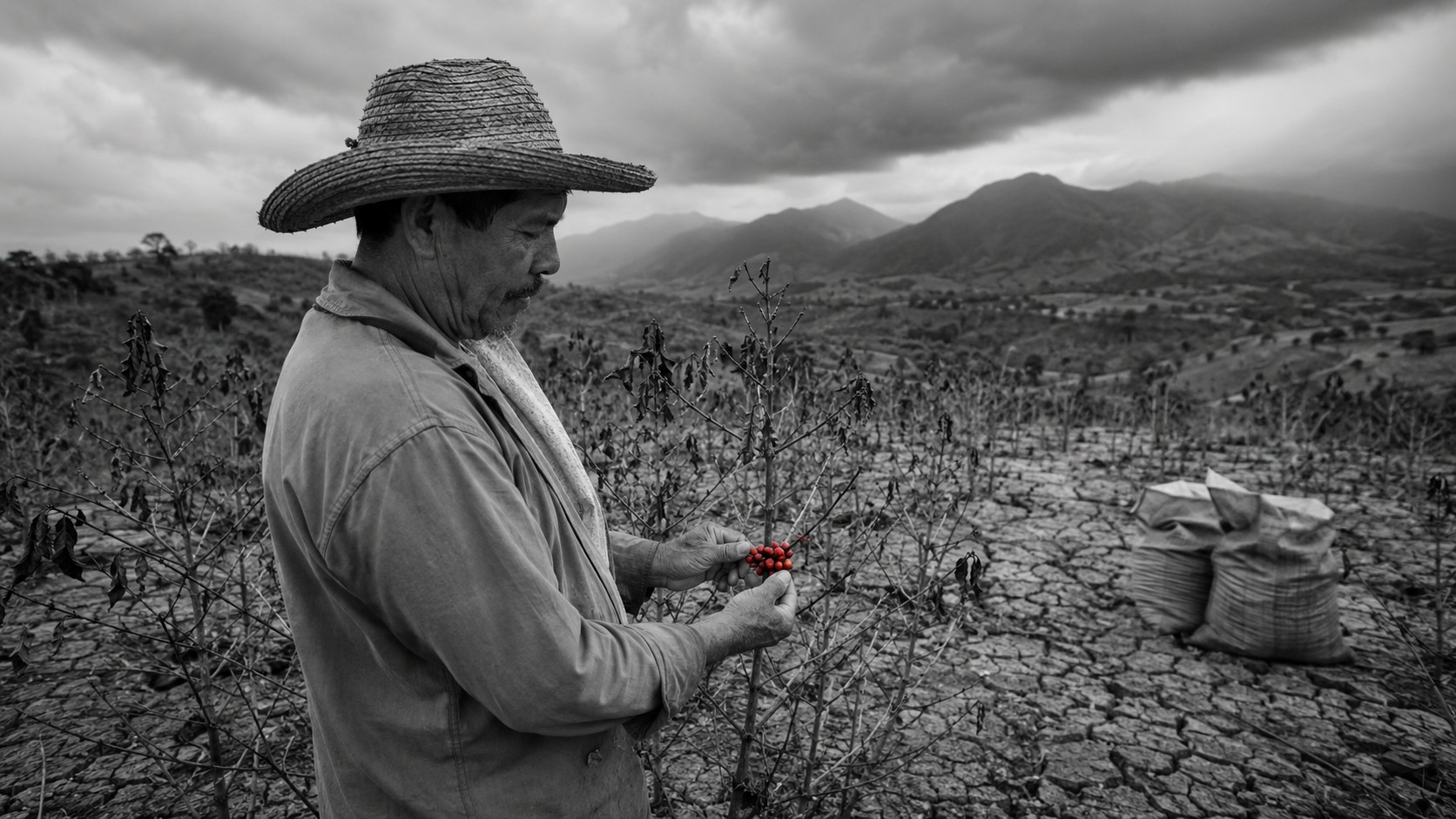
A strengthening El Niño is threatening harvests, food security and economic stability across emerging markets. New forecasts indicate that the weather event could become exceptionally strong during late 2026, placing fresh pressure on countries already confronting expensive imports, weak currencies and limited public finances.
Colombia offers an early warning
Colombia’s National Federation of Coffee Growers expects national coffee production to decline by 8 per cent this year, from 13.7 million to 12.5 million 60-kilogram bags. Heavy rainfall earlier in 2026 and the developing El Niño are considered more damaging to production than the powerful earthquake that struck western Colombia on 10 August.
Approximately 540,000 Colombian families depend on the coffee industry. Although exports through Buenaventura, the country’s main coffee port, have returned to normal, growers face a difficult combination of unstable weather and an appreciating peso. The stronger currency is reducing the local value of dollar-denominated coffee sales and squeezing farmers’ margins.


A potentially historic weather event
The United States Climate Prediction Center estimates that there is a greater than 90 per cent probability of a very strong El Niño during the Northern Hemisphere’s autumn and winter of 2026–27. It has also calculated a 69 per cent chance that the event will exceed the strength of every El Niño recorded since 1950.
El Niño is a naturally occurring warming of the central and eastern equatorial Pacific. It changes rainfall and temperature patterns around the world, frequently producing drought in South and Southeast Asia, Australia and Southern Africa, while bringing excessive rainfall to parts of South America. Human-driven climate change can intensify the resulting heat and extreme weather risks.
Tropical commodities enter the danger zone
Coffee, cocoa and sugar are particularly exposed. Drier conditions could reduce robusta coffee yields in Vietnam and Indonesia, while excessive rainfall or heat may damage cocoa production in West Africa. India and Thailand could receive weaker monsoon rainfall, threatening sugar output and other important crops.
These countries occupy central positions in global agricultural supply chains. Production losses would therefore affect not only farm incomes and export earnings but also international commodity prices, manufacturers and consumers far beyond the affected regions.
Food inflation becomes a financial risk
Emerging markets are especially vulnerable because food represents a comparatively large share of household expenditure. A sharp increase in food prices can rapidly weaken purchasing power, increase poverty and create political pressure for subsidies, export restrictions or emergency imports.
Persistent food inflation could also force central banks to keep interest rates elevated for longer. That would increase borrowing costs for households, businesses and governments, potentially slowing investment and economic growth. Countries with weak currencies would face an additional challenge as more expensive imports compound domestic supply shortages.
Preparation is now economic policy
The severity and location of El Niño’s effects remain uncertain, but the financial risks are becoming clearer. Governments can reduce the damage through water management, crop insurance, strategic food reserves and targeted support for vulnerable households.
For investors, the developing weather pattern makes agricultural production, reservoir levels, food prices and central-bank decisions important indicators to monitor. What begins as a change in Pacific Ocean temperatures could become one of the most significant economic tests facing emerging markets in 2027.
Newshub Editorial in Emerging Markets – 24 August 2026

Ask NF GPT
If you have an account with ChatGPT you get deeper explanations,
background and context related to what you are reading.
A strengthening El Niño is threatening harvests, food security and economic stability across emerging markets. New forecasts indicate that the weather event could become exceptionally strong during late 2026, placing fresh pressure on countries already confronting expensive imports, weak currencies and limited public finances.
Recent Comments