
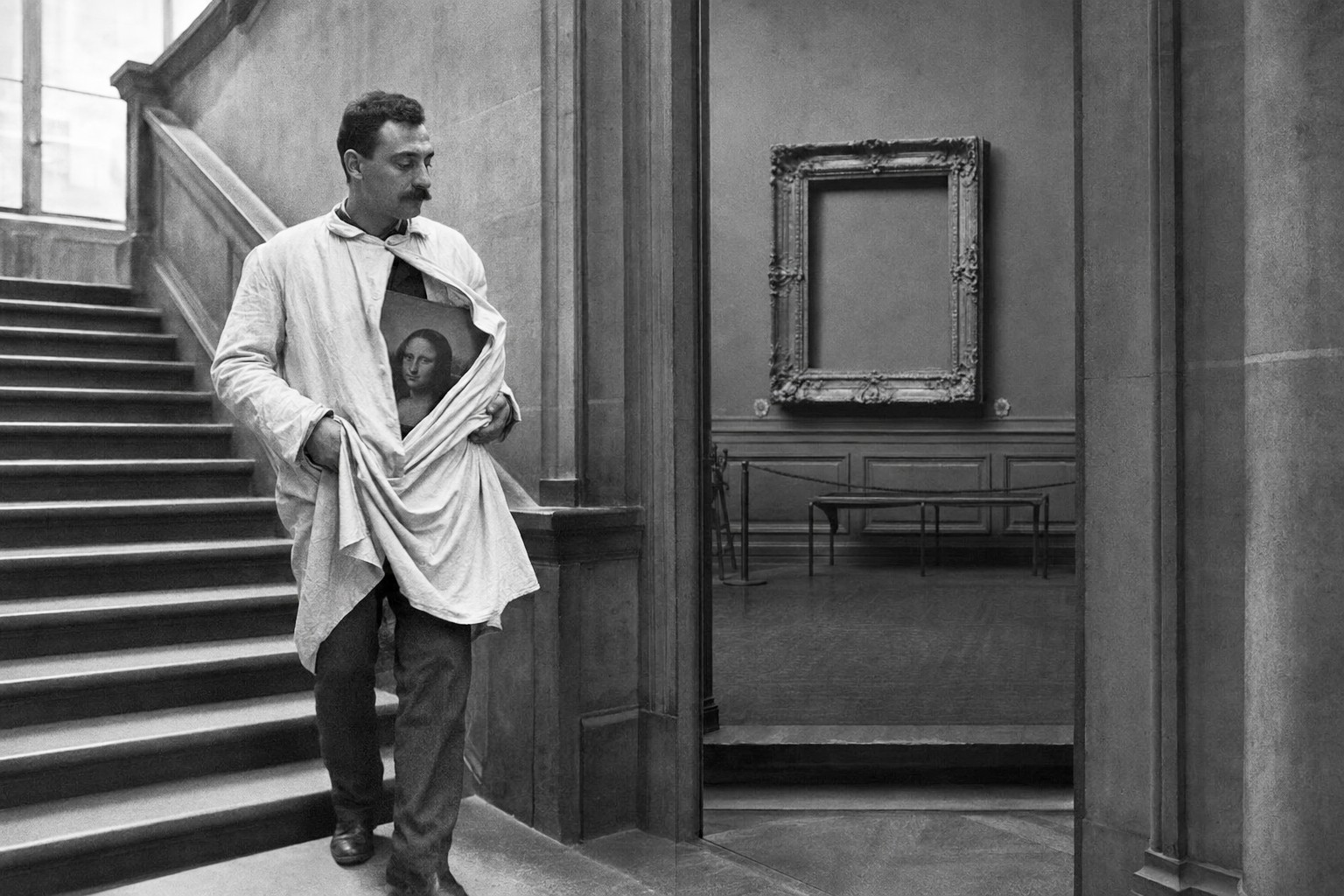
On 21 August 1911, Italian museum worker Vincenzo Peruggia walked out of the Louvre carrying Leonardo da Vinci’s Mona Lisa beneath his clothing. The painting would remain missing for more than two years — and the extraordinary theft would transform it into the most famous artwork in the world.
A masterpiece disappears
The Louvre was closed to the public on Mondays, giving Peruggia the opportunity he needed. Familiar with the museum after previously working there, he wore the white protective clothing commonly used by Louvre employees.
Peruggia removed the portrait from the Salon Carré and carried it to a secluded staircase. There, he took the painting out of its heavy frame and protective case before leaving the museum with the relatively small wooden panel concealed beneath his clothes.

Security at the Louvre was surprisingly limited. The museum housed thousands of works, while employees, photographers, cleaners and maintenance workers moved freely through its enormous galleries.
The disappearance was not immediately detected.
An empty space shocks Paris
The alarm was raised on 22 August when French artist Louis Béroud arrived to paint a copy of the Mona Lisa and found only four hooks on the wall.
Museum officials initially assumed that the painting had been taken away to be photographed. When it became clear that no authorised removal had occurred, the Louvre was closed and searched from top to bottom.
Police questioned employees, examined fingerprints and inspected the museum’s exits. The French border was placed under surveillance, but the thief and the painting had already disappeared into Paris.
Thousands later visited the Louvre simply to stare at the empty space.
Poets, painters and suspects
The investigation quickly became an international sensation. Newspapers printed reproductions of the portrait, turning the mysterious woman’s face into a global image.
The French poet Guillaume Apollinaire was arrested after one of his associates admitted stealing small antiquities from the Louvre. Pablo Picasso, who had previously purchased stolen sculptures from the same man, was also questioned.
Neither had anything to do with the disappearance of the Mona Lisa, and both were released.
With no convincing lead, the case gradually went cold.
Hidden in a Paris room
Peruggia kept the painting concealed in his modest Paris lodgings for more than two years. In late 1913, he contacted Florentine art dealer Alfredo Geri and offered to return the work to Italy in exchange for a reward.
He claimed that he had acted out of patriotism, believing the painting had been stolen from Italy by Napoleon. In reality, Leonardo had brought the portrait to France during the sixteenth century, and it later entered the collection of King Francis I.
Geri alerted the authorities after confirming that the painting was genuine. Peruggia was arrested in Florence, and the Mona Lisa was displayed triumphantly in several Italian cities before returning to the Louvre in January 1914.
The crime that created an icon
Peruggia received a relatively short prison sentence and was treated by some Italians as a misguided patriot rather than an ordinary thief.
The theft achieved what no exhibition or critic could have done. Before 1911, the Mona Lisa was already respected as an important Renaissance masterpiece. After the theft, it became a worldwide celebrity.
Its empty place on the Louvre wall, the international manhunt and the mystery surrounding its disappearance turned Leonardo’s portrait into something greater than a painting.
They turned it into an icon.
Newshub Editorial in Europe – August 21, 2026

Ask NF GPT
If you have an account with ChatGPT you get deeper explanations,
background and context related to what you are reading.
Recent Comments