
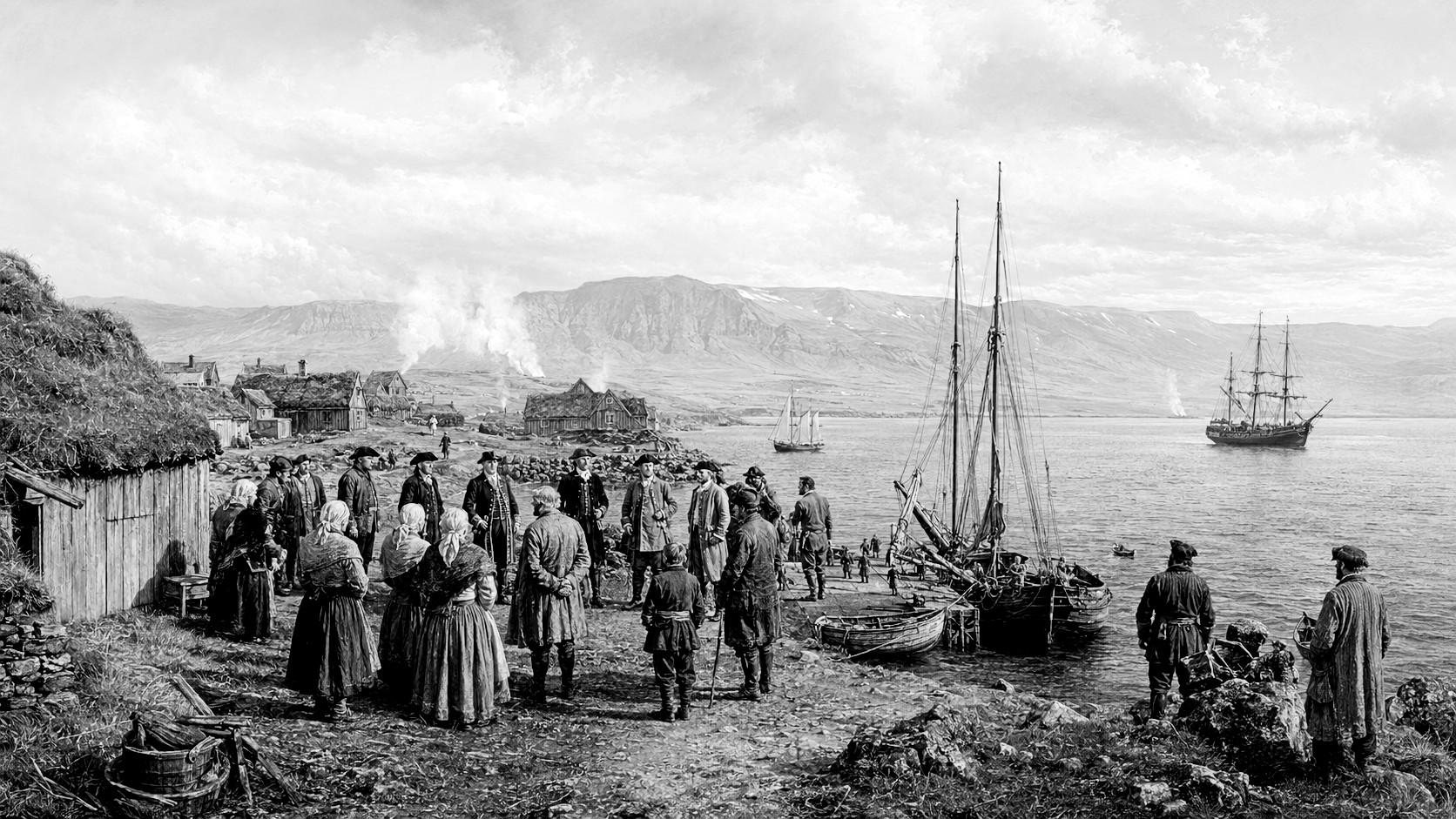
Reykjavík’s rise from trading settlement to Icelandic capital
On 18 August 1786, Reykjavík was designated as the administrative capital of Iceland, marking a decisive moment in the transformation of a scattered coastal settlement into the political, economic and cultural centre of the country. The decision strengthened Reykjavík’s position at a time when Iceland remained under Danish rule and had only a small population spread across isolated farming and fishing communities.
From smoky bay to growing settlement
The name Reykjavík means “smoky bay”, referring to the steam rising from the geothermal springs observed by early Norse settlers. According to Icelandic tradition, Ingólfur Arnarson established the country’s first permanent Norse settlement in the area in about 874.
For centuries, however, Reykjavík remained little more than a collection of farms. There was no substantial urban development, and Iceland’s population continued to depend heavily on agriculture, fishing and trade with other Nordic countries.

Trade created the foundations
The settlement began to change during the 18th century when Icelandic official Skúli Magnússon promoted local industry. Wool workshops were established in Reykjavík during the 1750s, creating employment and encouraging people to settle around the emerging commercial centre.
In 1786, the Danish Crown relaxed its trade monopoly and granted town and trading privileges to six Icelandic communities. Reykjavík was among them and ultimately proved the most successful. The decree gave the settlement greater economic importance and is generally regarded as the formal foundation of the modern city.
Reykjavík had only a few hundred residents at the time, but its coastal position, harbour and growing commercial activity provided the conditions for further development.
Political institutions followed
The designation of Reykjavík as the administrative centre did not immediately produce a capital in the modern sense. Its political role developed gradually as important Icelandic institutions were moved or established there.
The Althing, Iceland’s historic parliament, was restored in Reykjavík in 1845 after having been suspended by the Danish authorities. The city became the seat of Iceland’s home-rule government in 1904 and was confirmed as the capital when Iceland became a sovereign kingdom in personal union with Denmark in 1918.
When the Republic of Iceland was proclaimed on 17 June 1944, Reykjavík became the capital of a fully independent nation.
A centre of national life
Reykjavík subsequently developed into the centre of Icelandic government, finance, education, media and culture. Its harbour supported fishing and international trade, while the growth of public administration and service industries attracted residents from across the country.
The municipality had 139,804 inhabitants at the beginning of 2026, making it by far Iceland’s largest municipality. Together with the surrounding capital region, Reykjavík represents the dominant population and economic centre of the country.
The city’s development demonstrates how administrative authority, trade and infrastructure can gradually transform a small settlement. The decision taken in 1786 did more than change Reykjavík’s official position: it helped establish the foundations of the modern Icelandic state.
Newshub Editorial in Europe – 18 August 2026

Ask NF GPT
If you have an account with ChatGPT you get deeper explanations,
background and context related to what you are reading.
Recent Comments