
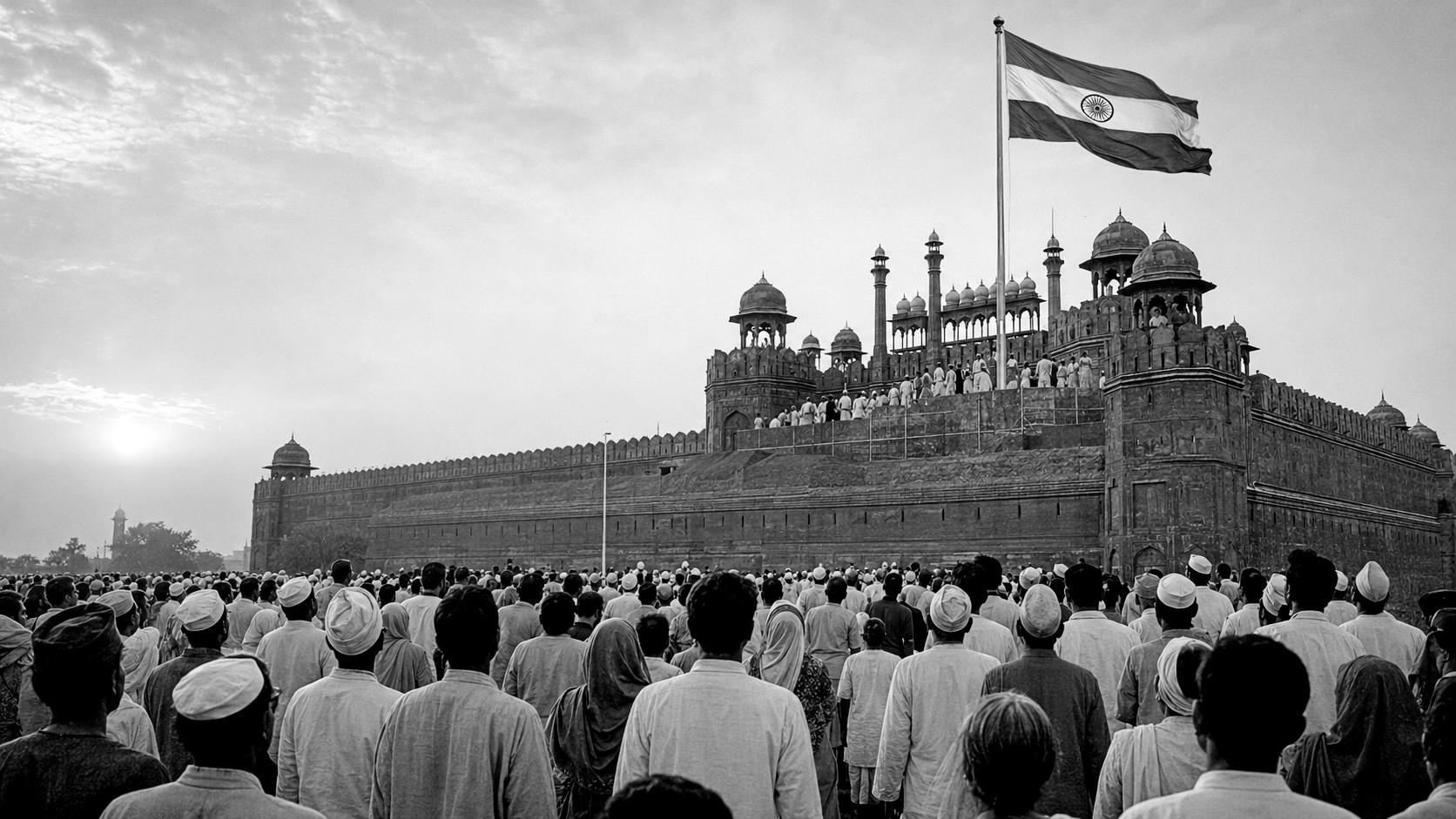
Seventy-nine years ago today, on 15 August 1947, India emerged as an independent nation after generations of resistance to British colonial rule. The transfer of power ended one of the most consequential chapters in imperial history and began an ambitious effort to unite a vast, diverse country under democratic government.
A movement built over generations
British influence expanded through the East India Company during the eighteenth century, before the Crown assumed direct control following the Indian Rebellion of 1857. Political opposition gradually became more organised, particularly after the Indian National Congress was founded in 1885. Early demands for greater representation eventually developed into a nationwide campaign for complete independence.
Mahatma Gandhi transformed the struggle by promoting non-violent resistance, civil disobedience and mass participation. The Non-Cooperation Movement, the Salt March and the Quit India campaign mobilised millions of Indians. Other political leaders, revolutionary organisations, workers, soldiers and regional movements also contributed to weakening colonial authority.

War accelerates the end of empire
Britain emerged from the Second World War economically exhausted and increasingly unable to maintain control over India. The British Labour government accepted that independence could no longer be postponed, while tensions between the Indian National Congress and the Muslim League complicated negotiations over the country’s future.
The Indian Independence Act was passed by the British Parliament in July 1947. It provided for the creation of two independent dominions: India and Pakistan. Lord Mountbatten, the final British viceroy, oversaw the transfer of power.
A historic midnight address
Shortly before midnight on 14 August, India’s Constituent Assembly gathered in New Delhi. Jawaharlal Nehru, who became the country’s first prime minister, delivered his celebrated “Tryst with Destiny” speech, describing the moment as one when India would awaken to life and freedom.
On 15 August, the Indian flag was raised above the Red Fort in Delhi. Celebrations spread across the country as people marked the end of colonial government and the beginning of national sovereignty.
Freedom accompanied by tragedy
Independence was inseparable from partition. British India was divided largely along religious lines, creating Hindu-majority India and Muslim-majority Pakistan. The rushed drawing of new borders triggered communal violence, the displacement of millions and the deaths of hundreds of thousands of people.
While political leaders celebrated in Delhi, Gandhi remained in Calcutta, working to prevent further violence between Hindus and Muslims. His absence from the official ceremonies reflected the painful contradiction at the heart of independence: national freedom had arrived alongside immense human suffering.
A legacy extending far beyond India
India adopted its constitution and became a republic in 1950, establishing the foundations of what developed into the world’s largest democracy. Its independence also accelerated decolonisation across Asia, Africa and the Caribbean, inspiring movements that challenged European imperial rule.
Today, 15 August is celebrated with flag-raising ceremonies, cultural events and the prime minister’s annual address from the Red Fort. The occasion honours those who fought for freedom while recalling the responsibility of maintaining democracy, unity and equality across one of the world’s most diverse nations.
Newshub Editorial in Asia – 15 August 2026

Ask NF GPT
If you have an account with ChatGPT you get deeper explanations,
background and context related to what you are reading.
Recent Comments