
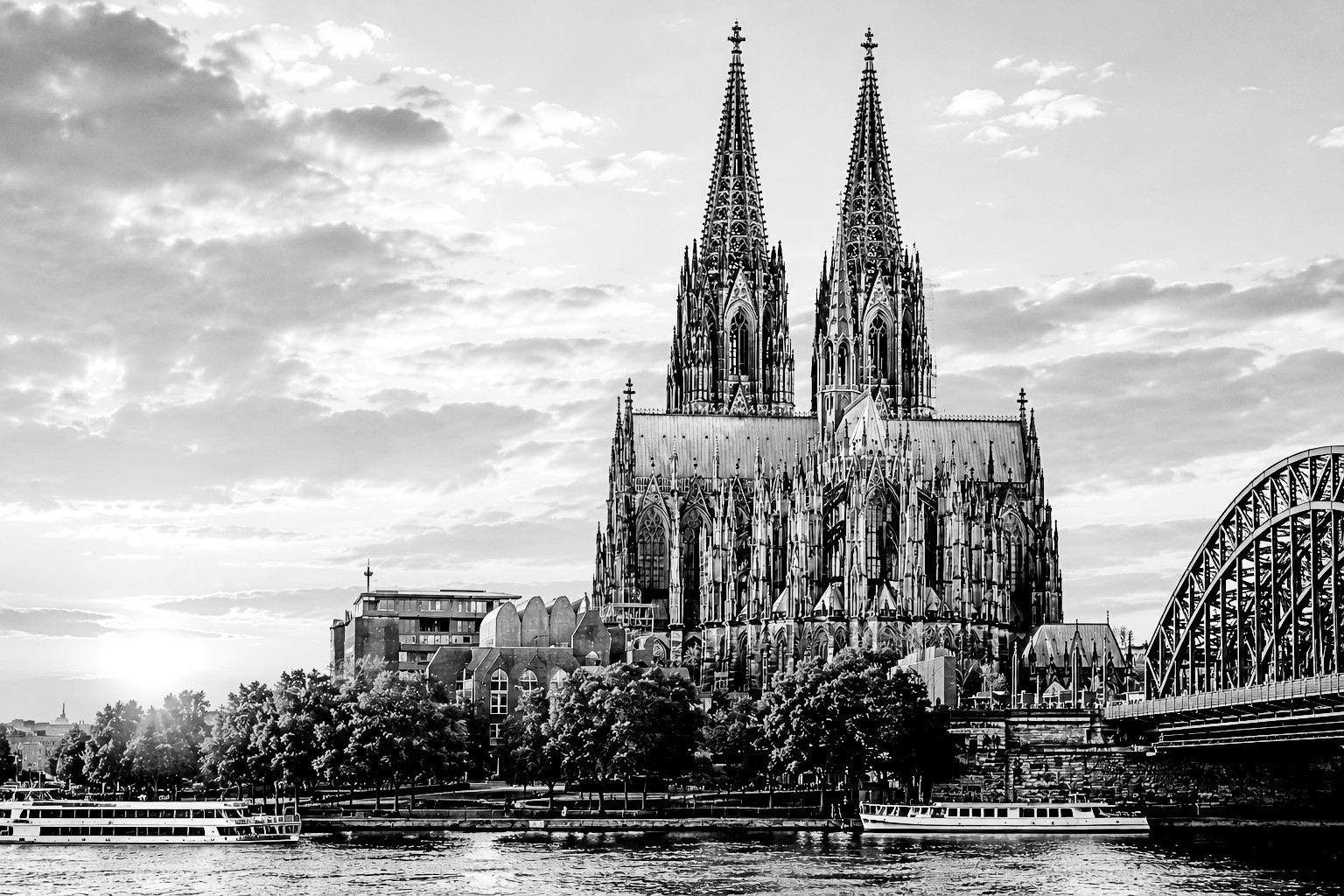
On 14 August 1880, one of Europe’s most extraordinary building projects reached its conclusion when Cologne Cathedral was completed, 632 years after construction had begun. The vast Gothic cathedral, whose foundation stone was laid in 1248, survived centuries of interrupted work, political upheaval and changing architectural eras before its twin spires finally transformed Cologne’s skyline.
A cathedral conceived in the Middle Ages
The origins of Cologne Cathedral are closely connected to the arrival of the supposed relics of the Three Wise Men in Cologne in 1164. Archbishop Rainald von Dassel brought the relics from Milan, turning the city into one of medieval Europe’s most important pilgrimage destinations. A new and considerably larger cathedral was eventually planned to provide an appropriate setting for the shrine and the growing number of pilgrims.
On 15 August 1248, Archbishop Konrad von Hochstaden laid the foundation stone for the new cathedral. Its first master builder, known as Master Gerhard, drew heavily on the great Gothic churches of France, particularly the architectural developments seen at Amiens and Paris. The scale of the project was extraordinary for its time and pushed medieval engineering close to its technical limits.

Centuries of construction – and silence
Progress was initially substantial. The cathedral’s choir was completed and consecrated in 1322, while work subsequently continued on the towers, transept and aisles. But enthusiasm, financing and political circumstances changed. By the 16th century, major construction had effectively stopped.
For more than three centuries, Cologne lived with an unfinished cathedral. The incomplete south tower, topped by a huge medieval construction crane, became a familiar feature of the city. The cathedral endured the Reformation, religious conflict, the Thirty Years’ War and the occupation of Cologne by French revolutionary forces.
The great project returns
Interest in completing the cathedral revived dramatically during the 19th century. Romantic fascination with the Middle Ages combined with growing German national sentiment, while surviving medieval plans demonstrated how the original builders had intended the western façade and towers to appear.
Construction formally resumed in 1842 with the support of King Friedrich Wilhelm IV of Prussia. Engineers and craftsmen remained remarkably faithful to the medieval design while taking advantage of modern technology, including iron structural elements, steam-powered machinery and railway-based equipment around the building site.
By 1863, the nave and transept were largely complete and the centuries-old temporary wall separating the finished choir from the unfinished cathedral could be removed. Attention then turned towards completing the enormous towers.
The tallest building in the world
In 1880, the final work was completed. Cologne Cathedral’s twin towers rose more than 157 metres above the city, making the cathedral the tallest building in the world at the time. The achievement was particularly remarkable because the 19th-century builders had followed a medieval façade design conceived roughly six centuries earlier.
The cathedral’s completion became both a religious and national event in the newly unified German Empire. It represented not merely the finishing of a church but the conclusion of a project connecting medieval Europe with the industrial age.
Today, Cologne Cathedral remains one of Germany’s most recognisable landmarks. UNESCO designated it a World Heritage Site in 1996, describing the building as a Gothic masterpiece constructed with remarkable fidelity to its original plans.
More than seven centuries after the first stone was laid, the cathedral continues to dominate Cologne – a monument to ambition measured not in years or decades, but in generations.
Newshub Editorial in Europe – 14 August 2026

Ask NF GPT
If you have an account with ChatGPT you get deeper explanations,
background and context related to what you are reading.
Open article chat
Recent Comments