
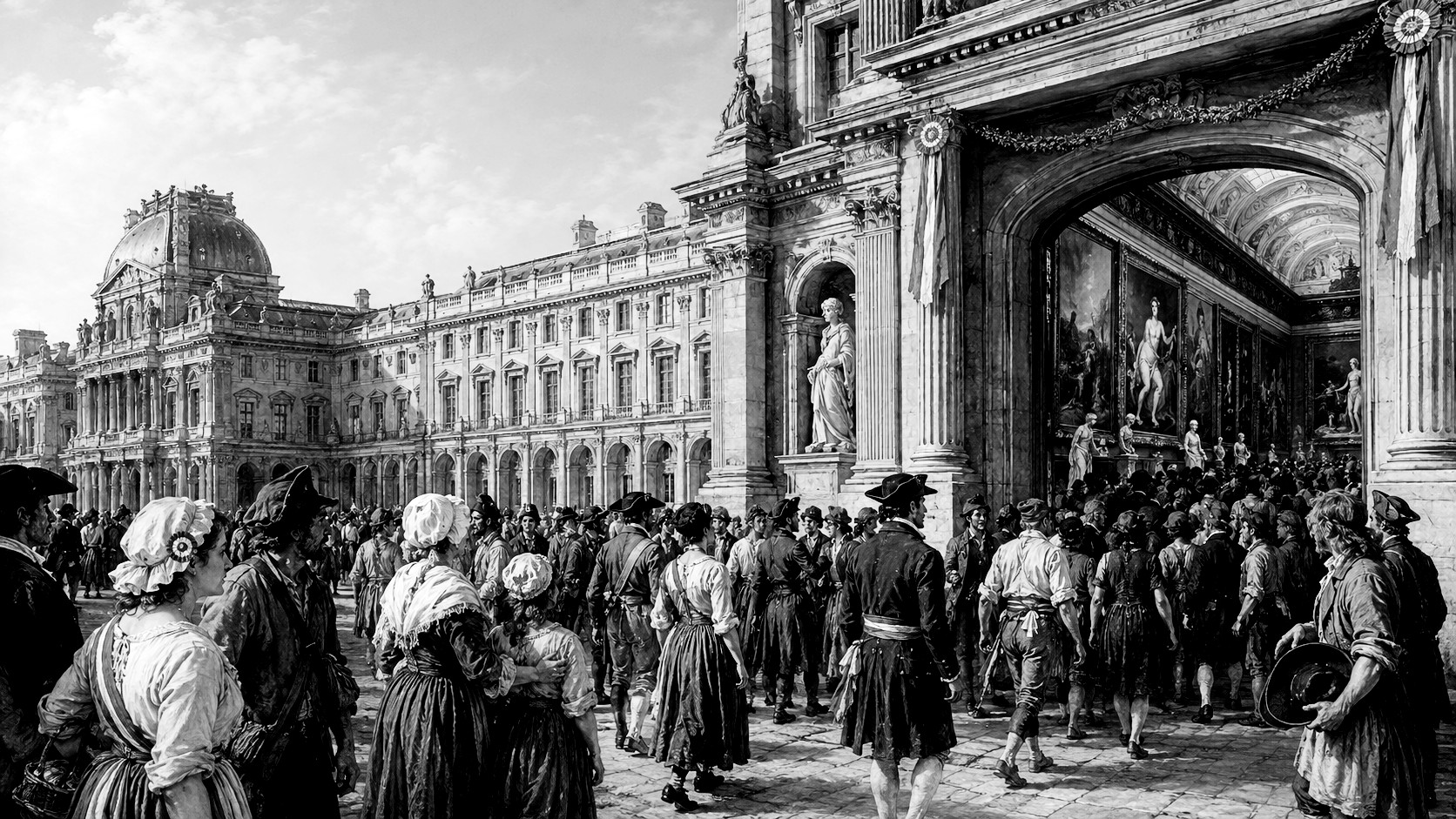
On 10 August 1793, amid the turmoil of the French Revolution, the Louvre opened its doors in Paris as a public museum. Formerly associated with kings, courts and royal privilege, the vast palace was transformed into the Muséum central des Arts de la République — an institution intended to place France’s artistic treasures in the hands of the nation.
From fortress to royal palace
The Louvre’s history began long before it became a museum. A fortress was constructed on the site during the reign of King Philip II in the late 12th century, protecting Paris from possible attack along the River Seine. During the Renaissance, Francis I began transforming the medieval stronghold into a royal residence. Successive monarchs expanded the palace and assembled collections of paintings, sculptures and antiquities.
A home for France’s growing art collection
The royal family gradually abandoned the Louvre after Louis XIV moved his court to Versailles in 1682. Artists, academies and craftsmen continued to occupy parts of the building, while proposals emerged to use the palace as a permanent public gallery. Under Louis XVI, serious plans were developed to exhibit the royal collection in the Louvre’s Grande Galerie, but revolution overtook the monarchy before the project could be completed.


Revolution changes the Louvre’s purpose
In 1791, the National Assembly declared that the Louvre should become a place where important works of art and science could be preserved and displayed. Following the collapse of royal authority in August 1792, the king’s collections became national property. Art confiscated from the Church, the Crown and aristocrats who had fled France was gathered for public exhibition.
The museum opened exactly one year after the attack on the Tuileries Palace, an event that had effectively ended the monarchy’s power. Its opening was therefore more than a cultural occasion. It was a political statement that treasures once reserved for kings and courtiers now belonged to the French people.
More than 500 paintings on display
The first exhibition contained 537 paintings, together with sculptures and other objects. Works were displayed in the Grande Galerie, many taken from the former royal collection or confiscated during the Revolution. Admission was free, although specific days were reserved for artists, foreign visitors and members of the general public.
Conditions were far removed from those of a modern museum. Paintings were crowded closely together, often extending from floor to ceiling, while information about individual works was limited. Structural problems eventually forced the museum to close in 1796. It reopened in 1801 with improved lighting and a more organised presentation.
Expansion under Napoleon
The Louvre’s collection expanded dramatically during Napoleon Bonaparte’s rule, when works of art were brought to Paris from territories conquered by French armies. Renamed the Musée Napoléon in 1803, it became a symbol of imperial power. After Napoleon’s defeat in 1815, many seized objects were returned to their countries of origin, although the museum remained central to French cultural life.
A revolutionary cultural legacy
Over the following centuries, the Louvre developed into one of the world’s most recognised museums. Its collections came to include the Mona Lisa, the Venus de Milo and the Winged Victory of Samothrace. The glass pyramid, completed in 1989, added a modern landmark to the historic palace.
The Louvre’s opening in 1793 helped establish a powerful principle: great art should form part of a shared public heritage. What had begun as a fortress and become a royal palace was now a museum for the nation.
Newshub Editorial in Europe – 10 August 2026

Ask NF GPT
If you have an account with ChatGPT you get deeper explanations,
background and context related to what you are reading.
On 10 August 1793, amid the turmoil of the French Revolution, the Louvre opened its doors in Paris as a public museum. Formerly associated with kings, courts and royal privilege, the vast palace was transformed into the Muséum central des Arts de la République — an institution intended to place France’s artistic treasures in the hands of the nation.
Recent Comments