
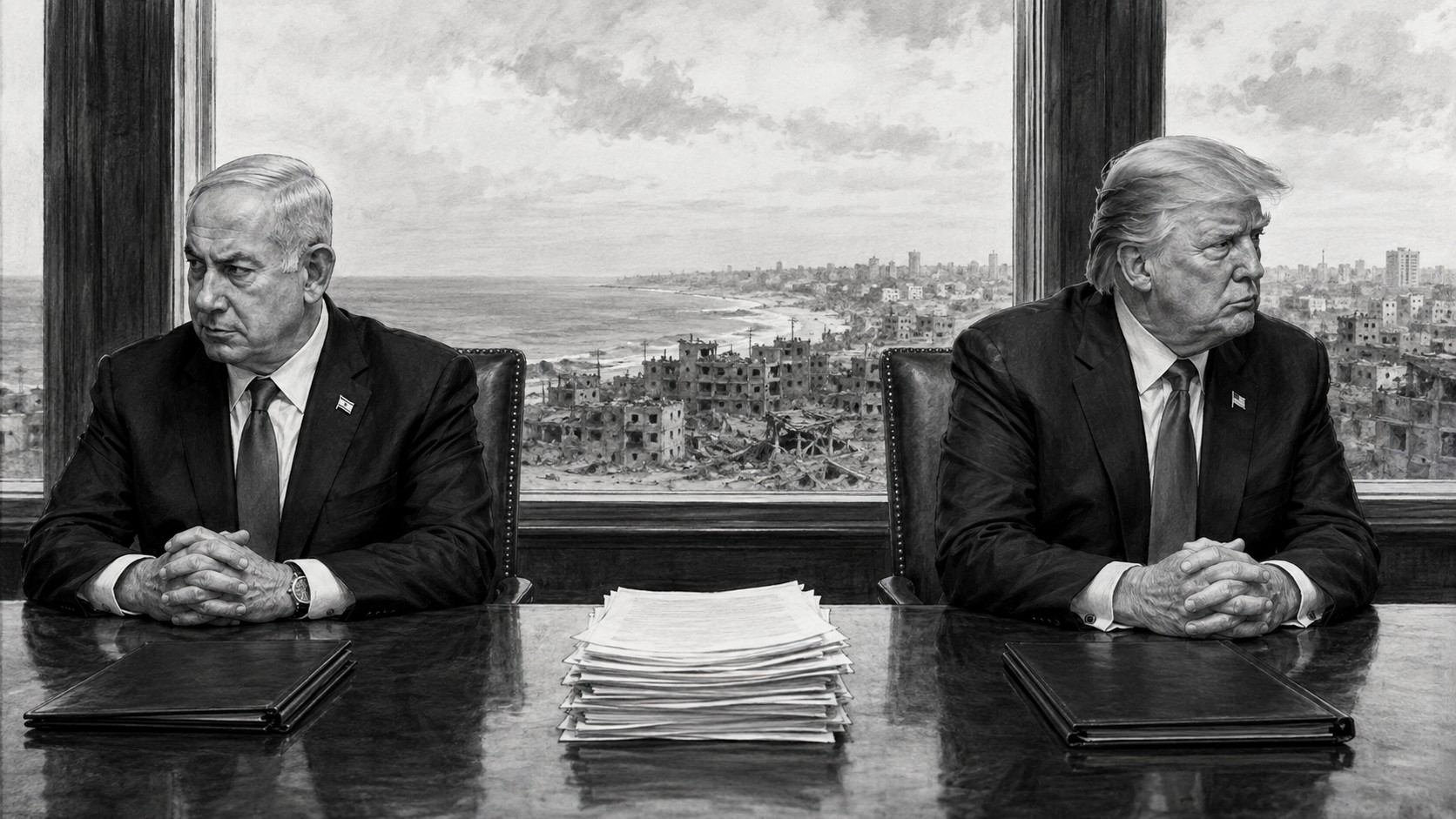
Israeli Prime Minister Benjamin Netanyahu has publicly rejected a US-led 15-point plan for Gaza, creating a rare open disagreement with President Donald Trump. Netanyahu said Israeli forces would not withdraw from any additional territory until Hamas had surrendered all its weapons and could no longer threaten Israel.
Public break with Washington
Speaking at the beginning of an Israeli cabinet meeting, Netanyahu said his government did not accept the document prepared through Trump’s Board of Peace. He insisted that Hamas must undergo complete and verifiable disarmament, including the removal of heavy weapons, smaller arms and remaining military infrastructure.
Although Netanyahu described Trump as Israel’s greatest friend in the White House, he said Israel would oppose proposals that it considered incompatible with its security. He also criticised international pressure intended to end regional conflicts without full Israeli approval.


The rejection is significant because Trump had previously presented the roadmap as an agreed framework for implementing the next phase of the Gaza ceasefire.
Disagreement centres on timing
The principal dispute concerns the sequence of Israeli withdrawal and Hamas disarmament. The US-backed plan proposes a sector-by-sector withdrawal by the Israel Defense Forces as Hamas weapons are collected and rendered unusable.
An International Stabilization Force would enter cleared areas and work alongside a newly trained Palestinian police service. Administration would gradually pass to the National Committee for the Administration of Gaza, a technocratic Palestinian body operating under international supervision.
Netanyahu argues that this sequence could allow Hamas to retain weapons or rebuild its military organisation after Israeli troops leave. His position is that disarmament must be completed before any further withdrawal begins.
Hamas says it remains committed
Hamas has said it remains committed to the 15-point roadmap and has called on the United States and other mediators to prevent Israel from obstructing its implementation.
The organisation avoids using the term “disarmament” but has reportedly agreed to place its weapons in storage under the authority of the new Palestinian administration. Hamas says Israeli attacks must stop and the military withdrawal must begin before it completes its own obligations.
Earlier in July, Hamas announced that it had dissolved its governing authority in Gaza to make way for the new technocratic committee. However, significant uncertainty remains over how its weapons, fighters and extensive tunnel network would be handled.
Political pressure shapes Israeli position
Netanyahu faces an election scheduled for 27 October and is under pressure from far-right coalition partners who oppose territorial withdrawals and the creation of any Palestinian state.
Finance Minister Bezalel Smotrich welcomed Netanyahu’s rejection, arguing that Israeli forces should not surrender territory before Hamas has been destroyed as a military organisation.
Netanyahu also repeated that he would not permit the establishment of a Palestinian state in Gaza or the occupied West Bank while he remains prime minister. That position conflicts with international efforts to create a longer-term political settlement based on Palestinian self-determination.
Military activity has been reduced
Israel has scaled back operations in Gaza following discussions with Nikolay Mladenov, the Board of Peace envoy responsible for overseeing the ceasefire. Israeli forces are reportedly limiting action to what they consider immediate threats and have suspended near-daily targeted killings.
The ceasefire established in October 2025 remains fragile. Gaza health authorities say Israeli attacks have killed more than 1,250 Palestinians since the agreement, while Israel says four of its soldiers have been killed during the same period.
Most of Gaza’s population remains displaced in overcrowded coastal areas, with reconstruction delayed by insecurity, damaged infrastructure and disagreement over future governance.
Negotiations remain open
Despite Netanyahu’s rejection, Israeli and US officials continue to discuss the roadmap. Mladenov has said negotiations are ongoing, suggesting that the dispute has not yet ended diplomatic efforts.
However, the public disagreement exposes a fundamental obstacle: Washington wants disarmament and withdrawal to advance together, while Netanyahu insists that Hamas must first be completely disarmed. Until that sequencing dispute is resolved, the next phase of Gaza’s peace process is likely to remain stalled.
Newshub Editorial in the Middle East – 10 August 2026

Ask NF GPT
If you have an account with ChatGPT you get deeper explanations,
background and context related to what you are reading.
Israeli Prime Minister Benjamin Netanyahu has publicly rejected a US-led 15-point plan for Gaza, creating a rare open disagreement with President Donald Trump. Netanyahu said Israeli forces would not withdraw from any additional territory until Hamas had surrendered all its weapons and could no longer threaten Israel.
Recent Comments