
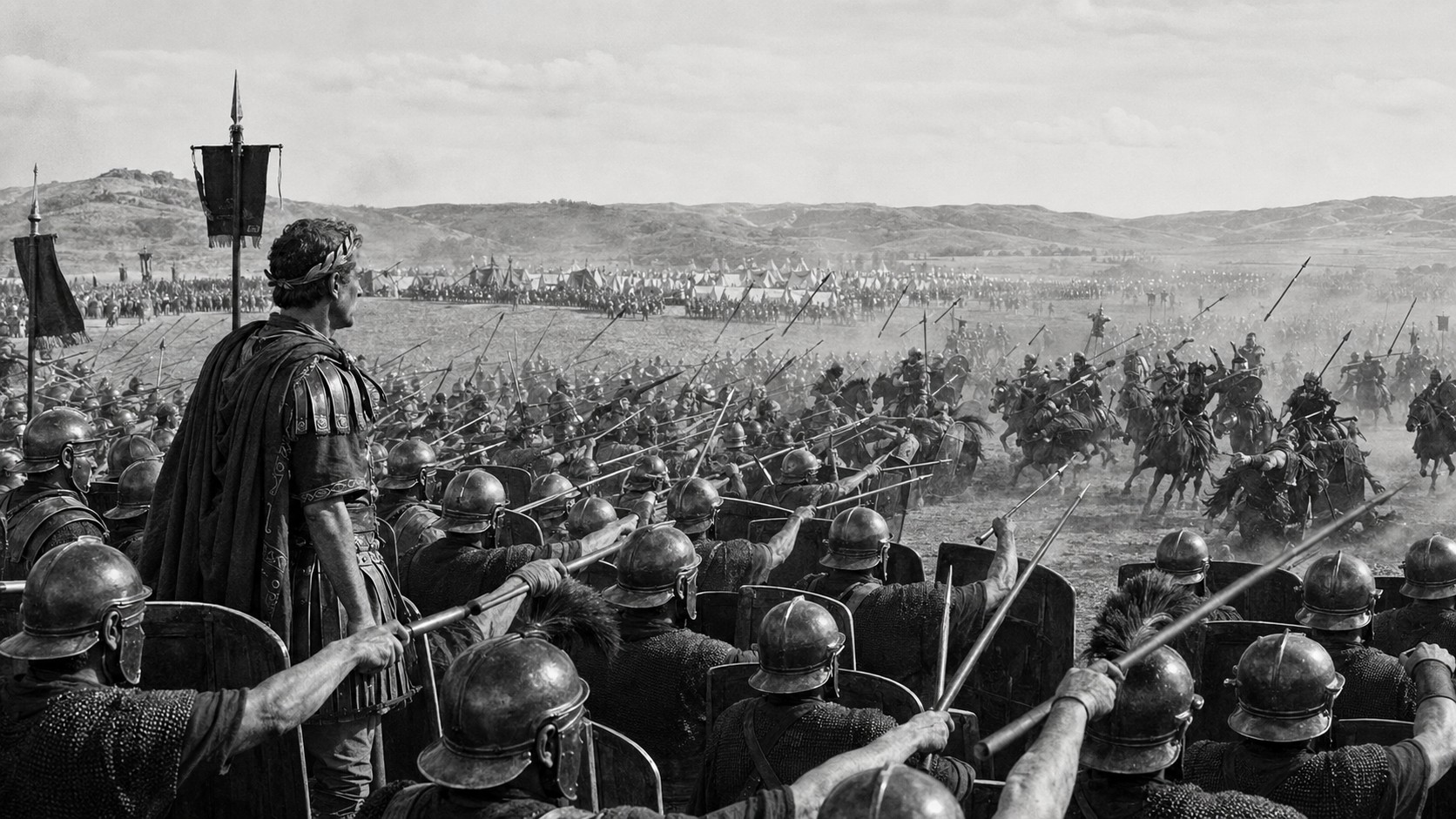
On 9 August 48 BC, Julius Caesar won one of antiquity’s most decisive military victories, defeating Pompey the Great at the Battle of Pharsalus in central Greece. Although Caesar faced a significantly larger army, his experienced legionaries and a carefully prepared tactical surprise shattered Pompey’s forces and changed the balance of power across the Roman Republic.
Former allies become enemies
Caesar and Pompey had once been political partners. Together with Marcus Licinius Crassus, they had dominated Roman politics through the informal alliance known as the First Triumvirate. The arrangement collapsed after the death of Crassus in 53 BC and the earlier death of Julia, Caesar’s daughter and Pompey’s wife.
As political tensions intensified, Pompey moved closer to conservative senators who feared Caesar’s popularity, military reputation and ambitions. In January 49 BC, Caesar crossed the Rubicon with his army, openly challenging the Senate’s authority and beginning a civil war.


Pompey and many senators abandoned Italy and established their military base in Greece. Caesar followed them across the Adriatic, but suffered a serious setback at Dyrrhachium. Pompey failed to exploit the victory fully, allowing Caesar to withdraw into Thessaly and reorganise his forces.
Pompey holds the numerical advantage
Near Pharsalus, Pompey commanded a larger army and possessed an overwhelming advantage in cavalry. Ancient estimates vary considerably, but Caesar claimed that he faced approximately 45,000 infantry and 7,000 cavalry with only around 22,000 infantry and 1,000 horsemen.
Pompey’s strategy was to use his cavalry to overwhelm Caesar’s right flank before attacking the rear of Caesar’s infantry. Confident of victory, several leading senators reportedly argued over the political offices and rewards they expected to receive after Caesar’s defeat.
Caesar, however, anticipated Pompey’s plan. He quietly removed several thousand experienced legionaries from his main formation and placed them in a concealed fourth line behind his vulnerable right wing.
Caesar’s hidden line decides the battle
When Pompey’s cavalry attacked, Caesar’s smaller mounted force began to retreat as expected. Pompey’s horsemen pursued, believing that Caesar’s flank was collapsing. At that moment, the concealed legionaries advanced and attacked at close range with their spears.
The unexpected resistance created panic among Pompey’s cavalry, which broke formation and fled. Caesar’s reserve troops then turned against the exposed flank of Pompey’s infantry. Caesar ordered his third line, which had remained rested, to enter the battle and deliver the decisive assault.
Pompey’s army collapsed. Many soldiers fled towards their camp, while others surrendered. Pompey himself abandoned the battlefield, reportedly removing the symbols of his command before escaping.
From Pharsalus to Egypt
Pompey travelled towards Egypt, hoping that the young King Ptolemy XIII would offer protection. Instead, Egyptian officials arranged his assassination, believing that his death would please Caesar. Pompey was killed shortly after reaching the Egyptian coast.
When Caesar arrived in Alexandria, he was presented with Pompey’s severed head and signet ring. Rather than celebrating, Caesar was reportedly appalled by the murder of his former ally and son-in-law.
A victory that accelerated Rome’s transformation
Pharsalus did not immediately end the civil war, but it destroyed Pompey’s position as Caesar’s principal rival. Caesar subsequently became Rome’s dominant political figure before his assassination in 44 BC.
The battle marked a decisive stage in the collapse of the Roman Republic. The political order that followed would eventually produce another series of civil wars and the rise of Augustus as Rome’s first emperor.
Newshub Editorial in Europe – 9 August 2026

Ask NF GPT
If you have an account with ChatGPT you get deeper explanations,
background and context related to what you are reading.
On 9 August 48 BC, Julius Caesar won one of antiquity’s most decisive military victories, defeating Pompey the Great at the Battle of Pharsalus in central Greece. Although Caesar faced a significantly larger army, his experienced legionaries and a carefully prepared tactical surprise shattered Pompey’s forces and changed the balance of power across the Roman Republic.
Recent Comments