
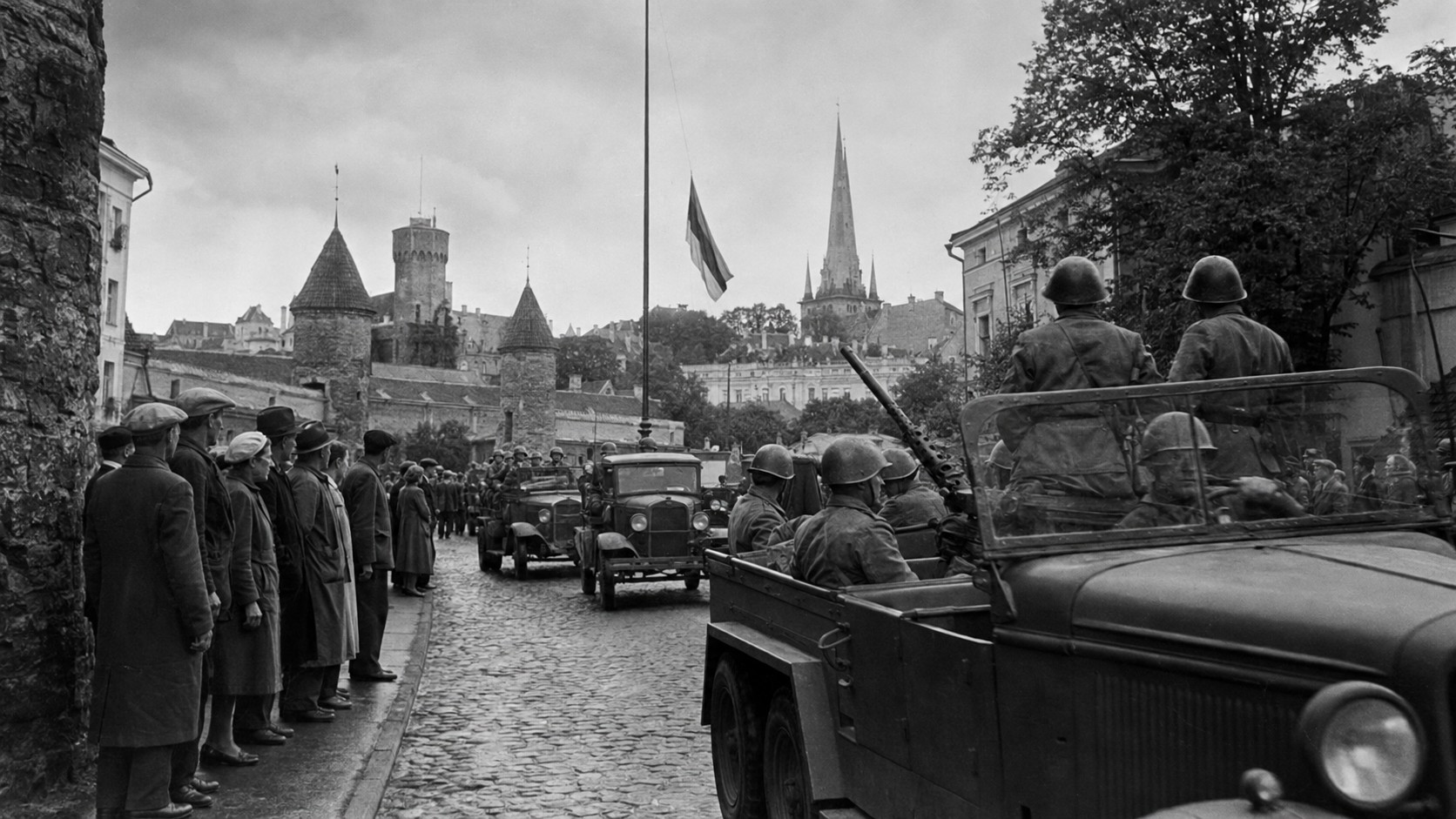
On 6 August 1940, Estonia was formally incorporated into the Soviet Union, completing a carefully orchestrated takeover that ended more than two decades of independence. The annexation followed military occupation, political intimidation and elections conducted under Soviet control. Estonia would remain under foreign rule for most of the next 51 years before restoring its independence in 1991.
A young republic under pressure
Estonia had declared independence from the Russian Empire on 24 February 1918. Following victory in the Estonian War of Independence, the 1920 Treaty of Tartu established peace with Soviet Russia, which recognised Estonia’s sovereignty and renounced territorial claims against it.
For the next two decades, Estonia developed as an independent European state. However, its position became increasingly vulnerable as tensions grew between Nazi Germany and the Soviet Union.

The secret agreement that divided Europe
In August 1939, Germany and the Soviet Union signed the Molotov–Ribbentrop Pact. A secret protocol divided parts of Eastern Europe into German and Soviet spheres of influence, placing Estonia, Latvia and Finland within the Soviet sphere. Lithuania was later transferred largely to Soviet control under a subsequent agreement.
In September 1939, Moscow forced Estonia to accept a mutual assistance treaty allowing Soviet military bases and thousands of Soviet troops to be stationed inside the country. Although Estonia formally retained its government, its ability to resist further Soviet demands was severely weakened.
Occupation followed by controlled elections
On 16 June 1940, the Soviet Union presented Estonia with an ultimatum demanding the formation of a new government and unrestricted entry for additional Soviet forces. Soviet troops occupied the country the following day.
President Konstantin Päts was gradually removed from power and later deported. A Soviet-backed administration was installed, while political opponents were arrested and independent organisations were suppressed.
Parliamentary elections were held in July, but only Soviet-approved candidates were permitted to participate. The newly formed parliament proclaimed Estonia a Soviet socialist republic and requested admission to the Soviet Union. On 6 August, the Soviet authorities in Moscow approved the request.
Annexation rejected by Western governments
The Soviet Union described the incorporation as voluntary, but Estonia and many Western countries regarded it as an illegal annexation carried out under military occupation. The United States and several other governments refused to recognise Soviet sovereignty over Estonia.
Estonian diplomatic missions continued operating abroad, helping preserve the principle that the republic still legally existed despite losing control of its territory.
Repression and renewed occupation
Soviet rule brought arrests, executions, property seizures and mass deportations. Thousands of Estonians were sent to prisons, labour camps or remote settlements within the Soviet Union.
Nazi Germany occupied Estonia between 1941 and 1944, during which the country suffered further persecution and destruction. Soviet forces returned in 1944, beginning another long period of repression, censorship, Russification and political control.
Independence restored in 1991
Estonia’s national movement re-emerged during the final years of the Soviet Union. On 20 August 1991, Estonia restored its independence, asserting the legal continuity of the republic established in 1918.
The events of 1940 remain central to Estonia’s national identity and its modern emphasis on sovereignty, democratic government and security within Europe.
Newshub Editorial in Europe – 6 August 2026

Ask NF GPT
If you have an account with ChatGPT you get deeper explanations,
background and context related to what you are reading.
On 6 August 1940, Estonia was formally incorporated into the Soviet Union, completing a carefully orchestrated takeover that ended more than two decades of independence. The annexation followed military occupation, political intimidation and elections conducted under Soviet control. Estonia would remain under foreign rule for most of the next 51 years before restoring its independence in 1991.
Recent Comments