
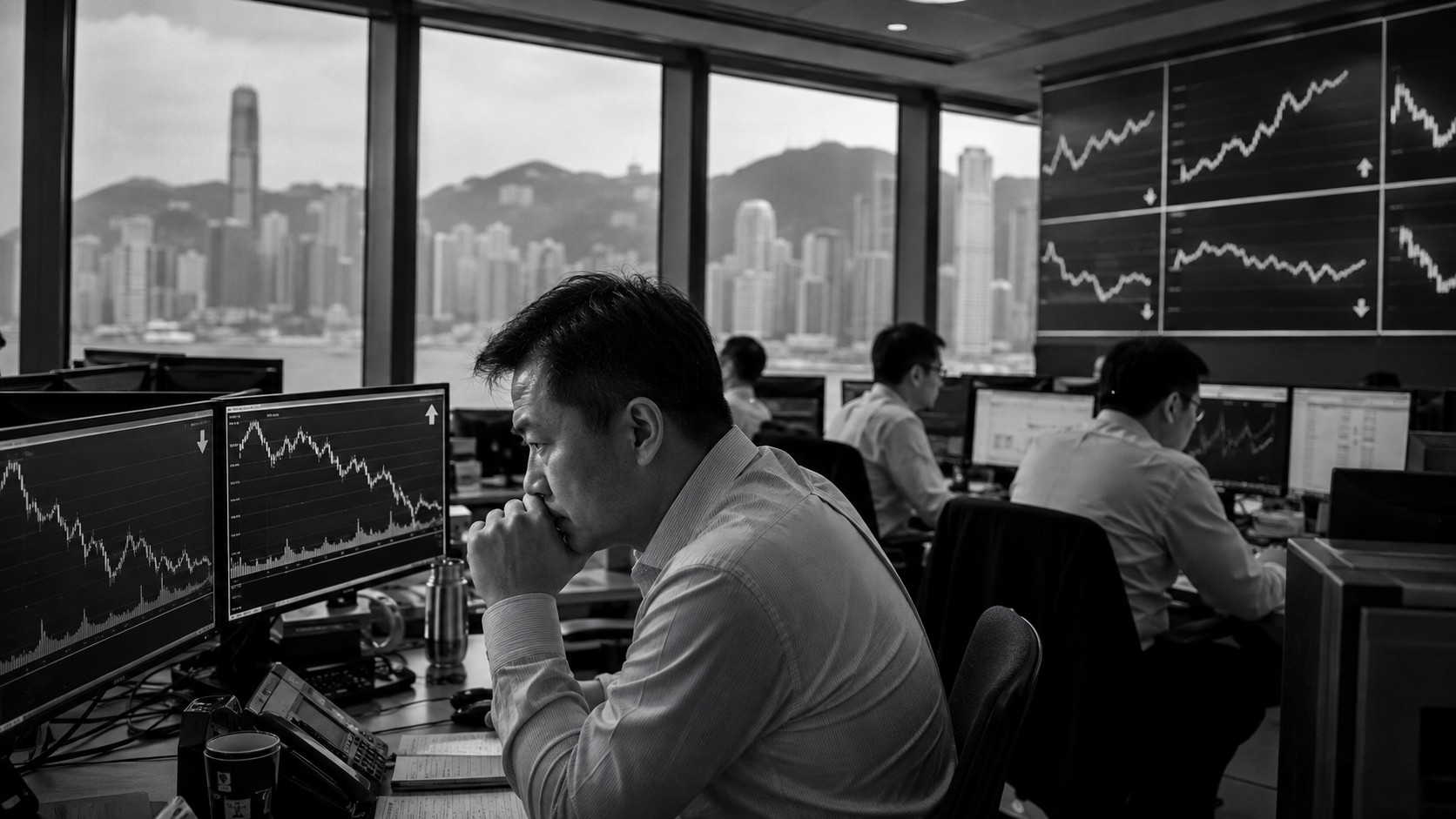
Asian markets opened with sharply different performances on Thursday as renewed weakness in technology shares weighed on Japan and Hong Kong, while investors supported equities in Singapore, Taiwan, Australia and India. The mixed session demonstrated that the regional decline was concentrated in specific sectors rather than representing a uniform withdrawal from Asian assets.
Japan retreats with semiconductor companies
Japan’s Nikkei 225 fell by approximately 1.1% during morning trading, extending its decline after opening under pressure. Semiconductor and electronics companies were among the weakest performers as investors reassessed the high valuations reached during the artificial intelligence rally.
Japanese memory-chip producer Kioxia fell almost 10%, while semiconductor equipment manufacturer Tokyo Electron declined by more than 4%. The losses followed a weaker technology session on Wall Street, where the Nasdaq ended its recent winning streak.

Hong Kong hit by insurance sell-off
Hong Kong’s Hang Seng Index fell by more than 2% shortly after the opening before reducing its decline to approximately 1.7%. The market was affected by both weaker technology sentiment and heavy selling among insurers and banks.
AIA Group dropped more than 8%, Prudential lost over 5% and FWD Group declined approximately 4.5%. The selling followed reports that Chinese authorities had begun applying a 20% personal income tax to returns from some insurance policies purchased outside mainland China.
Investors fear the measure could reduce demand for Hong Kong insurance products among mainland customers. HSBC and Standard Chartered also declined because of their substantial insurance operations and exposure to cross-border financial activity.
Mainland Chinese markets remain stable
Mainland Chinese equities were considerably calmer. The Shanghai Composite Index traded close to unchanged at around 3,879 points, suggesting that domestic investors were less affected by the regional technology sell-off.
The contrast between Shanghai and Hong Kong reflected the more direct exposure of the Hong Kong market to international technology sentiment, overseas capital flows and financial companies serving mainland customers.
Taiwan moves against the regional trend
Taiwanese equities advanced despite continued uncertainty surrounding semiconductor valuations. The Taiex gained approximately 2.4%, recovering part of the losses recorded during the recent period of intense technology-market volatility.
The rise suggested that some investors were willing to return to selected Taiwanese companies following substantial earlier declines. However, the size of recent daily movements showed that confidence in the semiconductor sector remains fragile.
Singapore and Australia record gains
Singapore produced one of the strongest performances in the region, with the Straits Times Index rising approximately 1.1% to around 5,645. Its greater concentration of banks, property companies and established industrial businesses provided some protection from the technology-driven weakness affecting northern Asian markets.
Australia’s S&P/ASX 200 gained approximately 0.5%, supported by a broader mix of financial, mining and consumer shares. The Australian market was also helped by expectations that moderate domestic inflation could reduce pressure for further interest-rate increases.
India opens moderately higher
India’s Sensex advanced approximately 0.2% to trade near 78,740, while investors continued to balance domestic growth expectations against global interest-rate uncertainty. Indonesia’s Jakarta Composite remained broadly unchanged after opening, reflecting a cautious approach among Southeast Asian investors.
Regional investors await US employment data
The broader MSCI Asia-Pacific index excluding Japan declined by approximately 0.7%, largely because of heavy technology losses in South Korea and parts of the Japanese market.
Attention is now turning towards the latest US employment report, which could influence expectations for Federal Reserve policy. Until markets receive greater clarity on interest rates and the profitability of AI investment, Asian trading is likely to remain volatile and increasingly divided between technology-heavy markets and more diversified regional exchanges.
Newshub Editorial in Asia – 6 August 2026

Ask NF GPT
If you have an account with ChatGPT you get deeper explanations,
background and context related to what you are reading.
Asian markets opened with sharply different performances on Thursday as renewed weakness in technology shares weighed on Japan and Hong Kong, while investors supported equities in Singapore, Taiwan, Australia and India. The mixed session demonstrated that the regional decline was concentrated in specific sectors rather than representing a uniform withdrawal from Asian assets.
Recent Comments