
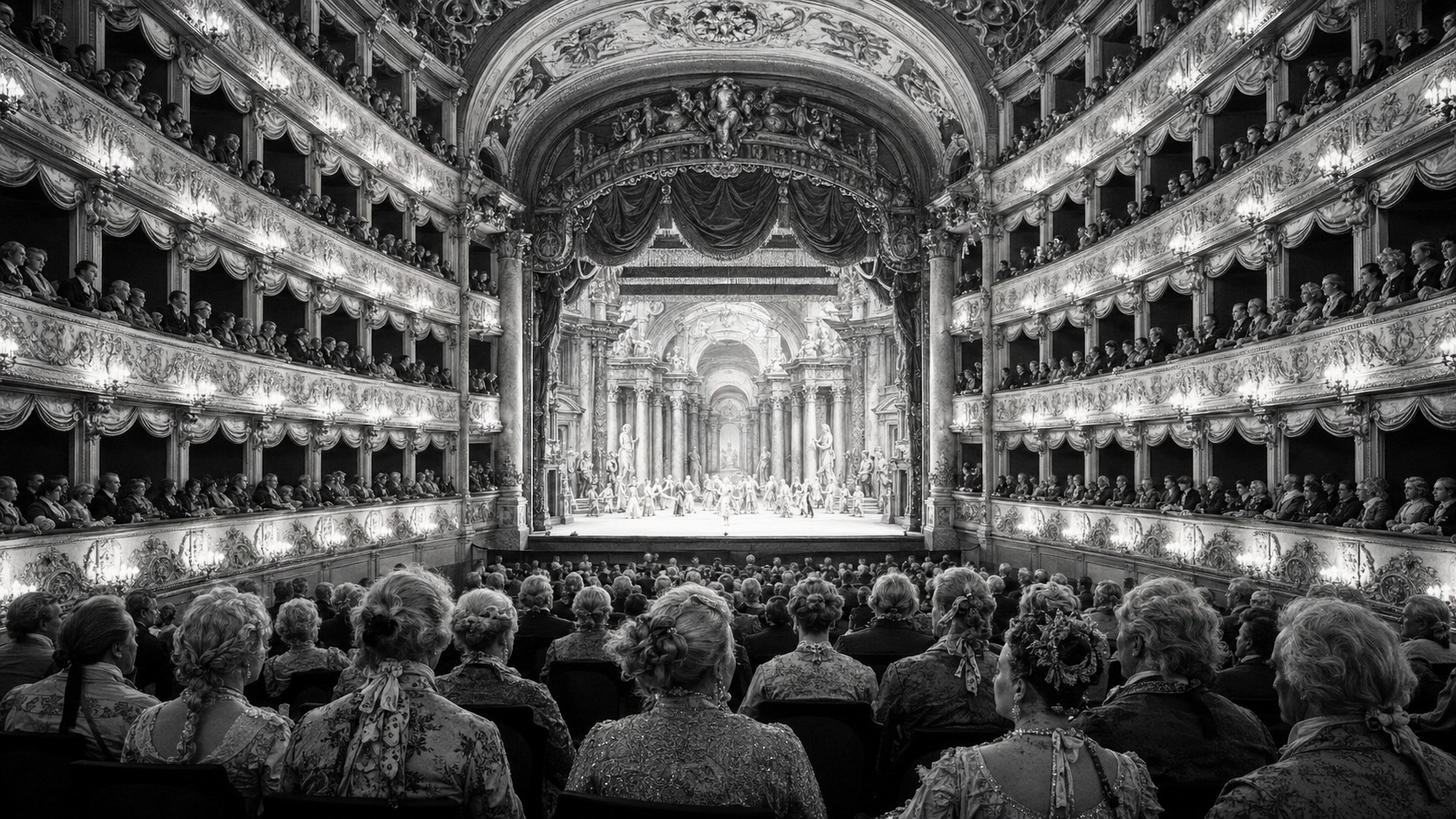
On this day in 1778, Milan’s Teatro alla Scala opened its doors for the first time, beginning the history of what would become one of the world’s most celebrated opera houses. The inaugural performance was Antonio Salieri’s L’Europa riconosciuta, presented before an audience drawn from Milan’s political, cultural and aristocratic elite.
Officially named the Nuovo Regio Ducale Teatro alla Scala, the theatre was designed by the distinguished neoclassical architect Giuseppe Piermarini. Its construction had followed the destruction of Milan’s previous opera house, the Teatro Regio Ducale, which was consumed by fire in February 1776.
The loss prompted a group of wealthy Milanese box owners to appeal for a replacement. The project received the support of Empress Maria Theresa, whose Habsburg monarchy controlled Lombardy at the time.

A theatre built over a church
The new opera house was constructed on the site of the former church of Santa Maria alla Scala. The church gave the theatre its name, which was gradually shortened in everyday usage to La Scala.
Piermarini created a relatively restrained exterior, but behind it stood an imposing auditorium designed to combine elegance, visibility and impressive acoustics. The original interior contained hundreds of private boxes arranged across several levels, reflecting the social structure of 18th-century Milan.
La Scala was more than a performance venue. Its private boxes became meeting places where members of Milanese society could dine, gamble, conduct business and discuss politics. Performances were therefore both artistic occasions and major social events.
The centre of Italian opera
During the 19th century, La Scala became closely associated with the development of Italian opera. Works by Gioachino Rossini, Vincenzo Bellini and Gaetano Donizetti were presented there, while Giuseppe Verdi established one of the most important relationships in the theatre’s history.
Verdi’s Nabucco premiered at La Scala in 1842 and helped establish him as a leading composer. His later masterpieces Otello and Falstaff also received their first performances at the theatre.
La Scala subsequently hosted the premieres of Giacomo Puccini’s Madama Butterfly in 1904 and Turandot in 1926. The latter was presented after Puccini’s death and conducted by Arturo Toscanini, one of La Scala’s most influential musical directors.
Surviving war and destruction
The theatre was badly damaged during Allied bombing of Milan in 1943. Its roof collapsed and much of the auditorium was destroyed, but reconstruction began soon after the war.
La Scala reopened on 11 May 1946 with a concert conducted by Toscanini, who had returned from the United States for the occasion. The reopening was regarded as a powerful symbol of Milan’s cultural and civic recovery.
Following another major restoration, the theatre reopened in December 2004 with a new production of Salieri’s L’Europa riconosciuta—the same work that had inaugurated La Scala in 1778.
Nearly 250 years after its opening, La Scala remains a defining institution of international opera and ballet, preserving the traditions established on that historic Milanese evening.
Newshub Editorial in Europe – 3 August 2026

Ask NF GPT
If you have an account with ChatGPT you get deeper explanations,
background and context related to what you are reading.
Recent Comments