
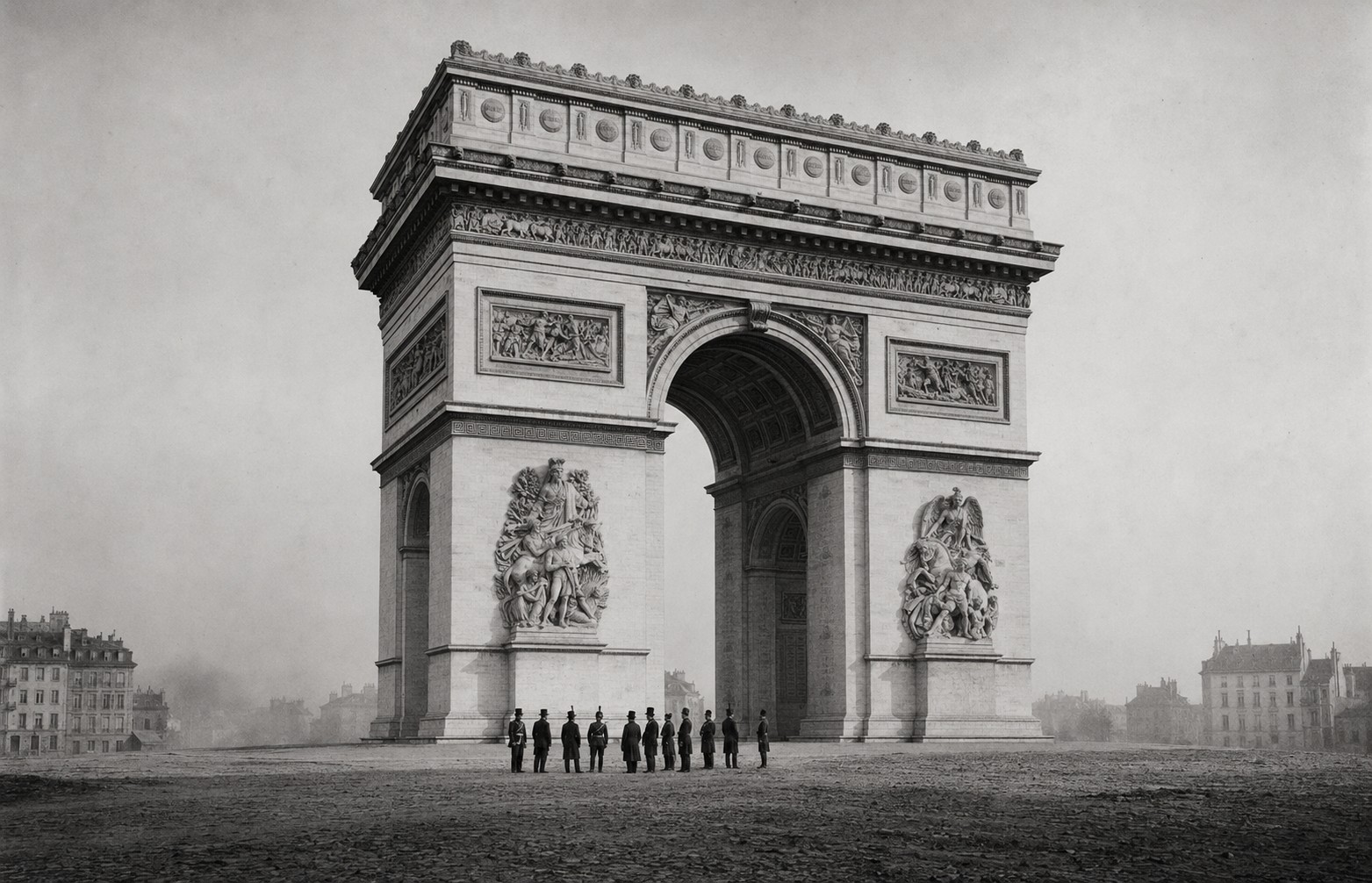
On this day in 1836, one of the world’s greatest monuments to military victory was inaugurated in Paris with almost no ceremony. After three decades of construction, the Arc de Triomphe opened at seven in the morning with only eleven people present and King Louis-Philippe conspicuously absent.
A monument conceived by Napoleon
Napoleon Bonaparte ordered the construction of the Arc de Triomphe in 1806, following his decisive victory over Russian and Austrian forces at the Battle of Austerlitz.
The emperor envisioned a monumental gateway honouring the soldiers of France’s Revolutionary and Napoleonic armies. Standing at the Place de l’Étoile, at the western end of the Champs-Élysées, it would evoke the triumphal arches of ancient Rome while proclaiming the military power of modern France.
Architect Jean-François-Thérèse Chalgrin designed the enormous Neoclassical structure. Its foundations alone took two years to complete, while political upheaval, military defeat and changes of government repeatedly delayed the project.

Napoleon never saw the completed monument. Construction slowed after his fall and largely stopped during the Bourbon Restoration before eventually resuming under successive French governments.
A celebration cancelled by fear
By 1836, the Arc de Triomphe was finally ready to be unveiled. A major national celebration was planned for 29 July, the anniversary of the July Revolution that had brought Louis-Philippe to the French throne.
The ceremony was intended to unite the legacy of the Revolution, the Napoleonic Empire and the July Monarchy. However, continuing political unrest and fears of an assassination attempt against the king caused the government to cancel the festivities.
Louis-Philippe had survived several attempts on his life, including an attack only weeks before the inauguration. Officials were unwilling to expose the monarch and assembled dignitaries to another potential assault.
Instead, the monument was opened quietly at seven in the morning. Only eleven people reportedly attended: Prime Minister Adolphe Thiers, Finance Minister Antoine d’Argout, six members of the National Guard, the monument’s guardian and two official visitors.
There were no marching armies, royal processions or cheering crowds beneath the arch built to celebrate military triumph.
Paris eventually gathers
The inauguration did not remain entirely invisible. At nightfall, Parisians gathered around the monument as approximately 700 gaslights illuminated its vast stone façades.
Standing about 50 metres high and 45 metres wide, the Arc de Triomphe was then the largest triumphal arch in the world. Its surfaces carried the names of French generals, battles and military victories, while monumental sculptures presented competing images of triumph, resistance, sacrifice and peace.
Four years later, Napoleon finally passed beneath the arch when his remains were returned from Saint Helena to Paris in 1840. The monument subsequently became the setting for military parades, state funerals, national celebrations and moments of mourning.
Since 1920, the Tomb of the Unknown Soldier has rested beneath its vault. An eternal flame, first lit in 1923, continues to honour unidentified French soldiers killed in war.
A monument designed for spectacle thus began its public life almost in secret. Yet the quiet opening of 1836 would prove only a brief prelude to the central place the Arc de Triomphe would occupy in French history.
Newshub Editorial in Europe – July 29, 2026

Ask NF GPT
If you have an account with ChatGPT you get deeper explanations,
background and context related to what you are reading.
Recent Comments