
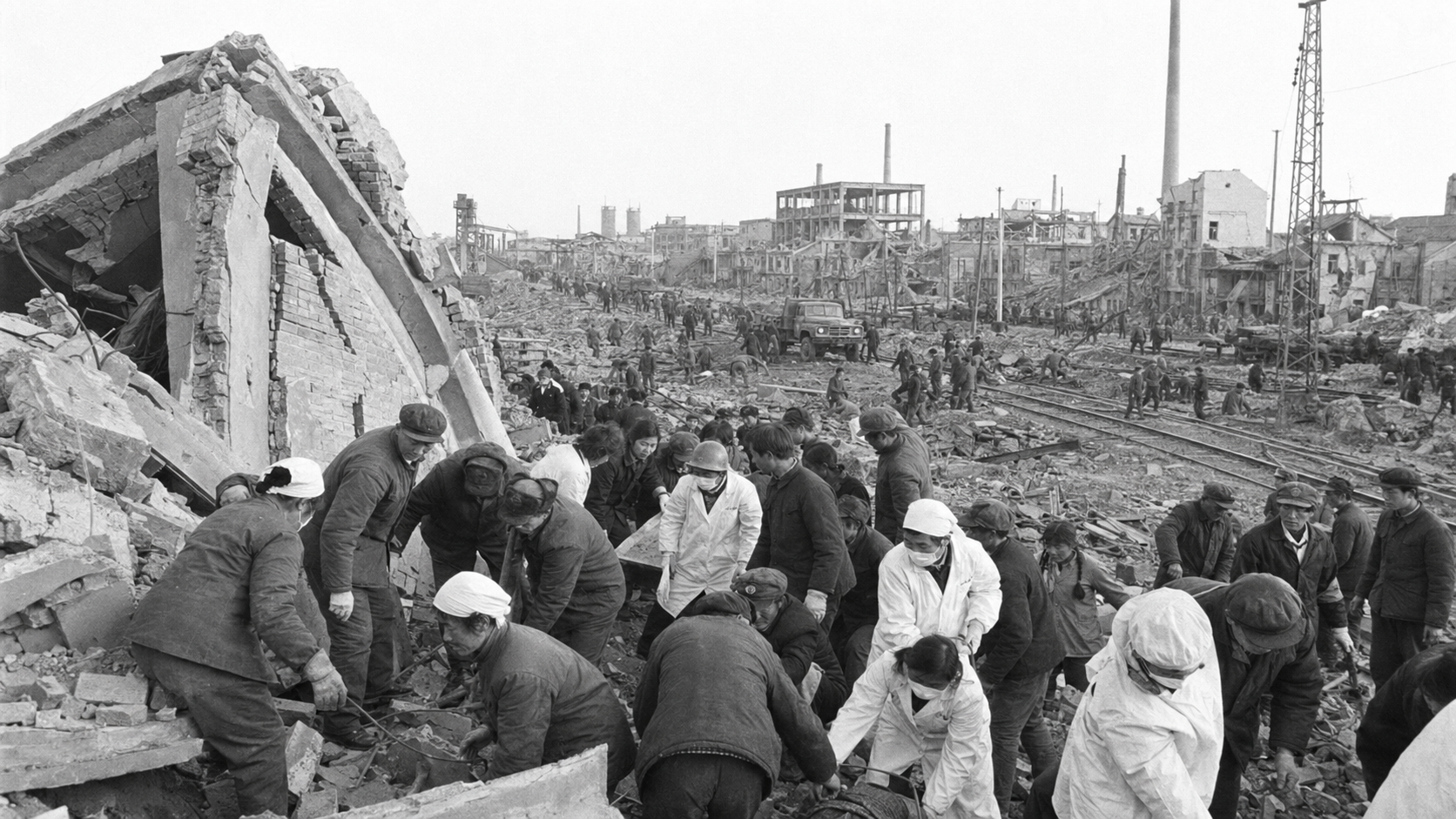
On this day in 1976, one of the deadliest earthquakes in recorded history struck the industrial city of Tangshan in northern China, killing more than 240,000 people and reducing much of the city to rubble within seconds.
A city struck without warning
At 3.42am on July 28, most of Tangshan’s residents were asleep when a powerful earthquake, now generally estimated at magnitude 7.6, struck directly beneath the city.
Tangshan, located approximately 150 kilometres east of Beijing in Hebei province, was one of China’s most important industrial centres. Its coal mines, factories, railways and densely populated residential districts made it vital to the country’s economy.

The earthquake lasted only seconds, but the destruction was overwhelming. Entire neighbourhoods collapsed, roads split apart and railway lines were twisted. Electricity, water supplies and communications failed almost immediately.
It is estimated that around 85 per cent of the city’s buildings either collapsed or were rendered unusable. Hospitals, schools, factories and homes were destroyed, leaving hundreds of thousands of people trapped beneath concrete, bricks and timber.
More than 240,000 lives lost
The official death toll was eventually placed at more than 242,000, while hundreds of thousands more were injured. Some later estimates suggested the true number of fatalities may have been significantly higher.
A powerful second earthquake struck the region later that day, causing further destruction and placing survivors and rescue workers in renewed danger. Numerous aftershocks continued to shake the area.
With roads, bridges and railways badly damaged, emergency assistance initially struggled to reach Tangshan. Survivors dug through ruins with their bare hands, searching for relatives, neighbours and strangers.
Military personnel, medical teams and volunteers were eventually deployed in a massive rescue operation. Temporary hospitals were established, while seriously injured survivors were transported to other cities for treatment.
The scale of the disaster was initially difficult for the outside world to assess. China was nearing the end of the Cultural Revolution, and information about domestic catastrophes remained tightly controlled.
A city rebuilt from the ruins
Despite the devastation, Tangshan was not abandoned. The Chinese authorities decided to rebuild the city on the same site, introducing stronger construction standards and redesigned residential and industrial districts.
Modern Tangshan once again became a major centre for steel, coal, manufacturing and transportation. Memorials, museums and preserved ruins now stand as reminders of the lives lost and the extraordinary destruction suffered by the city.
The disaster also transformed China’s approach to earthquake monitoring, emergency planning and the construction of buildings in seismically vulnerable regions.
Fifty years later, the Tangshan earthquake remains a powerful warning about the vulnerability of rapidly growing cities to natural disasters. It also remains a story of human endurance: a city destroyed before dawn, mourned by a nation and rebuilt by its survivors.
Newshub Editorial in Asia – July 28, 2026

Ask NF GPT
If you have an account with ChatGPT you get deeper explanations,
background and context related to what you are reading.
Recent Comments