
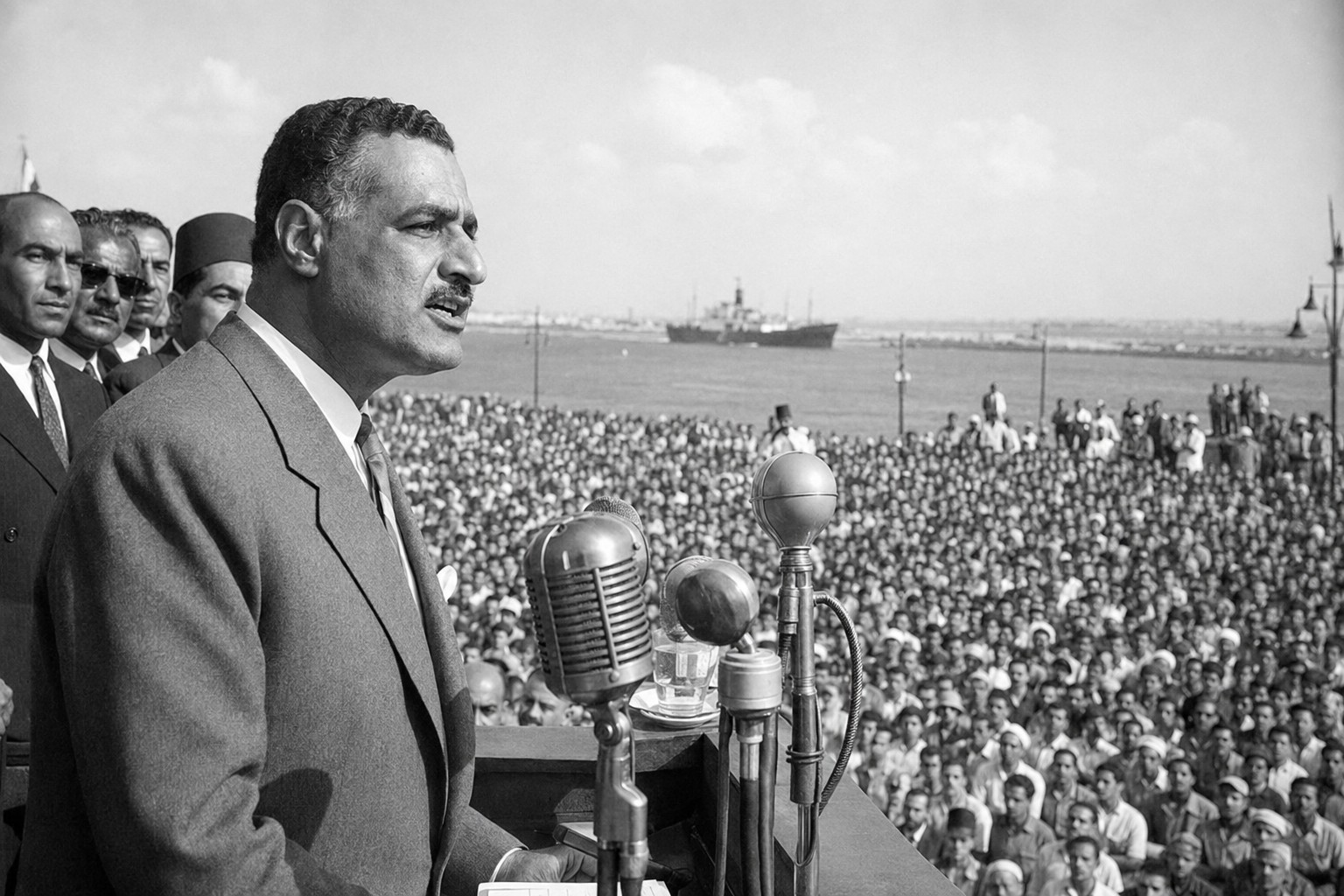
On this day in 1956, Egyptian President Gamal Abdel Nasser announced the nationalisation of the Suez Canal Company, seizing control of one of the world’s most strategically important waterways and triggering an international crisis that would weaken Britain and France while transforming Nasser into a symbol of Arab nationalism.
A canal controlled from abroad
The Suez Canal, completed in 1869, connected the Mediterranean Sea with the Red Sea and dramatically shortened the maritime route between Europe and Asia. Although the canal ran through Egyptian territory, the company operating it was largely controlled by British and French interests.
Britain regarded the canal as essential to its trade routes, oil supplies and remaining influence across the Middle East. British forces had maintained a military presence around the canal for decades, making it a powerful symbol of foreign control over Egyptian affairs.

Nasser, who had emerged as Egypt’s dominant leader following the 1952 revolution, wanted to end that influence and establish Egypt as an independent regional power.
The decision that shocked the world
On 26 July 1956, during a speech in Alexandria, Nasser declared that the Suez Canal Company would be nationalised. Egyptian authorities immediately moved to take control of the company’s offices and operations.
The decision followed the withdrawal of American and British financial support for the construction of the Aswan High Dam. Nasser argued that revenue generated by the canal could instead be used to finance the project, which was central to Egypt’s plans for economic development, electricity production and control of the Nile.
For many Egyptians, nationalisation was an assertion of sovereignty. For Britain and France, however, it represented both an economic threat and a direct challenge to their international authority.
The Suez Crisis
In October 1956, Israel invaded Egypt’s Sinai Peninsula. Britain and France then issued an ultimatum demanding that both sides withdraw from the canal area, before launching military operations against Egypt.
The intervention initially achieved military gains but produced a severe diplomatic backlash. The United States opposed the invasion, fearing that it could strengthen Soviet influence across the Arab world. The Soviet Union also condemned the attack, while pressure mounted through the United Nations.
Facing international isolation and intense economic pressure, Britain and France were forced to accept a ceasefire and withdraw their forces. Israel subsequently pulled back from Egyptian territory, and the canal remained under Egyptian control.
A turning point in global power
The crisis exposed the declining influence of Britain and France and demonstrated that the two former imperial powers could no longer act internationally without American support.
Although Egypt suffered military losses, Nasser emerged politically strengthened. Across Africa, the Middle East and other parts of the developing world, he became a powerful symbol of resistance to colonialism and foreign domination.
The nationalisation of the Suez Canal was therefore far more than an economic decision. It marked a decisive shift in the post-war balance of power and accelerated the decline of European imperial influence.
Newshub Editorial in Africa – 26 July 2026

Ask NF GPT
If you have an account with ChatGPT you get deeper explanations,
background and context related to what you are reading.
Recent Comments