
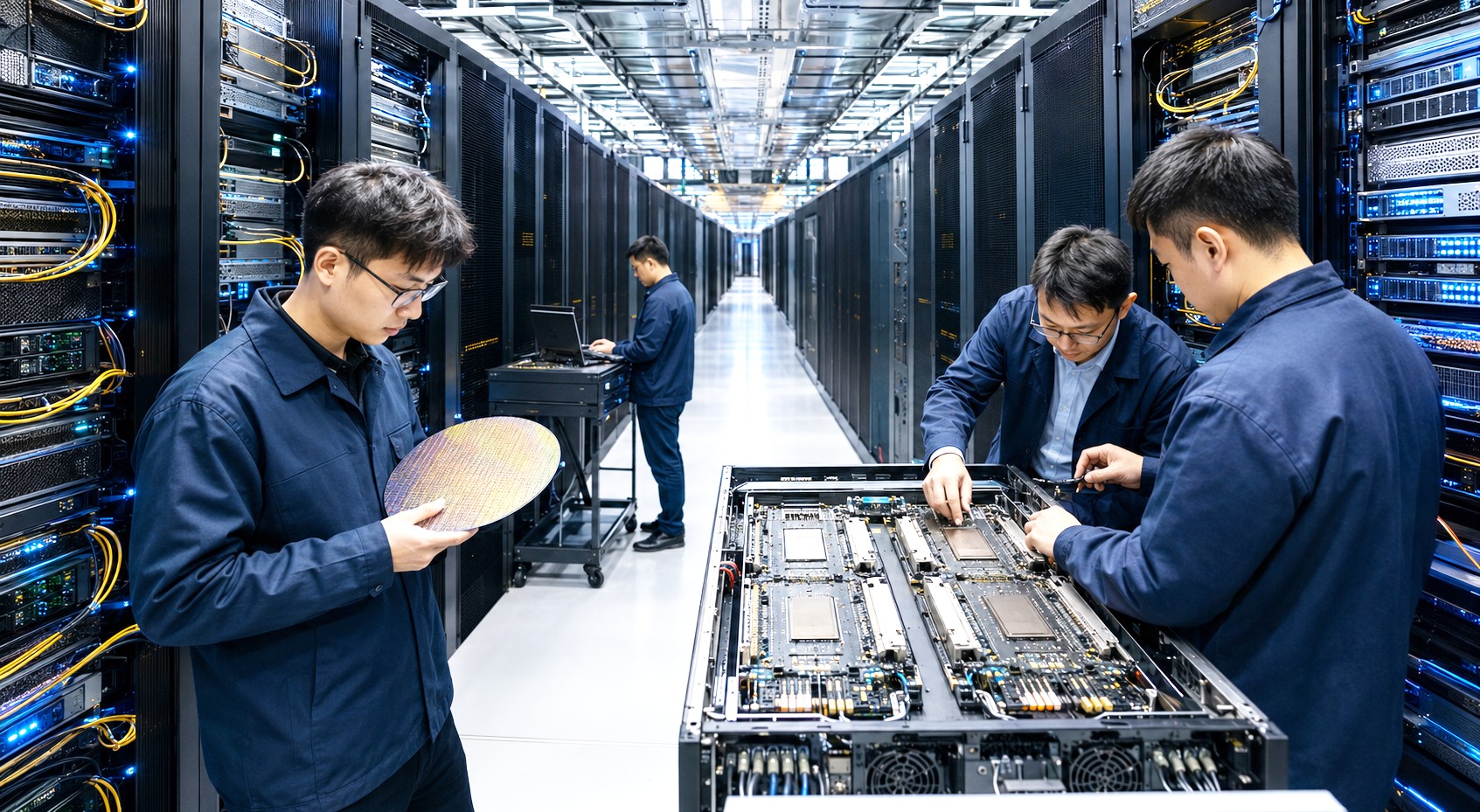
SenseTime has launched its Galaxy Project with almost 20 technology partners, aiming to build five large computing clusters based on domestically developed AI processors and reduce China’s dependence on foreign hardware for training and operating advanced artificial intelligence models.
Five domestic computing clusters planned
The initiative was announced during the 2026 World Artificial Intelligence Conference in Shanghai. SenseTime said each of the five planned clusters would contain approximately 10,000 Chinese-developed AI accelerators.
The Galaxy Project will bring together chip designers, component manufacturers, software developers and data-centre operators. Participating processor companies include Huawei Ascend, Cambricon, Hygon, Moore Threads, Biren Technology, MetaX and Sunrise.


SenseTime also plans to create what it describes as an industrial-scale “token factory”, referring to infrastructure designed to produce the vast quantities of AI-generated processing units required by models and commercial applications.
The project will support joint development across 10 technical areas and provide computing capacity and services to as many as 200 AI start-ups.
Scale requires more than individual chips
China has produced a growing number of domestic AI processors, but converting individual products into reliable large-scale computing systems remains difficult.
AI clusters require processors to communicate rapidly while sharing memory and workloads. Hardware must also operate with compatible software, networking equipment, cooling systems and model-development tools.
Nvidia’s advantage is consequently not limited to the performance of its processors. Its CUDA software ecosystem and established networking technology allow developers to operate thousands of chips together with relatively predictable results.
The Galaxy Project seeks to address that gap by combining products from several Chinese manufacturers through SenseTime’s SenseCore computing platform. This could allow workloads to be distributed across different processor architectures rather than depending on a single supplier.
SenseTime claims efficiency improvements
SenseTime says its optimisation technology has improved model-flops utilisation on leading domestic chips by between 85 and 152 per cent. Model-flops utilisation measures how effectively available processor capacity is converted into useful AI computation.
The company also claims that heterogeneous inference, which divides different stages of model processing between different types of chips, can increase token output by 2.5 times at the same cost.
Another system coordinates computing demand with electricity availability. SenseTime says it can forecast workload requirements with 96 per cent accuracy and reduce average electricity prices by approximately 10 per cent compared with data centres in the same region.
These figures have been presented by the company and will need to be demonstrated across sustained commercial operations.
Domestic scale-up becomes strategic
China’s drive to expand domestic AI infrastructure has accelerated as US export controls restrict access to Nvidia’s most advanced processors and semiconductor manufacturing equipment.
Chinese chips continue to face constraints in fabrication capacity, high-bandwidth memory, advanced packaging and energy efficiency. Building clusters with more processors can compensate for some performance limitations, but it also increases electricity consumption and technical complexity.
SenseTime’s project does not itself expand semiconductor fabrication. Instead, it attempts to create sufficient commercial demand and system compatibility for domestic processors to be deployed at scale.
If successful, the Galaxy Project could provide Chinese model developers with a broader alternative to imported hardware. Its greater significance may lie in establishing a shared infrastructure ecosystem in which competing domestic chip companies can operate together, turning China’s collection of emerging processors into a more coherent AI computing platform.
Newshub Editorial in Asia – 23 July 2026

Ask NF GPT
If you have an account with ChatGPT you get deeper explanations,
background and context related to what you are reading.
SenseTime has launched its Galaxy Project with almost 20 technology partners, aiming to build five large computing clusters based on domestically developed AI processors and reduce China’s dependence on foreign hardware for training and operating advanced artificial intelligence models.
Recent Comments