
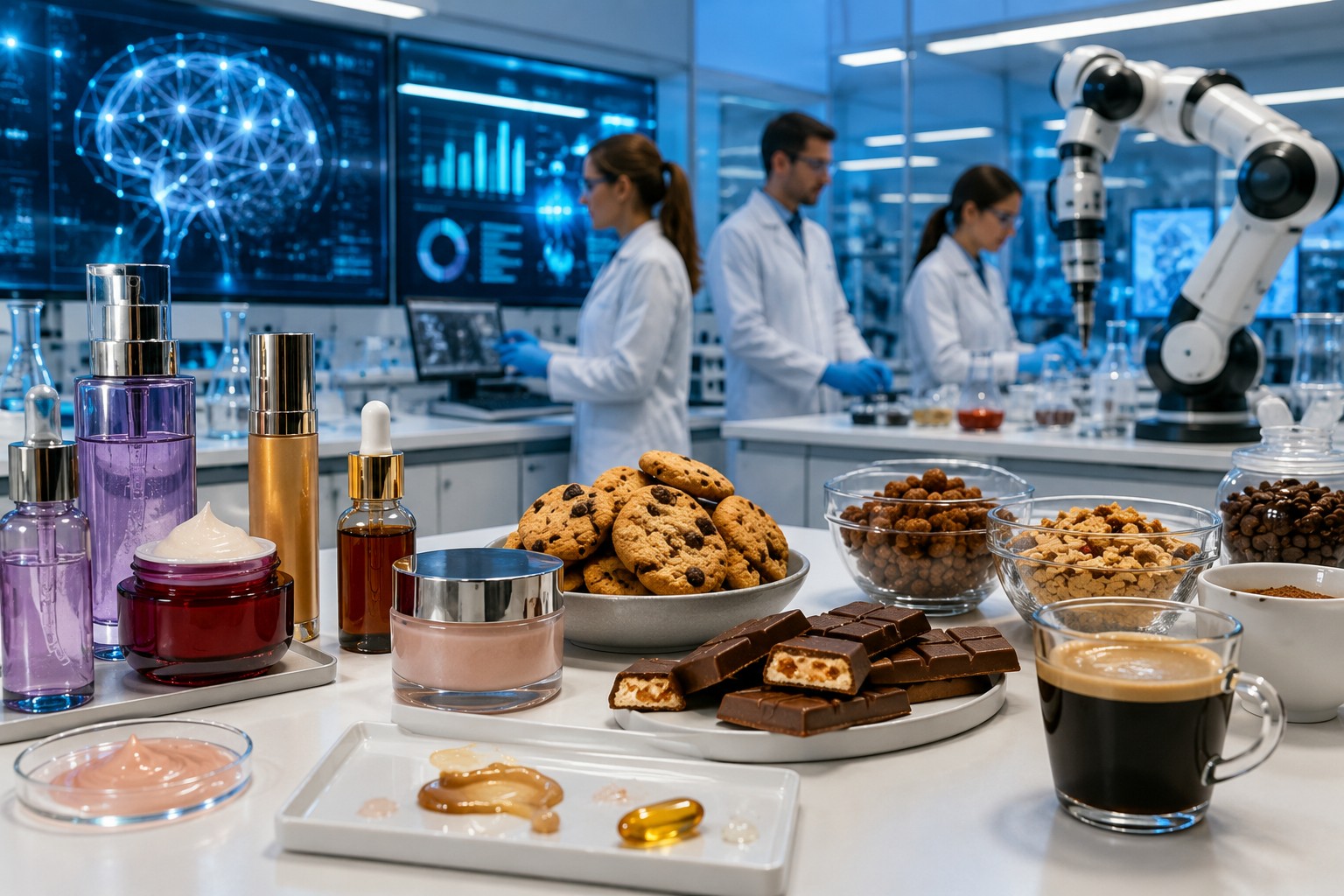
Some of the world’s largest consumer goods companies are increasingly turning to artificial intelligence to shorten product development cycles, improve consumer insights and bring new products to market more quickly. L’Oréal, Mondelez and Nestlé are among the global brands integrating AI into research, formulation and product testing as competition intensifies across the consumer goods sector.
Artificial intelligence is becoming an important tool throughout the product development process. Rather than replacing researchers or product designers, AI is being used to analyse vast amounts of consumer data, identify emerging trends and generate new product concepts that can then be refined by human experts.
For manufacturers operating in highly competitive markets, reducing development time by even a few months can provide a significant commercial advantage.


Beauty industry embraces digital innovation
L’Oréal has expanded its use of AI across product research, formulation and personalised beauty solutions. By analysing consumer preferences, skin characteristics and purchasing behaviour, AI systems help researchers identify potential product opportunities and predict which formulations are most likely to succeed.
The company is also using AI to support marketing, virtual beauty consultations and digital customer experiences, reflecting a broader transformation across the cosmetics industry.
Executives believe that combining scientific expertise with artificial intelligence allows innovation teams to work more efficiently while maintaining rigorous product safety and quality standards.
Food companies accelerate research
Food manufacturers Mondelez and Nestlé are also applying AI to product development. The technology is helping research teams evaluate flavour combinations, optimise recipes and analyse consumer feedback from multiple markets simultaneously.
Instead of relying solely on traditional product testing, AI enables companies to identify patterns in customer preferences that may not be immediately apparent through conventional market research.
The result is a faster innovation process that can respond more quickly to changing consumer tastes, dietary trends and regional preferences.
From months to weeks
One of the most significant benefits of AI is its ability to reduce the time required to develop and evaluate new products. Tasks that previously required months of market analysis or laboratory experimentation can increasingly be completed in weeks through advanced modelling and predictive analytics.
Researchers still conduct extensive physical testing before products reach consumers, but AI helps narrow the range of potential formulations and concepts, allowing development teams to focus resources more effectively.
This combination of machine learning and human expertise is becoming a defining feature of modern consumer product innovation.
The future of consumer goods
As artificial intelligence continues to evolve, analysts expect its role within consumer goods companies to expand further. Beyond product development, AI is already supporting supply chain management, manufacturing, quality control, demand forecasting and personalised marketing.
Companies such as L’Oréal, Mondelez and Nestlé view AI not simply as a technology investment but as a strategic capability that can improve efficiency, strengthen innovation and respond more rapidly to changing market conditions.
While human creativity, scientific expertise and consumer testing remain central to successful product development, AI is increasingly becoming an indispensable partner in bringing the next generation of products to market more quickly and effectively.
Newshub Editorial in Europe – 8 July 2026

Ask NF GPT
If you have an account with ChatGPT you get deeper explanations,
background and context related to what you are reading.
Some of the world's largest consumer goods companies are increasingly turning to artificial intelligence to shorten product development cycles, improve consumer insights and bring new products to market more quickly. L’Oréal, Mondelez and Nestlé are among the global brands integrating AI into research, formulation and product testing as competition intensifies across the consumer goods sector.
Recent Comments