
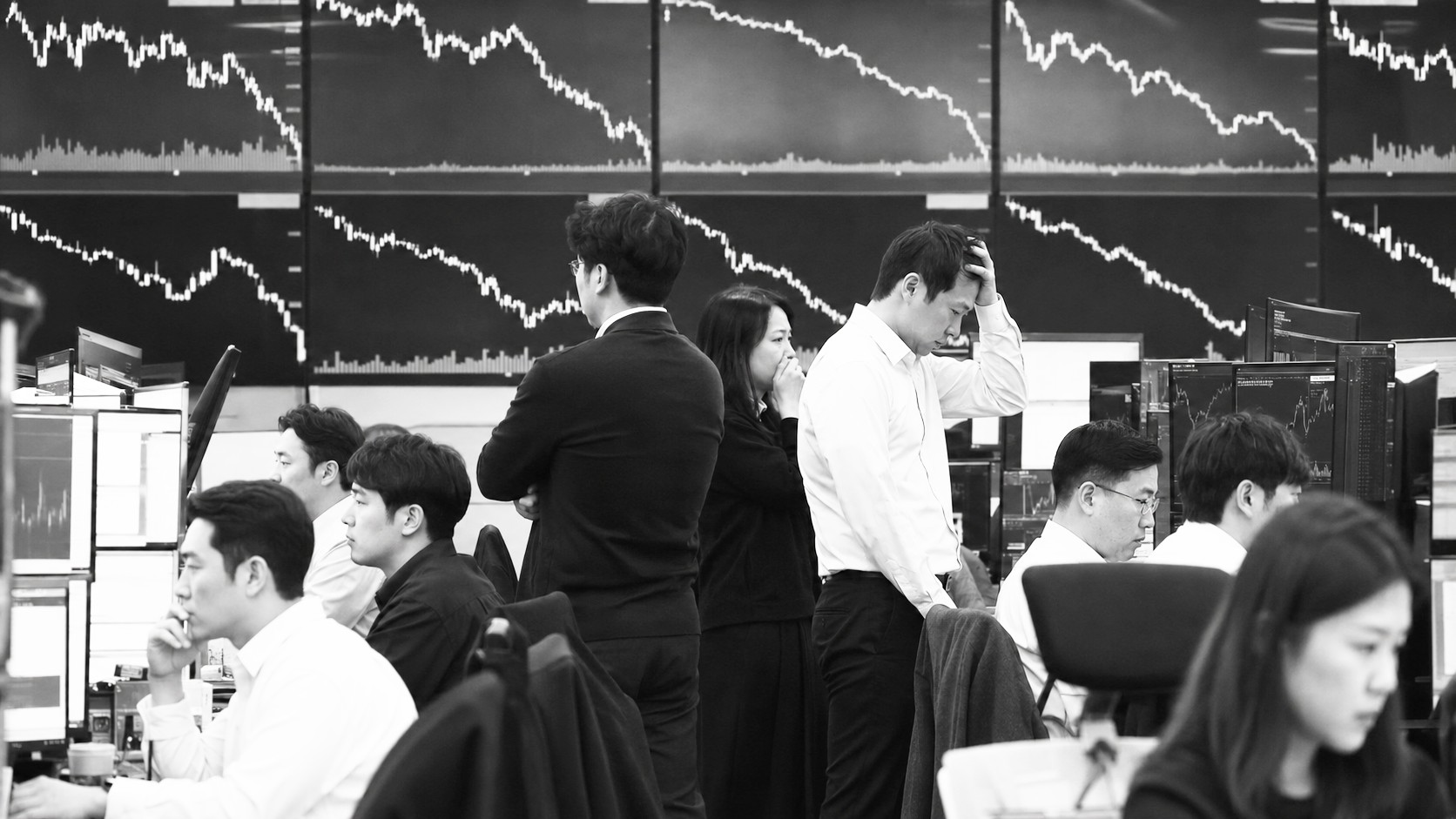
South Korea’s KOSPI plunged more than 10 per cent on Tuesday as investors abandoned semiconductor and artificial intelligence stocks, triggering emergency trading restrictions and spreading heavy losses across several of Asia’s largest markets.
KOSPI loses more than 698 points
The benchmark KOSPI fell 698.43 points, or 10.34 per cent, to 6,057.32 during the session, marking one of its most dramatic one-day declines of the year.
The sell-off was dominated by South Korea’s two largest technology companies. Samsung Electronics and SK Hynix both fell by more than 12 per cent as investors rapidly reduced their exposure to semiconductor manufacturers.

Together, the two companies account for more than half of the KOSPI’s weighting. Their enormous influence meant that heavy selling in only a small number of technology shares was enough to drag the entire South Korean market sharply lower.
The scale and speed of the decline triggered temporary restrictions on programme trading. Similar measures were activated on the technology-heavy Kosdaq market as authorities attempted to control extreme volatility.
China challenges the AI investment story
The immediate pressure came from growing doubts about whether the huge sums invested in artificial intelligence infrastructure will generate sufficient returns.
Nvidia shares had fallen around 5 per cent in the United States following reports that the company could become involved in financing guarantees connected to a massive OpenAI data-centre project. The news increased concern about the complex financial relationships developing between chip manufacturers, AI companies and data-centre operators.
Investors were also unsettled by China’s accelerating semiconductor ambitions. The extraordinary stock market debut of Chinese memory-chip producer ChangXin Memory Technologies highlighted the emergence of a potentially powerful competitor to Samsung and SK Hynix.
Reports that China had made progress in producing domestic deep ultraviolet lithography equipment added to fears that Chinese companies could eventually reduce their dependence on foreign technology and increase global chip production.
This combination raised the possibility of greater competition, excess semiconductor capacity and pressure on future prices and profit margins.
Losses spread across Asia
The technology sell-off quickly moved beyond South Korea. Japan’s Nikkei 225 dropped around 4 per cent, with memory-chip producer Kioxia and other semiconductor-related companies suffering particularly heavy losses.
Taiwan’s Taiex fell approximately 3.9 per cent as investors sold shares connected to the global chip supply chain. MediaTek dropped sharply, while Taiwan Semiconductor Manufacturing Company also came under pressure.
Mainland Chinese markets recorded more moderate declines. The Shanghai Composite lost around 1 per cent, while the CSI 300 fell more heavily. Hong Kong’s Hang Seng moved slightly lower as weakness in technology companies was partly balanced by gains elsewhere.
Australia’s S&P/ASX 200 avoided the regional trend and advanced modestly, demonstrating that the sell-off remained concentrated primarily in technology-dependent markets.
A warning from an extraordinary rally
The KOSPI had already fallen substantially from its June record after an exceptional AI-driven rally. High levels of borrowing, leveraged investment products and the dominance of a small number of semiconductor companies have intensified recent market swings.
Tuesday’s plunge does not necessarily signal the collapse of the Asian technology sector. It does, however, demonstrate how quickly confidence can disappear when enormous valuations depend on continued growth in AI spending and limited competition.
Newshub Editorial in Asia – July 28, 2026

Ask NF GPT
If you have an account with ChatGPT you get deeper explanations,
background and context related to what you are reading.
Recent Comments