
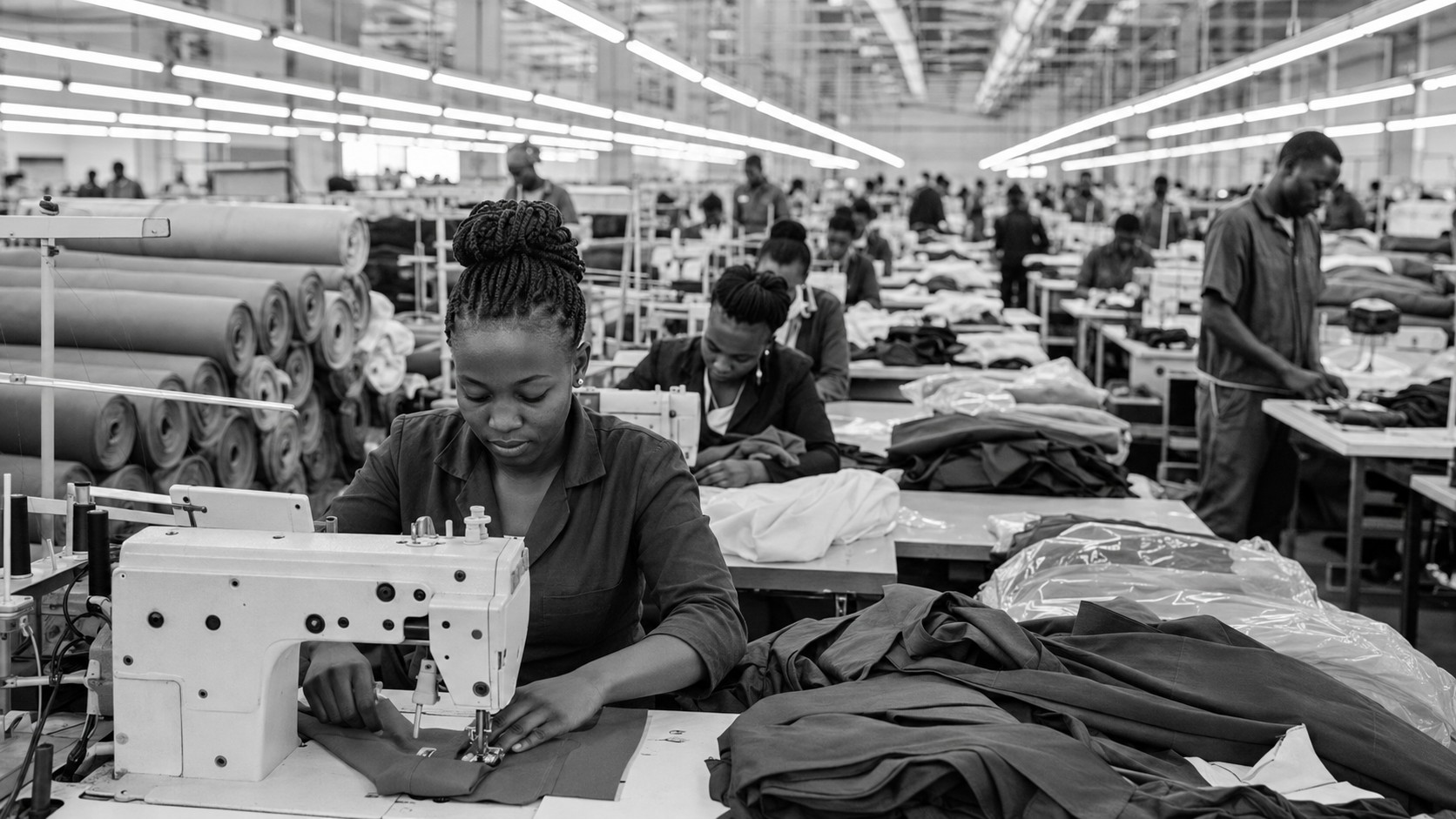
The African Growth and Opportunity Act has transformed several African countries into major clothing exporters, but a rule allowing manufacturers to use Chinese and Indian textiles has raised difficult questions about how much industrial value remains on the continent.
A rule that made African exports competitive
Introduced in 2000, AGOA grants eligible sub-Saharan African countries tariff-free access to the United States for thousands of products.
One of its most important components is the third-country fabric provision. This allows qualifying African countries to manufacture garments using yarn and fabric imported from outside the continent while still exporting the finished clothing to the United States without tariffs.

The rule has enabled factories to purchase competitively priced materials from China, India, Taiwan and South Korea. It has reduced production costs and allowed African manufacturers to meet the detailed requirements of major American clothing companies.
Without that flexibility, many African factories would struggle to compete with established manufacturers in Asia.
Countries including Kenya, Lesotho, Madagascar, Mauritius and Eswatini have attracted considerable foreign investment under the programme. New factories have created hundreds of thousands of jobs, many of them for women entering formal employment for the first time.
Garment factories without textile industries
The criticism is that AGOA has encouraged garment assembly without creating a complete African textile industry.
Many factories operate through a cut-make-trim model. Fabric, yarn, buttons, zips and other materials are imported, while African workers cut and assemble the garments before they are shipped to the United States.
This means African countries capture the labour-intensive manufacturing stage but lose much of the value generated through cotton processing, spinning, weaving, dyeing, finishing, design and textile technology.
The availability of imported materials also reduces the commercial incentive for foreign investors to build expensive textile mills in Africa. In some countries, locally produced cotton continues to be exported as a raw commodity before returning to the continent as finished fabric.
The result is an industry that creates employment but remains dependent on Asian suppliers.
Dependence brings economic risks
This dependence makes African clothing exporters vulnerable to shipping disruption, currency movements and changes in foreign trade policy.
AGOA expired in September 2025 before being renewed retroactively in February 2026. The current extension lasts only until December 31, creating uncertainty for factories, international buyers and potential investors.
The experiences of Madagascar and Ethiopia demonstrate the danger. Both suffered factory closures and job losses after losing AGOA eligibility following political crises.
Companies are unlikely to invest heavily in African spinning and weaving facilities when access to the American market can be withdrawn or renewed only for short periods.
Removing the rule could destroy jobs
Ending the third-country provision immediately would not necessarily create an African textile industry. Without sufficient local fabric production, many existing garment factories could simply close or move to Asia.
The more realistic challenge is to preserve the jobs created by AGOA while gradually expanding local production.
Benin is pursuing one possible model through the Glo-Djigbé Industrial Zone, where locally grown cotton is intended to move through processing and manufacturing before becoming finished clothing.
The African Continental Free Trade Area could also help create regional supply chains connecting cotton-producing countries with textile mills and garment factories elsewhere on the continent.
AGOA’s third-country rule has therefore both supported and limited African industrialisation. It made large-scale clothing exports possible, but it also allowed an externally dependent production model to become permanent.
Africa’s next step must be to retain more of the value between cotton field and finished garment.
Newshub Editorial in Africa – July 28, 2026

Ask NF GPT
If you have an account with ChatGPT you get deeper explanations,
background and context related to what you are reading.