
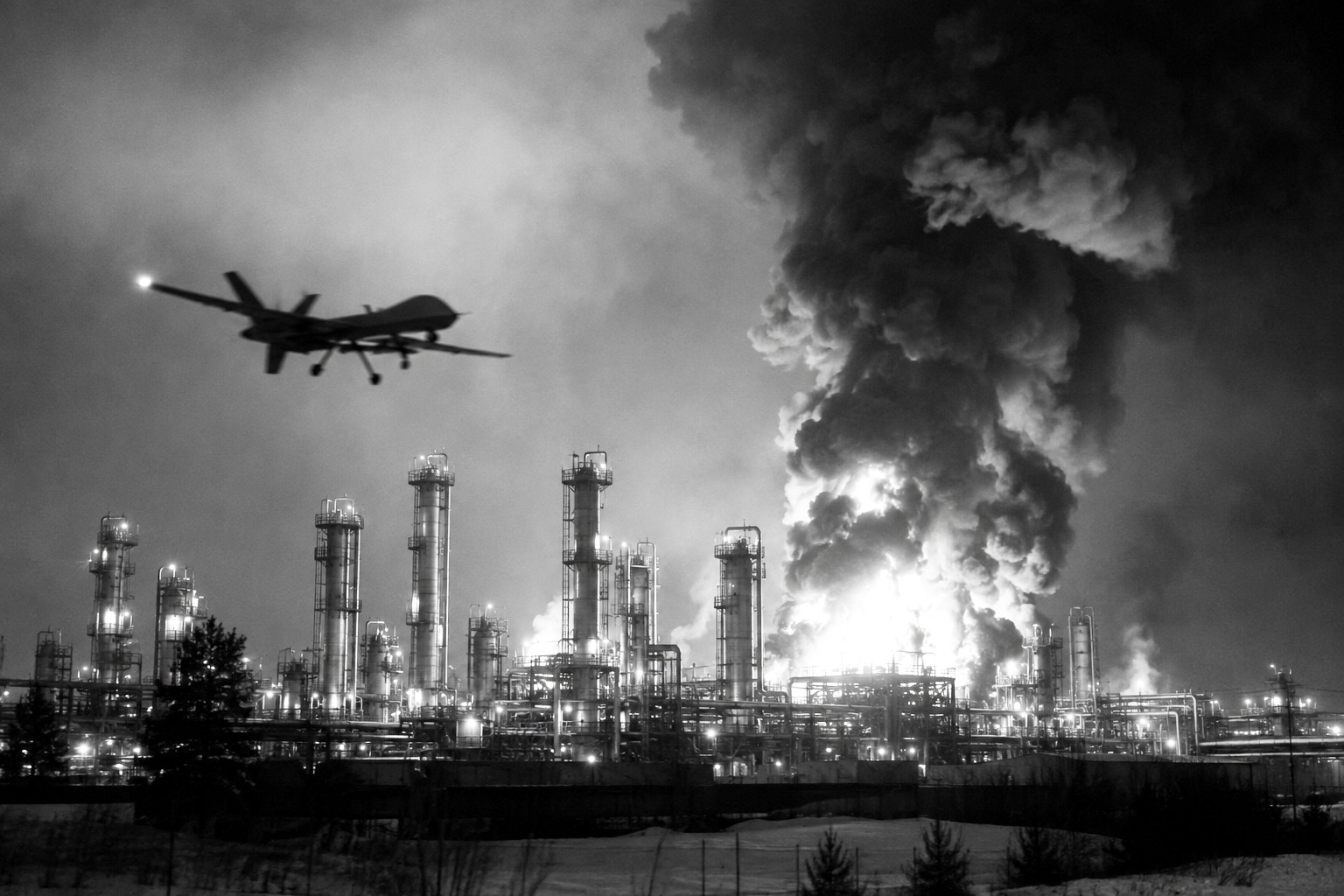
Ukraine has claimed one of its longest-range drone strikes of the war after targeting an oil refinery deep inside Russia’s Siberian region, signalling an expanding ability to hit strategic infrastructure far from the front lines. President Volodymyr Zelenskyy described the operation as an “important achievement”, saying it demonstrated that areas once considered beyond Ukraine’s operational reach were no longer immune from attack. At the same time, he renewed appeals to Western allies for stronger air defence systems to protect Ukrainian cities from continuing Russian missile and drone assaults.
A strike deep inside Russia
According to Ukrainian officials, the attack struck an oil refinery in Siberia, hundreds of kilometres beyond the areas regularly affected by cross-border operations. The refinery forms part of Russia’s broader energy infrastructure, a network that has increasingly become the focus of Ukrainian long-range drone campaigns.
Russian authorities acknowledged that a facility had been attacked, although they provided limited details regarding the extent of the damage. As has frequently been the case during the conflict, independent verification of the full impact was not immediately available.


Long-range capabilities continue to expand
The latest operation underlines Ukraine’s growing investment in domestically developed long-range drones capable of penetrating deep into Russian territory. Since the full-scale invasion began in 2022, Kyiv has steadily expanded both the range and sophistication of its unmanned aerial systems.
These strikes are designed not only to damage industrial facilities but also to complicate Russia’s military logistics, fuel supplies and air defence planning. Moscow has been forced to allocate additional resources to protect critical infrastructure spread across one of the world’s largest countries.
Military analysts suggest that sustained attacks on energy facilities can have cumulative effects by increasing repair costs, disrupting fuel distribution and forcing defensive assets away from the battlefield.
Zelenskyy renews plea for air defences
While highlighting the success of Ukraine’s own drone programme, Zelenskyy stressed that offensive capabilities alone are not sufficient. He again urged international partners to accelerate deliveries of advanced air defence systems and interceptor missiles.
Ukraine continues to face regular waves of Russian missile and drone attacks targeting cities, energy infrastructure and civilian facilities. Although Western-supplied systems have significantly improved the country’s defensive capabilities, officials say additional batteries and ammunition remain urgently needed.
Kyiv argues that stronger air defences would better protect civilians while allowing the military to concentrate resources on offensive operations rather than homeland defence.
Energy infrastructure remains a key battleground
Throughout the conflict, energy infrastructure has become an increasingly important target for both sides. Russia has repeatedly attacked Ukraine’s electricity generation and distribution networks, seeking to undermine civilian resilience and industrial production.
Ukraine, meanwhile, has increasingly targeted Russian refineries, fuel depots and other energy installations that support the country’s economy and military operations. These attacks are intended to increase economic pressure while demonstrating that critical infrastructure across Russia is vulnerable despite its vast geography.
As both sides continue to expand the use of drones and precision weapons, the conflict is increasingly extending well beyond the traditional front lines. The latest strike into Siberia illustrates how technological innovation is reshaping the battlefield and expanding the geographical reach of the war, even as diplomatic efforts to end the conflict remain elusive.
Newshub Editorial in Europe – 7 July 2026

Ask NF GPT
If you have an account with ChatGPT you get deeper explanations,
background and context related to what you are reading.
Open an account:
Ukraine has claimed one of its longest-range drone strikes of the war after targeting an oil refinery deep inside Russia’s Siberian region, signalling an expanding ability to hit strategic infrastructure far from the front lines. President Volodymyr Zelenskyy described the operation as an “important achievement”, saying it demonstrated that areas once considered beyond Ukraine’s operational reach were no longer immune from attack. At the same time, he renewed appeals to Western allies for stronger air defence systems to protect Ukrainian cities from continuing Russian missile and drone assaults.
Recent Comments